
Pipework pressure testing is the only definitive way to move gas safety from hopeful guesswork to measurable engineering certainty. For landlords and homeowners across Croydon and Greater London, the integrity of a gas installation isn't something that should be left to chance. It's natural to feel a sense of unease regarding the hidden network of pipes behind your walls, particularly when faced with the complexity of evolving UK safety regulations. You want to know your property is secure, but the fear of undetected leaks or the worry of a disruptive testing process can be overwhelming.
This guide explains exactly how professional pressure testing works, why it's a mandatory pillar of Gas Safe compliance, and how you can protect your building from risk. We'll examine the technical thresholds for 2026, the specific procedures our engineers use to verify gas tightness, and what you should expect during a standard inspection. By the end of this article, you'll have a clear understanding of how to maintain a valid certificate whilst ensuring your home remains a safe environment for everyone inside. Our goal is to provide the professional clarity you need to feel like your property is in a safe pair of hands.
Key Takeaways
- Understand that pipework pressure testing is the definitive method for verifying "gas tightness" and preventing hazardous leaks or carbon monoxide exposure.
- Learn how Gas Safe engineers use precise digital manometers to measure minute pressure changes in millibars, ensuring your system operates within legal safety margins.
- Discover why pneumatic testing is the industry standard for residential properties and how it differs from other pressurisation mediums.
- Recognise the legal and insurance risks of using non-registered workers and why professional certification is essential for London landlords.
- Gain a clear step-by-step overview of the testing procedure to ensure your property remains fully compliant with the latest UK gas safety regulations.
What is Pipework Pressure Testing and Why is it Vital?
Pipework pressure testing is the technical process of verifying the "gas tightness" of an entire installation. It involves using specialised equipment to ensure that the network of pipes, joints, and valves within a property forms a perfectly sealed system. Unlike civil engineering projects that often focus solely on construction phases, residential and light commercial testing ensures ongoing safety in occupied buildings. It's a critical safeguard against the silent threat of carbon monoxide poisoning and the catastrophic risk of gas explosions.
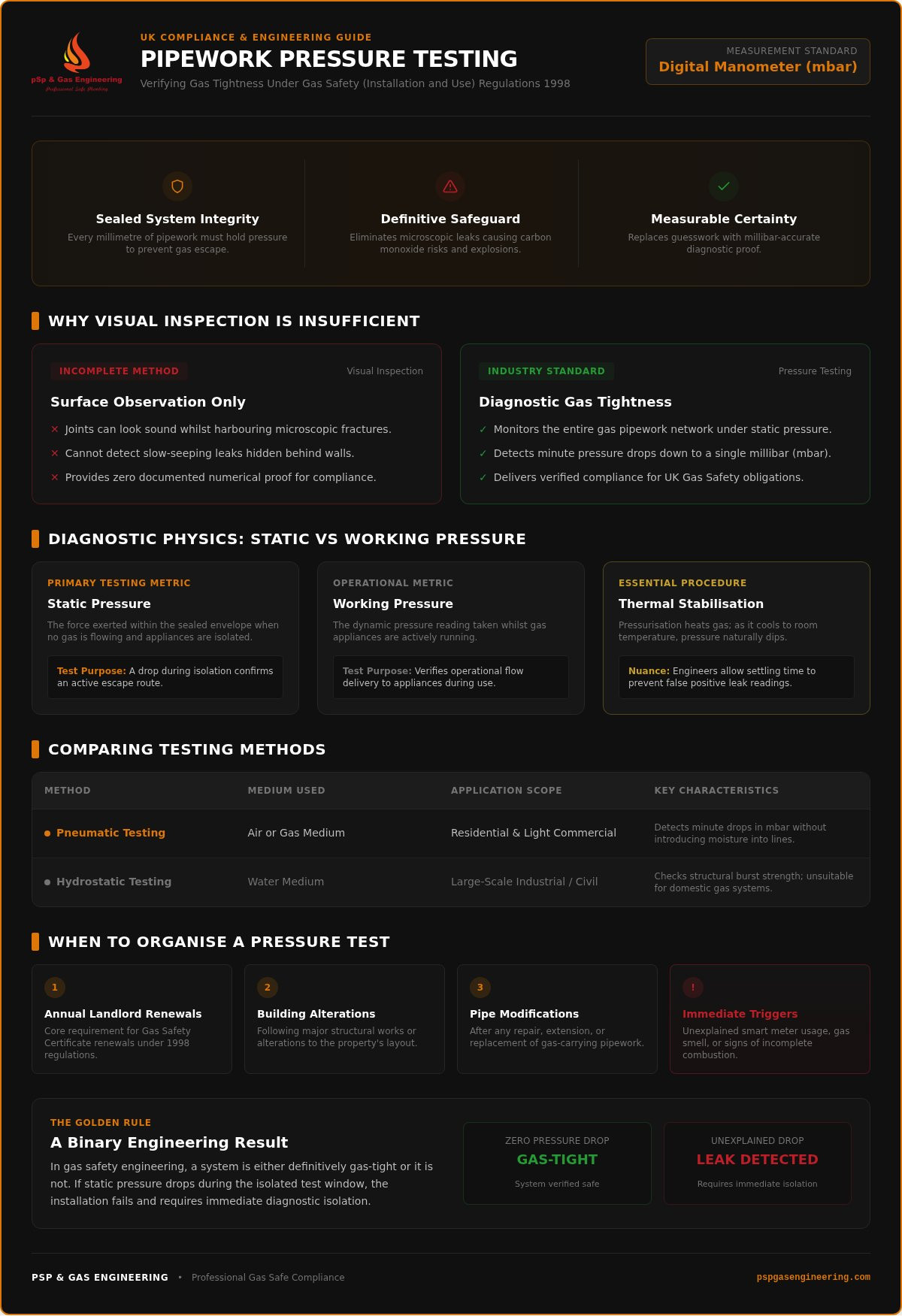
Relying on visual inspections alone is insufficient for modern safety standards. A joint can look perfectly sound to the naked eye whilst harbouring a microscopic fracture or a slow-seeping leak. For landlords, this isn't just a matter of best practice; it's a legal obligation. Under the Gas Safety (Installation and Use) Regulations 1998, property owners must ensure that gas appliances and pipework are maintained in a safe condition. A professional test provides the documented proof that these duties have been met.
The Concept of Gas Tightness
Gas installations operate on a "sealed system" philosophy. Every millimetre of the network must be capable of holding pressure without letting gas escape. Engineers distinguish between a "permissible drop," which can sometimes occur due to temperature fluctuations, and a genuine leak that requires immediate isolation. Whilst some large-scale industrial applications might use hydrostatic testing with water to check for structural integrity, residential gas systems are tested pneumatically. This allows us to detect even the smallest drop in millibars without introducing moisture into your gas lines.
When Should You Organise a Pressure Test?
Regular pipework pressure testing is a core component of annual landlord gas safety certificate London renewals. However, there are specific scenarios where an additional test is essential for peace of mind:
- Following major building works or alterations to the property's internal layout.
- After any repair, extension, or replacement of gas-carrying pipework.
- If a smart meter indicates unusually high usage when all appliances are switched off.
- Immediately if any resident reports the smell of gas or signs of incomplete combustion.
Precision is paramount. Environmental factors like a sudden drop in room temperature can cause gas to contract, potentially leading to a false pressure reading. A seasoned engineer understands these technical nuances, ensuring that your property is genuinely safe rather than just passing on paper. It's about providing a safe pair of hands for your tenants and your investment.
The Science of Pressure: How Engineers Detect Invisible Leaks
Detecting a gas leak isn't always about following a distinct scent. Many escapes are so minute that they bypass human senses entirely. This is where the physics of pipework pressure testing becomes indispensable. By using a manometer, an engineer can measure pressure changes down to a single millibar (mbar). Even a microscopic aperture in a joint creates a path of least resistance, causing the internal pressure to bleed away into the atmosphere. This loss is captured by our diagnostic tools, providing a clear signal that the system's integrity is compromised.
Precision relies on understanding the difference between static and working pressure. Static pressure is the force exerted when gas is not flowing, whilst working pressure is the reading taken when appliances are active. For a tightness test, we focus on static pressure to ensure the "envelope" of the pipework is secure. If the pressure drops whilst the system is isolated, a leak is present. It's a binary result: the system is either gas-tight or it isn't. If you suspect your system's performance is dipping, our team can provide expert gas safety inspections to pinpoint the issue before it escalates.
Before the final reading is recorded, we must allow the system to settle. This is a crucial step because the act of pressurising a pipe generates a small amount of heat, which causes the gas to expand. As the gas cools to the ambient room temperature, the pressure naturally dips. Skipping this stabilisation period leads to "false positives" where a system appears to be leaking when it's simply cooling down. Following HSE guidance on pressure testing safety, our engineers maintain a methodical pace to ensure every reading is technically accurate.
Essential Tools of the Trade
The transition from traditional analogue U-tube manometers to high-precision digital gauges has revolutionised domestic diagnostics. Digital manometers offer a level of sensitivity that can detect a drop of 0.01 mbar, something impossible to see with the naked eye on a liquid-filled tube. Alongside these gauges, we use electronic "sniffers" that detect trace amounts of hydrocarbons in the air and specialised leak detection sprays that bubble at the exact point of escape. The gas meter acts as our primary isolation point, allowing us to separate the property's internal network from the external mains supply.
Identifying the Source of a Pressure Drop
Finding a leak in a large property requires a logical process of elimination known as sectional testing. By isolating individual floors or branches of the network, we can narrow down the search area. Common culprits often include aged compression joints that have loosened over time, vibrating appliances that have fatigued their connections, or accidental damage from DIY projects like a misplaced floorboard nail. According to IGEM/UP/1B standards, a permissible leak is defined as a pressure drop of no more than 4 mbar over a two-minute period in an existing installation, provided no gas appliances are connected and the smell of gas is not present.
Comparing Testing Methods: Pneumatic vs Hydrostatic vs Gas
Choosing the correct medium for pipework pressure testing depends entirely on the specific application and the pressures involved. In the gas industry, the priority is to identify potential leaks without damaging the internal surfaces of the pipes or introducing contaminants that could interfere with appliance performance. Whilst civil engineering often relies on water for structural tests, gas engineers almost exclusively utilise pneumatic methods for domestic and light commercial installations.
Safety protocols vary significantly between high-pressure industrial environments and domestic settings. Industrial tests may involve extreme pressures requiring restricted access zones, whereas residential checks focus on detecting minute millibar drops at standard operating pressures. Environmental factors also play a role; for instance, testing with air is inherently cleaner and avoids the disposal issues associated with chemical-heavy fluids. Every procedure we perform is designed to align with the Gas Safety (Installation and Use) Regulations 1998, ensuring your property meets statutory legal requirements.
Pneumatic Testing (Air and Inert Gases)
Pneumatic testing is the industry standard for both residential and commercial gas safety certificate London inspections. For routine maintenance, we use compressed air to verify tightness. However, for new installations or after significant modifications, we may use nitrogen for strength testing. Nitrogen is an inert gas, meaning it doesn't support combustion, making it an incredibly safe medium for high-pressure strength checks before gas is ever introduced into the system.
The primary advantage of pneumatic testing is its sensitivity. Air molecules are smaller and more mobile than water, allowing them to escape through tiny fissures that a liquid might bridge. It's a fast, clean process that ensures the pipework is ready for immediate use. This approach provides the technical precision needed to confirm a system is truly gas-tight before appliances are reconnected.
Hydrostatic Testing (Water)
Hydrostatic testing involves filling a system with water and pressurising it to a specific level. This method is the backbone of our commercial plumbing services London, particularly when commissioning large-scale heating circuits or water mains. Water is virtually incompressible, making it ideal for structural integrity tests where a failure wouldn't result in a dangerous release of stored energy.
However, water is never used for gas pipework. Introducing moisture into a gas line leads to internal corrosion and can cause blockages in the delicate jets of boilers or cookers. Even trace amounts of water can react with gas impurities, creating a sludge that compromises the entire system. By sticking to pneumatic methods for gas, we protect the longevity of your appliances whilst providing an accurate and reliable safety assessment.
The Step-by-Step Pressure Testing Process for London Properties
Professional pipework pressure testing follows a methodical sequence designed to eliminate risk. Unlike basic pre-commissioning checks used in other industries, our process for live residential systems ensures every joint and valve remains secure under real-world conditions. This procedure provides the documented evidence required for a valid gas safe compliance certificate, confirming your property meets the highest standards of safety.
Stage 1: Isolation and Visual Inspection
The process begins with the total isolation of the gas supply. We turn off all appliances and close the main control valve at the meter. A thorough visual inspection follows, where our engineers look for obvious signs of external corrosion or sections of "unsupported" pipework that may be prone to vibration. We also verify that the gas meter is correctly earthed and bonded, as electrical safety is intrinsically linked to gas integrity. This initial check prevents us from pressurising a system that has visible, high-risk defects.
Stage 2: The Pressure Drop Test
Once isolated, we raise the system pressure to the required level, typically 20mbar for domestic properties in London. We monitor the gauge for a set period, usually between 2 and 10 minutes, depending on the system volume and the presence of any appliances that cannot be isolated. If the needle moves, we investigate for a "let-by," which occurs when gas seeps through an isolation valve that should be fully closed. This stage is the most critical part of pipework pressure testing, as it reveals leaks that are otherwise invisible behind walls or under floorboards.
Stage 3: Testing Appliances and Re-commissioning
After confirming the pipework is tight, we re-connect and test individual appliances. This includes checking the working pressure of cookers and any recent boiler installation Croydon units to ensure they receive the correct gas flow whilst operational. Finally, we purge the system to remove any air introduced during the test before reigniting pilot lights. If you need to verify the safety of your current system, you can book a professional gas inspection with our Croydon-based team today.
Every reading is meticulously recorded. This data forms the backbone of your safety records, providing peace of mind that your home or rental property is operating within legal thresholds. Our engineers don't just tick boxes; we provide a comprehensive guarantee of competence and care for your property's gas infrastructure.
Ensuring Compliance: Why Gas Safe Registration is Non-Negotiable
Using an unregistered individual for pipework pressure testing is more than just a safety risk; it's a significant legal liability. The Gas Safety (Installation and Use) Regulations 1998 are explicit: only Gas Safe registered engineers are legally permitted to work on gas fittings. If a handyman or an unqualified contractor performs a test, the resulting documentation is technically worthless. This choice can invalidate your buildings insurance, leaving you personally liable for damages or injuries in the event of an incident. For landlords, a professional pressure test is a non-negotiable component of the annual CP12 certificate. Without this measurable proof of gas tightness, your property is not legally compliant for rental.
At PSP & Gas Engineering, we understand that safety isn't a box-ticking exercise. It's about providing a comprehensive guarantee of competence. Based in Croydon and serving the wider Greater London area, our engineers ensure that every test is conducted with the technical precision required to protect both your tenants and your investment. We provide the professional calm and expert diagnostics needed to handle high-stakes safety requirements without unnecessary stress.
Understanding the Gas Safe Register
Verifying an engineer's credentials is a simple but vital step for any property owner. You should always ask to see a Gas Safe ID card and check the reverse side to confirm the engineer is qualified for the specific task at hand. For pressure testing, the engineer must hold valid "Pipework" and "Meters" competencies. London's housing stock is incredibly varied, ranging from Victorian terraces in Croydon to modern high-rise apartments. These different eras of construction often feature complex, aged pipework networks that require a specialist's touch. Our local expertise ensures we understand the nuances of London's infrastructure, allowing us to identify potential vulnerabilities that a generalist might overlook.
What to Do if Your System Fails the Test
A failed pressure test requires immediate, decisive action. Engineers categorise defects into two main classifications: "At Risk" (AR) and "Immediately Dangerous" (ID). If a system is found to be ID, the gas supply must be disconnected to prevent a potential explosion or poisoning event. Whilst this sounds alarming, our role is to provide the solution as quickly as possible. Repairs can range from tightening a loose compression joint to more extensive interventions like flue relining services London if we detect that combustion gases aren't being evacuated safely.
We pride ourselves on being a "safe pair of hands" during these technical challenges. Our diagnostic equipment allows us to pinpoint the exact source of a pressure drop, minimising the need for invasive searches behind walls or under floors. We'll explain the fault clearly, provide a transparent path to repair, and re-test the system to ensure it's fully gas-tight before we leave. This methodical approach ensures your property is back online safely, keeping your compliance records up to date and your residents protected.
Securing Your Property with Professional Engineering Certainty
Maintaining a gas-tight installation is a fundamental responsibility that directly impacts the safety and legal standing of your property. As we have explored, professional pipework pressure testing is the only method to move beyond visual assumptions and achieve measurable engineering certainty. By identifying minute pressure drops before they escalate into hazardous leaks, you protect your residents from the risks of carbon monoxide and ensure your insurance remains valid. For landlords across Croydon and Greater London, this process is a vital pillar of annual compliance that cannot be overlooked.
Relying on a "safe pair of hands" ensures that these technical diagnostics are handled with precision and care. Our Gas Safe Registered Engineers specialise in expert compliance for London landlords, providing the thorough documentation needed for your safety records. Whether you require a routine inspection or 24/7 emergency gas support, we are here to provide professional reliability without the stress of home maintenance.
Book your professional gas pipework pressure test with PSP & Gas Engineering today and enjoy the peace of mind that comes from knowing your home is fully protected by local experts. We look forward to helping you maintain a safe and compliant environment.
Frequently Asked Questions
How long does a gas pipework pressure test usually take?
A standard visit for a gas pressure test typically takes between 30 and 45 minutes to complete. The actual observation period on the gauge lasts between 2 and 10 minutes, depending on the volume of the pipework and the specific requirements of the IGEM/UP/1B standards. Our Croydon engineers allow additional time for the stabilisation of gas temperatures and a thorough visual inspection of all accessible joints to ensure total accuracy before issuing any certification.
Will the engineer need to turn off my gas during the pressure test?
Yes, the engineer must turn off your gas supply at the primary meter control valve to perform the test. Pipework pressure testing requires the system to be fully isolated so that the internal pressure can be monitored without interference from the external mains supply. This temporary interruption ensures that we can detect even minute leaks. Once the test is complete and the system is verified as gas-tight, we'll purge the lines and reignite your appliances.
What is the difference between a tightness test and a strength test?
A tightness test is a routine procedure used to verify that an existing gas installation doesn't have any leaks at normal operating pressures, usually around 20mbar. In contrast, a strength test is performed on brand-new installations or major extensions using much higher pressures, often with nitrogen. Strength testing ensures the structural integrity of the joints and materials before gas is ever introduced, providing an extra layer of safety for new infrastructure in London properties.
How often should a commercial property have its pipework pressure tested?
Commercial properties in the United Kingdom should have their gas pipework tested at least once every twelve months as part of their annual gas safety inspection. This is a legal requirement for most business premises to ensure compliance with the Gas Safety (Installation and Use) Regulations 1998. Regular pipework pressure testing is particularly important for Croydon businesses with complex networks or high-usage appliances, as it mitigates the risk of undetected fatigue in the system over time.
Can a pressure test damage my old copper or lead pipes?
A professional pressure test won't damage your existing copper or lead pipework because it's conducted at very low pressures. We typically test residential systems at approximately 20mbar, which is the standard operating pressure for domestic gas. This level of stress is insufficient to cause structural failure in sound pipes. If a pipe does fail during a test, it's usually because the material was already severely compromised by corrosion or previous physical damage.
What happens if the engineer finds a leak during the pressure test?
If a leak is detected, our engineer will immediately isolate the affected section and classify the fault as either "At Risk" or "Immediately Dangerous." We prioritise your safety by identifying the exact source of the escape using modern diagnostic tools. Depending on the severity, we may perform an on-site repair, such as tightening a joint or replacing a faulty valve. Our Croydon team provides 24/7 emergency support to ensure your system is restored to a safe condition quickly.
Is a pressure test included in a standard boiler service?
Yes, a tightness test is a mandatory component of a professional boiler service and any standard gas safety inspection. Whilst the service focuses on the appliance's efficiency and internal components, we must also verify that the supply pipework is gas-tight. This ensures that the entire system, from the meter to the burner, is operating safely. It's a standard part of the "safe pair of hands" approach we take for every London homeowner and landlord.
Can I perform a DIY pressure test using a kit from a hardware store?
You cannot legally perform a DIY gas pressure test. UK law requires that any work on gas fittings, including testing and diagnostics, must be carried out by a Gas Safe registered engineer. Hardware store kits aren't calibrated to the professional standards required for legal certification and don't provide the expertise needed to interpret results safely. Attempting a DIY test puts your household at risk and will invalidate your home insurance and landlord safety records.


