

Turning radiators down in rooms you rarely use can help reduce gas use, but the bigger opportunity may be heating only when you need it. Optimising central heating for lower gas bills starts with sensible radiator settings and comfortable temperatures, then uses boiler controls and a timer to avoid unnecessary heating.
It’s reasonable to ask whether turning radiators down will save money. The answer depends on your heating controls and which rooms you use, so a balanced approach is usually more practical than treating every room the same.
This guide explains how radiator use, heating temperatures, boiler settings and timers affect gas use and bills. You’ll learn what to adjust, how to make changes gradually, and why a timed programme can work better than leaving the heating on all day.
Key Takeaways
- Adjusting your boiler’s flow temperature can affect gas use; make changes gradually and consider your heating system type.
- Use thermostatic radiator valves to keep less-used rooms cooler without treating every radiator the same.
- Keep cylinder hot water at a safe temperature while setting room heating for comfort, not excess warmth.
- Programme heating around your daily routine so it runs when needed rather than staying on all day.
1. What’s the best temperature to set my central heating to?
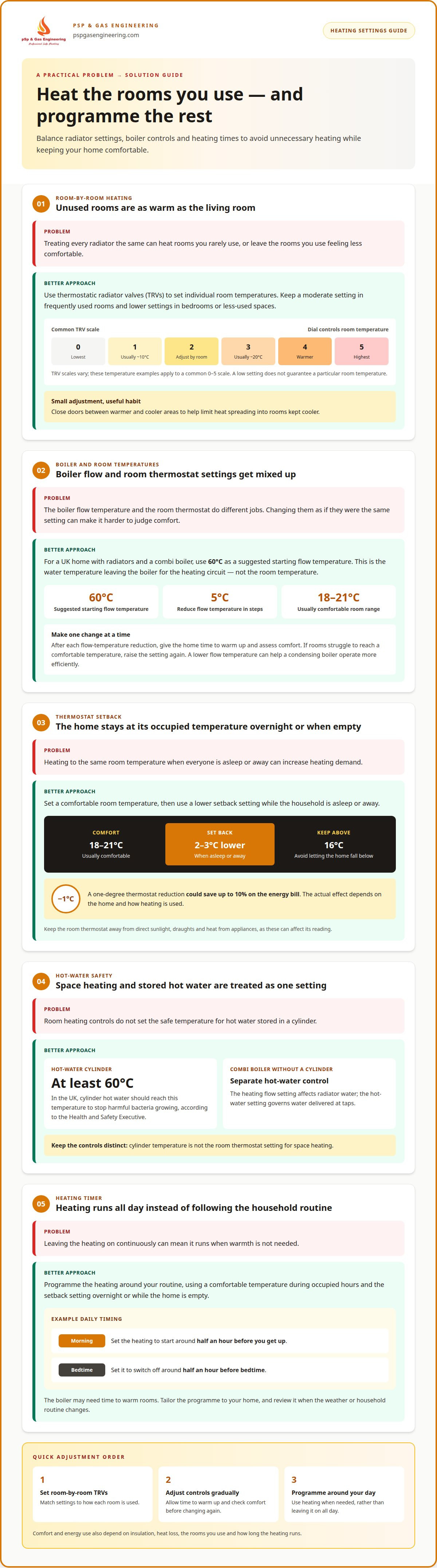
For a UK home with radiators and a combi boiler, 60 degrees Celsius is a suggested starting flow temperature. This is the temperature of water leaving the boiler for the heating circuit, not the room thermostat setting. Try reducing it in steps of 5 degrees Celsius, then allow the home time to warm up and assess comfort. If rooms struggle to reach a comfortable temperature, raise the setting again.
Room thermostats and boiler flow controls do different jobs. A room temperature between 18 and 21 degrees Celsius is usually comfortable in the UK. Setting the room thermostat lower can reduce heating demand, while lowering flow temperature can help a condensing boiler operate more efficiently. The amount of energy used also depends on how well the home is insulated and how long heating runs.
Have your boiler serviced every year. Regular servicing checks its safe operation and components, while an older boiler may be less efficient than it once was. Installation costs depend on the property, existing system and work required, so the price is provided after a quote request.
UK households may be eligible for government support for heating-efficiency improvements. Applicable schemes depend on the household and the measure, so check current eligibility before including support in your budget.
Your gas tariff determines how much you save for each unit of gas avoided, while the standing charge remains payable regardless of consumption. Boiler efficiency affects how much useful heat each unit provides, so the same reduction in heating demand can lead to different bill savings.
Electric air source heat pumps are an alternative to gas boilers and are described as three to four times as efficient as traditional gas boilers. Their performance depends on the property and heating system, including insulation. A considered approach to optimising central heating for lower gas bills starts with suitable settings, then weighs whether existing appliances or a different heating system better suit the home.
2. Does turning your radiators off save gas?
Turning down radiators in rooms you use less can reduce the area you heat. Thermostatic radiator valves (TRVs) control individual radiators, so you can set different temperatures around the home. A cooler spare room and a warmer living room can be more practical than turning every radiator off.
TRV dials vary, but a common scale runs from 0 to 5. On this type, setting 1 usually corresponds to around 10°C, while setting 3 usually corresponds to around 20°C. Use a moderate setting in rooms used most, then lower the setting in bedrooms or less-used spaces. The dial controls the room temperature, rather than the temperature of the hot water in the system.
The effect depends on how you use your heating and which rooms need warmth. Keep doors closed between heated and cooler areas to help limit heat spreading into rooms you’re keeping cooler.
Bleeding radiators can help if trapped air leaves them cold at the top or unevenly warm. Air reduces the radiator surface available to transfer heat into the room, so the heating may feel less effective. Address cold spots promptly. If the problem remains after bleeding, it may indicate an issue beyond that radiator.
Follow this sequence: set TRVs according to how each room is used, close doors between areas at different temperatures, then see whether rooms stay comfortable. A low setting doesn’t guarantee that a room will reach a particular temperature, since room conditions and heat loss also matter. Draughts around a window can make a room feel colder even when its radiator is working.
If radiator cold spots persist, a wider boiler issue may need attention. Explore boiler installation options when an ageing or inefficient boiler is affecting how effectively your home heats.
3. What are the best boiler settings for saving money?
Set the room thermostat to a comfortable temperature, then use a lower setback setting while everyone is asleep or away. In UK homes, 18 to 21 degrees Celsius is usually comfortable. A setback temperature 2 or 3 degrees below that can reduce heating demand, but avoid letting the home fall below 16 degrees Celsius. A one-degree thermostat reduction could save up to 10% on the energy bill.
Keep the room thermostat away from direct sunlight, draughts and heat from appliances, which can affect its reading. Set radiator valves to suit each room rather than using them to override the main thermostat. If you’re comfortable at a slightly lower setting, an extra layer of clothing may help you avoid turning the thermostat up.
Hot-water cylinder settings need a separate safety consideration. In the UK, hot water in a cylinder should be heated to at least 60 degrees Celsius to stop harmful bacteria growing, according to the Health and Safety Executive. Keep this cylinder temperature distinct from the room thermostat setting, which controls space heating.
A combi boiler without a hot-water cylinder has a separate hot-water control. Its heating flow temperature affects the water in radiators, while its hot-water setting governs the water delivered at taps. Adjust the heating control gradually and see whether rooms reach the thermostat setting. Avoid changing several settings at once, so you can identify which adjustment affected comfort or energy use.
Set the programme to match your routine, with a lower setting overnight or while the home is empty. For example, choose a comfortable temperature for occupied hours, then use the setback setting outside those periods. The boiler may need time to warm rooms, so tailor the programme to your home instead of repeatedly switching the heating on and off.
Review your settings when the weather or household routine changes. A room that feels comfortable on a mild day may need a different programme in colder conditions. Radiator valves can help manage differences between rooms.
4. Using a heating timer or programme
A timer matches heating hours to your household routine instead of keeping the system on continuously. Set it to start around half an hour before you get up, then switch off around half an hour before bedtime. These are practical starting points. Adjust them to how quickly your home warms up and cools down.
Try this approach: programme heating for the periods when rooms are occupied, then set it to stop before the household leaves or goes to bed. If you’re unsure when to start, turning heating on about 30 minutes before it’s needed gives you a useful baseline. Likewise, setting it to switch off 30 minutes before warmth is no longer needed uses residual heat in the home.
Leaving heating on low all day is usually not cheaper, according to the Energy Saving Trust. Nesta’s Salford Energy House tests found that, for most households, heating for short periods used 14% less gas than leaving heating on low continuously. The practical takeaway is to programme distinct heating periods, then review whether the rooms are warm at the times you use them.
A smart thermostat can reduce energy consumption by 5–15%. The effect on gas bills depends on how much heating the household previously used, the tariff and how controls are programmed. Place a thermostat centrally, away from draughts and direct sunlight, so its readings can better reflect the occupied space.
For a heat pump, programme the controls around the system’s operation and your household routine. Don’t assume it should follow precisely the same schedule as a gas boiler: the system and property affect how efficiently warmth is delivered. After installing new controls, use consistent settings and observe comfort over several days before making further adjustments.
If a boiler fails to follow its programmed schedule, or heating controls do not operate correctly, get help with your heating system so the fault can be assessed.
PSP & Gas Engineering
PSP & Gas Engineering can help when routine adjustments do not resolve heating concerns or your boiler needs professional attention. Its Gas Safe Registered engineers carry out gas safety inspections and boiler installations, supporting safe operation and informed decisions about heating equipment.
If radiators remain unevenly warm, the boiler behaves inconsistently or you’re considering replacing an older system, a qualified assessment can help identify the underlying issue. A gas safety inspection checks gas appliances and the installation for safe operation. If replacing the boiler is appropriate, an installation can provide a way to update your heating system.
Contact PSP & Gas Engineering to discuss your central heating requirements.
Make your next heating adjustment with confidence
Rather than changing several controls at once, note each adjustment and how the home feels afterwards. This gives you a clearer basis for refining your routine as household needs or the weather change. Optimising central heating for lower gas bills is an ongoing process, guided by comfort and how your system responds.
If a concern goes beyond everyday settings, professional advice can help identify the next step. PSP & Gas Engineering also provides flue relining when a flue needs attention.
For help with your heating needs, contact PSP & Gas Engineering. Take the next step towards a heating system that works well for your home.
Frequently Asked Questions
Does turning your radiators off save gas?
Turning down an individual radiator reduces heat in that room, but it doesn’t switch off the boiler or stop it heating other areas. If you rarely use a room, use its radiator valve to limit heat rather than turning off every radiator. Monitor comfort and signs of damp, particularly in rooms with limited ventilation or persistent draughts.
How can I make my home more energy efficient?
Reduce heat loss as well as managing your heating controls. Draught-proofing floorboards can save up to £40 per room, according to the Energy Saving Trust. Close gaps around doors and windows, and use curtains to help retain warmth after dark. In Croydon homes, tackling a draughty room can make heating feel more effective without turning up the thermostat.
How much does eco mode on a boiler save?
There isn’t one savings figure for eco mode because its function varies between boiler models. On some appliances, it changes how hot water is prepared but may not affect the central heating schedule. Check your boiler’s instructions to see what the setting controls, then compare hot-water response and everyday use. The effect on gas consumption depends on the mode and household habits.
Want to cut down on your gas use altogether?
To reduce gas use for home heating, consider replacing a gas boiler with an electric air source heat pump. Heat pumps are described as three to four times as efficient as traditional gas boilers, although they use electricity rather than eliminating energy use. The right option depends on the property’s insulation, heating system and hot-water needs, including how the home can accommodate the change.
What are the best boiler settings for saving money?
Alongside room and heating controls, the boiler’s pressure is worth understanding. A UK boiler should have a pressure between 1 and 2 bars to work efficiently. The gauge and instructions for restoring pressure vary by appliance, so use the manufacturer’s directions rather than adjusting unfamiliar controls. If pressure repeatedly changes or the boiler behaves unusually, arrange a professional assessment.
What uses the most gas in my house?
Space heating uses the largest share of gas in the vast majority of UK homes, accounting for 80% of gas use. Hot water accounts for 15%, while cooking accounts for 5%. This means reducing unnecessary heating can have a greater effect on gas consumption than changing cooking habits alone. Your household’s actual pattern depends on how you heat rooms and water.


