
A boiler’s pressure should change with the heating, but it shouldn’t keep falling. When the heating is off, a typical UK boiler should read between 1 and 1.5 bar; when it’s on, the pressure may rise to around 2 bar. Effective troubleshooting boiler pressure loss starts with understanding this difference and noticing whether the reading drops repeatedly.
It’s understandable to worry when the boiler pressure gauge falls, especially if you can’t see a leak. Pressure can drop after bleeding radiators, but repeated loss may point to a leak or a component that needs professional attention.
This guide covers how to read pressure changes when the heating is on or off, what to look for around your heating system, and when to stop monitoring the gauge and contact a Gas Safe Registered engineer. These steps can help you make a safe, informed decision.
Key Takeaways
- Damp patches, staining and signs of moisture near radiator valves can help pinpoint where a heating-system leak may be occurring.
- A dripping external outlet can signal a pressure-relief or expansion-vessel problem that needs professional assessment.
- Frequent pressure drops or boiler shutdowns are reasons to arrange an assessment with a Gas Safe Registered engineer.
- A professional inspection can help distinguish a pipework leak from an internal boiler fault without you removing the casing.
What pressure should my boiler be set at?
- Tenants in England, Scotland, Wales and Northern Ireland can report pressure loss to their landlord or letting agent and ask for it to be investigated. Share the current gauge reading and explain whether the boiler keeps losing pressure or shuts down.
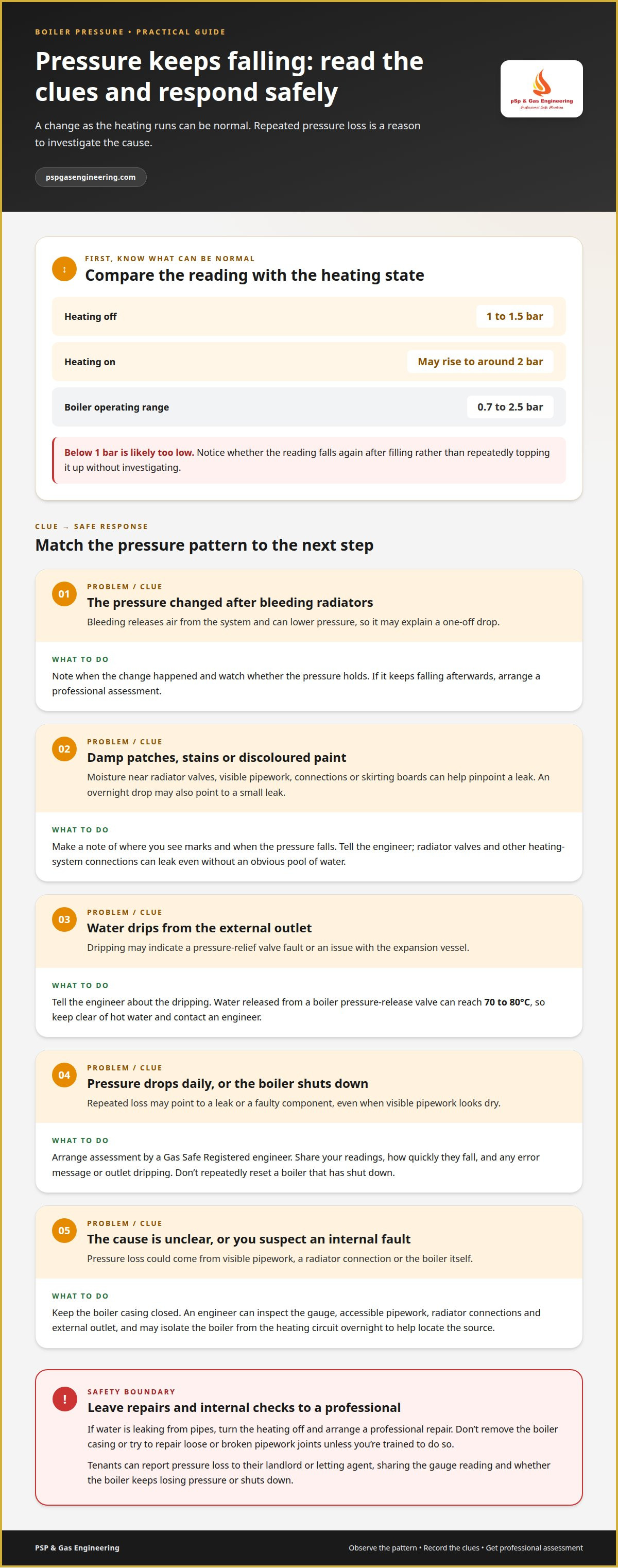
- For safe filling, a professional checks the combi boiler’s gauge, uses its filling loop and stops when the reading reaches 1 to 1.5 bar. They then close both filling-loop valves by turning them clockwise and check whether the pressure holds.
- Compare the gauge reading with the boiler’s operating range, which is 0.7 to 2.5 bar. A reading below 1 bar is likely to be too low; note whether it falls again after filling, rather than repeatedly topping it up without investigating the cause.
- Consider whether you bled the radiators shortly before the pressure dropped. Bleeding releases air from the system and can lower its pressure, so the timing may explain a one-off change. If pressure keeps falling afterwards, arrange a professional assessment.
- Look for signs of a leak, including damp patches, water stains or discoloured paint near visible pipework and skirting boards. Radiator valves and heating-system connections can leak. A pressure drop overnight may also point to a small leak.
- Note any water dripping from the external overflow pipe and tell the engineer. This may indicate a faulty pressure-relief valve or an issue with the expansion vessel. Daily pressure loss, repeated shutdowns or frequent top-ups call for professional assessment, not repeated resets.
- Arrange an inspection if the cause remains unclear. Troubleshooting boiler pressure loss means considering gauge behaviour alongside visible pipework, radiator connections and the boiler’s pressure-release outlet, rather than assuming every drop has the same cause.
How can a professional detect a leak in my boiler?
An engineer can check the pressure gauge, visible pipework, radiator connections and the boiler’s external outlet. They can investigate possible leaks around radiators, pipes and the boiler without removing its casing.
-
Have an engineer check the gauge and investigate visible leaks
When arranging an inspection, explain when pressure falls, such as overnight or after the heating runs. The engineer can compare the gauge readings with your observations and look for damp patches, water stains or flaking and discoloured paint near pipework and skirting boards. Mention any dripping from the external pressure-release outlet, which may indicate a valve or expansion-vessel issue.
-
Have an engineer inspect radiators and connections
Ask the engineer to inspect radiator valves, joints and visible connections for signs of escaping water. A leak at a radiator valve or another heating-system component can cause pressure to fall even if there’s no obvious pool of water. Visible marks can help identify whether moisture or staining is concentrated around a particular radiator or fitting.
-
Have an engineer trace leaks along the pipework
The engineer can check accessible heating-system pipework, including sections near skirting boards, for dampness, staining or other visible signs. An overnight pressure drop may indicate a small leak, though its source might not be immediately visible. An assessment of the boiler and external pipework can help distinguish an appliance fault from a leak elsewhere in the system.
- Tell the engineer if visible checks have not revealed a leak. They may isolate the boiler from the heating circuit overnight to help determine whether pressure loss is within the boiler or the wider system. Don’t remove the boiler casing yourself. For a professional boiler inspection, arrange an assessment.
When to contact a Gas Safe Registered engineer
Turn the heating off if water is leaking from pipes, and arrange a professional repair. Water released from a boiler pressure-release valve can reach 70 to 80°C, so keep clear of hot water and contact an engineer.
- Arrange an assessment if the boiler loses pressure daily. Repeated drops may indicate a leak or faulty component, even if the pipework looks dry. Give the engineer your pressure readings and explain how quickly they fall. This pattern can help guide the investigation towards the boiler or heating system.
- Book a Gas Safe Registered engineer if the boiler shuts down or keeps losing pressure. Don’t repeatedly reset a boiler that has shut down. Arrange a repair and tell the engineer about any error message, dripping outlet or recent pressure changes.
- Keep the boiler casing closed if you suspect an internal leak. Don’t remove it to inspect internal components. An engineer can assess the appliance safely and investigate whether pressure loss relates to an internal fault, pressure-relief valve or expansion vessel.
- Don’t try to repair loose or broken pipework joints unless you’re trained to do so. A suspected central-heating leak needs expert attention. If water is escaping from pipework, leave the repair to a qualified professional rather than tightening or dismantling connections yourself.
- Ask the engineer to investigate repeated pressure loss instead of relying on frequent filling-loop top-ups. Repressurising may restore operation temporarily, but it won’t fix a leak or faulty part. A lasting repair starts with identifying the source, whether it’s visible pipework, a radiator connection or the boiler.
- Arrange professional advice if the gauge keeps falling after bleeding radiators or repressurising the system. Share when the drop occurs, such as after the heating runs or overnight. This information helps the engineer assess the fault without you opening the boiler or testing internal parts.
Normal boiler pressure when cold and when heating
A boiler may lose pressure a couple of times a year. If it needs topping up every few months, monitor whether the pressure falls again. Compare readings with the heating off and on, as pressure normally changes as the system warms.
-
Check pressure when the boiler is cold
Check the gauge when the heating has been off and the system is cool. A typical UK boiler should read between 1 and 1.5 bar in this state. Record the reading and whether the boiler is also providing hot water normally. If the gauge is below 1 bar, it’s likely too low; a professional can assess repeated drops rather than relying on frequent top-ups.
-
Compare pressure while heating
Note the gauge reading after the heating has been running, then compare it with the cold reading. Most UK boilers reach around 2 bar when heating is on, as water expands as it warms. A rise is expected, but a sharp increase towards the maximum needs attention. For example, if pressure rises from 1.5 bar to the maximum within 10-30 minutes, the expansion vessel may need recharging.
- Record when pressure changes, such as after the heating starts or switches off. This pattern helps distinguish a rise while the system heats from pressure that continues falling afterwards. A repeated drop between heating cycles differs from a temporary change as the system warms and cools.
- If a boiler loses pressure every few months, it can be repressurised and monitored for further drops. Note each top-up and gauge reading, then share this history with an engineer if the pressure keeps falling. Repeated loss may point to a leak or component fault, rather than ordinary changes between cold and heated conditions.
- Arrange a professional assessment if the gauge reaches its maximum soon after the heating starts or keeps dropping after repressurising. Comparing cold and hot readings can help identify an expansion-vessel issue or another fault. Don’t interpret a pressure reading in isolation; consider it alongside the boiler’s behaviour and recurring symptoms.
PSP & Gas Engineering: Boiler Installations
PSP & Gas Engineering provides boiler installations when recurring pressure loss and faults make replacement a consideration. A boiler over 10 to 15 years old may be a candidate for replacement if it frequently loses pressure or develops recurring faults, so discuss the boiler’s history and pressure readings with a qualified engineer.
For unexplained pressure changes, a Gas Safety Inspection can help assess the boiler’s safety, while a Video Inspection can support an investigation where visual assessment is useful. The appropriate next step depends on the symptoms and the condition of the existing system. PSP & Gas Engineering carries out work through Gas Safe registered engineers.
To discuss a boiler installation or arrange an inspection, contact PSP & Gas Engineering.
Take the next step with confidence
Help the engineer focus the assessment by noting when pressure changes, whether the heating was running and any previous repairs. Include the boiler’s make and model, service history and visible signs such as dampness near pipework. These details provide a clearer starting point for troubleshooting boiler pressure loss and deciding what work is appropriate. Avoid repeated top-ups without investigating why the pressure is falling.
PSP & Gas Engineering provides boiler installations, Gas Safety Inspections and flue relining. The appropriate service depends on the issue and the condition of the appliance or flue. Share your observations with the engineer, and leave internal boiler checks to a qualified professional.
For a considered next step, contact PSP & Gas Engineering to discuss your boiler concerns. A clear record of the symptoms can help you move forward with confidence.
PSP & Gas Engineering for Boiler Pressure Loss
PSP & Gas Engineering provides plumbing services if you’ve checked for obvious causes of boiler pressure loss but still need help identifying the issue.
If the boiler needs further attention, PSP & Gas Engineering also provides boiler installations, gas safety inspections, flue relining and video inspections. Contact the company if pressure loss persists or you need one of these services.
Frequently Asked Questions
How does an engineer find a leak in my heating system?
An engineer can combine pressure readings with a visual inspection to narrow down the source. They can check accessible joints, radiator valves, the boiler’s external outlet and areas showing damp or staining. If the source remains unclear, an engineer may isolate the boiler from the heating circuit overnight to help distinguish a boiler-side fault from a leak elsewhere in the system. Keep a record of when the gauge changes.
How can an engineer lower boiler pressure without bleeding radiators?
An engineer can release water from the heating system through an appropriate drain point, then recheck the gauge. The correct method depends on the boiler and system layout. Don’t loosen fittings or operate the pressure-relief valve yourself: hot water may escape, and a disturbed valve may not reseal properly. If pressure keeps rising, the engineer can investigate overfilling, the filling loop or the expansion vessel.
What should I do if I’m still experiencing pressure loss, and when should I call an engineer?
If pressure keeps falling after a top-up, arrange an assessment rather than repeatedly refilling the system. Contact a Gas Safe Registered engineer promptly if the boiler loses pressure daily, shuts down repeatedly or shows signs of an internal fault. If water is escaping from pipework, turn the heating off and seek a professional repair. Share the gauge readings and when each drop occurs.
What boiler pressure is normal in the UK when cold and when running?
For a UK boiler, expect around 1 to 1.5 bar with the heating off and around 2 bar while it’s running. The reading can rise as water heats and expands, so compare readings in similar conditions. A cold reading below 1 bar is likely too low. Check the boiler’s own instructions too, as the recommended range can vary by appliance.
What are the common causes of boiler pressure loss?
Common causes include leaks at radiator valves, joints or other heating-system components, and water escaping through a faulty pressure-relief valve. An expansion-vessel problem can also affect pressure. Bleeding radiators may lower system pressure because air and water leave the circuit. If pressure drops after a radiator bleed, tell the engineer when it happened.
Why does boiler pressure rise when heating is on and fall when it cools?
Water expands as the heating warms it, so a modest rise on the gauge is expected; pressure can then fall as the system cools. A pronounced rise, such as from 1.5 bar to the maximum within 10-30 minutes, may indicate an expansion-vessel problem. If the pressure then drops unusually low or continues falling between cycles, arrange a professional assessment rather than treating it as routine cooling.


