
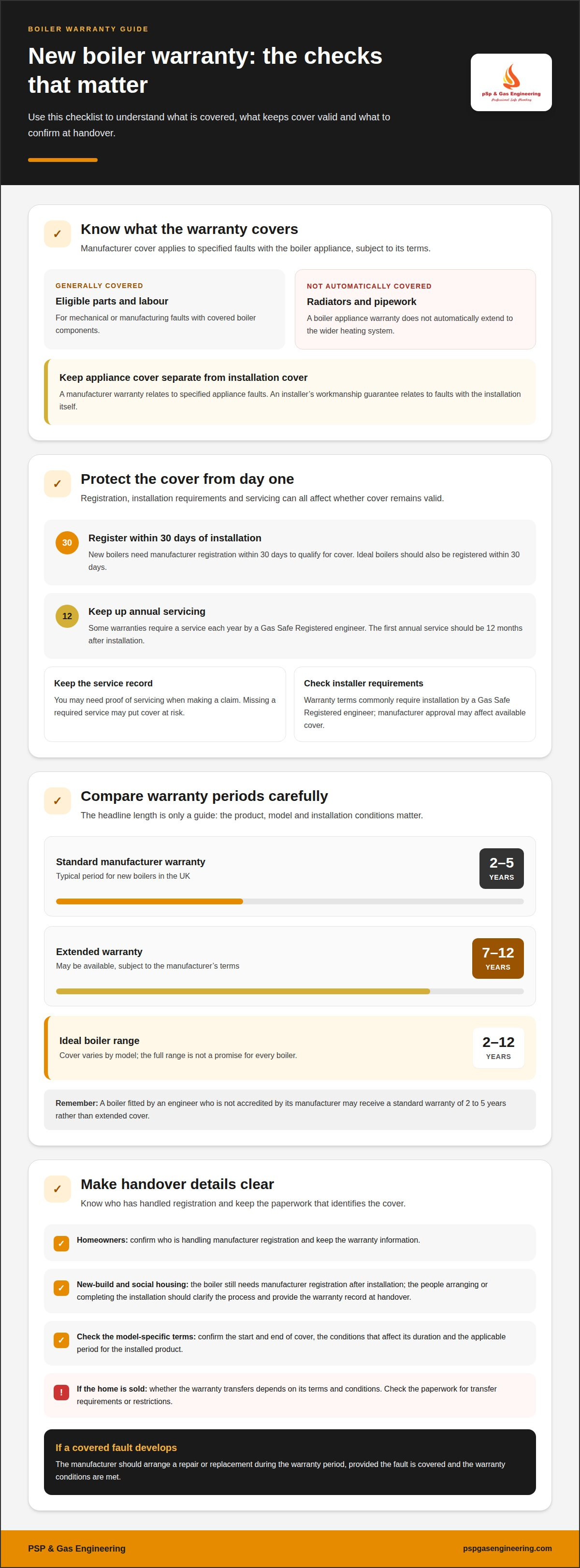
A new boiler warranty can cover parts and labour for mechanical or manufacturing faults, but it won’t necessarily cover every heating problem. What you need to know about a new boiler warranty is that standard cover typically lasts between 2 and 5 years, while extended warranties can range from 7 to 12 years. Registration may be required within a set period after installation, and some warranties require annual servicing to remain valid.
It’s reasonable to expect a new boiler to be protected if something goes wrong. The details matter: warranty terms vary, and cover for the boiler itself is different from an installer’s workmanship guarantee or protection for radiators and pipework.
This article explains which faults a boiler warranty may cover, how cover periods vary, and who is responsible for registration in different situations. It also outlines why installation requirements and ongoing servicing matter, so you can understand the conditions of your cover and what to expect if a fault develops.
Key Takeaways
- Manufacturer warranties generally cover specified mechanical or manufacturing faults, including parts and labour, rather than problems with radiators or pipework.
- Registration can be time-sensitive: new boilers may need to be registered with the manufacturer within 30 days of installation.
- Warranty length depends on the boiler and its installation; Ideal boiler warranties range from 2 to 12 years.
- Keep manufacturer cover distinct from an installer’s workmanship guarantee, which relates to faults with the installation itself.
What Does an Ideal Boiler Warranty Cover?
What you need to know about a new boiler warranty is that it covers specified faults, not every heating problem. A manufacturer’s warranty covers faults with the boiler appliance that meet its terms and conditions.
Parts and Labour Cover
Manufacturer warranties generally cover mechanical or manufacturing faults, including eligible replacement parts and labour. This may help with repairs to a covered boiler component, but it does not automatically extend to the wider heating system.
For example, a boiler fault and a radiator fault are different issues: a boiler warranty generally covers manufacturing problems with the appliance, not radiators or pipework. The warranty documents explain which components and repairs qualify. Knowing what a new boiler warranty covers helps you distinguish an appliance claim from a problem elsewhere in the system.
Servicing and Cover
Annual servicing is a common condition for keeping boiler warranty cover valid. Manufacturers commonly require proof that a Gas Safe Registered engineer has serviced the boiler each year.
A newly installed boiler should have its first annual service twelve months after installation. Keep the service record with the warranty information, as you may need proof when making a claim. Missing a required service may put cover at risk, even if the fault concerns a component that would otherwise be covered.
Exclusions and Home Sale Transfers
A boiler warranty and an installer’s workmanship guarantee cover different issues. The warranty applies to specified appliance faults, while a workmanship guarantee covers problems with the installation itself. The installer is responsible for putting covered installation problems right.
Common exclusions include faults caused by poor maintenance, accidental damage or installation by a non-approved engineer. If you sell your home, whether the boiler warranty transfers depends on its terms and conditions. Check the warranty paperwork for transfer requirements or restrictions, so the buyer can understand whether cover continues after the sale.
Registering warranties for homeowners, new builds, social housing and installers
New boilers need manufacturer registration within 30 days of installation to qualify for cover. Ideal boiler warranties should also be registered within 30 days. The required process depends on the manufacturer, so the handover should make clear whether registration has been completed and how the warranty record is provided.
For homeowners, the practical priority is knowing who is handling registration and keeping the resulting warranty information. In a new-build property or social housing, the boiler still needs to be registered with its manufacturer after installation. The people arranging or completing the installation should clarify registration and provide the warranty record at handover.
An installer’s accreditation can affect the available cover. A boiler fitted by an engineer who isn’t accredited by its manufacturer may receive a standard warranty of 2 to 5 years, rather than an extended warranty. Extended cover can range from 7 years up to 12 years, subject to the manufacturer’s terms.
Installation requirements also matter. Warranty terms commonly require installation by a Gas Safe Registered engineer, ideally one approved by the manufacturer. Registration alone does not replace these conditions: both the installer’s status and the manufacturer’s registration process can affect the cover attached to the boiler.
If a boiler develops a fault or breaks down during its warranty period, the manufacturer should arrange a repair or replacement, provided the fault is covered and the warranty conditions are met. This differs from an installer’s workmanship guarantee, which covers problems with the installation itself.
For a replacement or new-build installation, clear handover information helps establish the registration status and applicable warranty conditions. A professional boiler installation can help ensure installation requirements are addressed as part of the work.
Typical boiler warranty lengths by manufacturer
In the UK, standard manufacturer warranties for new boilers typically last between 2 and 5 years. Ideal boiler warranties range from 2 to 12 years, so the manufacturer and model both matter when comparing cover.
Warranty Lengths by Model
Ideal warranty length varies across its boiler range, with available cover spanning 2 to 12 years. That range is a guide to the manufacturer’s products, not a guarantee that every model receives the same term.
The warranty period depends on the product, its installation and what it is installed with. Two boilers from the same manufacturer could have different cover periods if their models or installation arrangements differ. A manufacturer-approved installer may also be relevant to extended cover, so the model name alone may not establish the final term.
Across manufacturers, the stated standard warranty range is 2 to 5 years, while extended boiler warranties can run from 7 years up to 12 years. These figures describe typical periods, not a like-for-like promise for every boiler. Compare the specific product and installation conditions as well as the headline length.
Checking Guarantee Length
To establish a boiler’s warranty length, use its manufacturer, model details and installation record to identify the applicable terms. The registration information can help connect the installed appliance with its cover period.
Read the terms and conditions for the start and end of cover, plus any conditions that affect its duration. For an Ideal boiler, confirm the model-specific period rather than assuming the full 2 to 12-year range applies. For another manufacturer, use its stated warranty for that particular product.
Installation can also affect the warranty. Check whether the stated period depends on an accredited installer or other installation arrangements, and distinguish standard cover from extended cover. This gives you a more accurate view of the protection attached to the boiler than relying on a general manufacturer range.
Warranty registration deadlines
Register a new boiler with its manufacturer within 30 days of installation to qualify for cover. Ideal boiler warranties should also be registered within 30 days. Treat this as a deadline, not an administrative detail to leave until the first service. The registration process depends on the manufacturer’s requirements.
The installation date is the key reference point for the 30-day period. Arrange registration promptly after the boiler is installed, using the manufacturer’s process and the appliance details supplied at handover. For example, a homeowner taking over a newly fitted boiler should establish whether registration has been completed, rather than assuming installation alone activates cover.
For Ideal, the stated deadline is 30 days after installation. Other manufacturers may set their own registration process and timeframe, so the Ideal deadline shouldn’t be treated as a universal rule. Registration requirements matter because a new boiler may need to be registered within the manufacturer’s set period to qualify for warranty cover.
Keep the registration confirmation with the boiler’s installation and warranty records. This gives you a clear record that the manufacturer has registered the appliance, which can help when arranging a repair for a covered fault. Registration does not replace other warranty conditions, such as installation requirements or servicing terms.
If registration is missed, the impact depends on the manufacturer’s warranty conditions. A missed deadline may affect eligibility for cover, so check the relevant terms to understand what protection applies. For a boiler that is already installed, establish its registration status and read the manufacturer’s conditions before relying on warranty cover.
Planning a replacement? Arrange a boiler installation with registration deadlines in mind, so the warranty process is part of the handover.
PSP & Gas Engineering: Boiler Installations
PSP & Gas Engineering provides boiler installations for homeowners planning a replacement or fitting a new boiler. Installation matters to warranty cover because manufacturer terms commonly require a Gas Safe Engineer, ideally one approved by the manufacturer. Work carried out by Gas Safe registered engineers helps address this installation requirement, while the specific warranty period and conditions depend on the boiler and its manufacturer.
When arranging a new installation, consider the warranty conditions alongside your boiler choice and installation requirements. This helps you understand how the appliance’s cover relates to the work being carried out. PSP & Gas Engineering also provides gas safety inspections, flue relining and video inspections. Contact us to discuss a boiler installation in Croydon and the surrounding Greater London area.
Plan your next boiler decision with confidence
Replacing a boiler is an opportunity to plan for your home’s heating needs, not simply choose a model. What you need to know about a new boiler warranty can help frame that decision, but the boiler’s suitability and installation also matter. Consider how your household uses heating, the space available for the appliance and whether the existing system needs related work. These points give your installation discussion a practical starting point.
It can also help to decide what matters most before choosing a boiler, such as how the system needs to serve your property. That keeps the decision focused on your home’s requirements, with warranty cover considered as one part of a suitable installation rather than the only measure.
For a planned replacement, contact PSP & Gas Engineering to discuss your boiler installation. A clear conversation is a positive first step towards a heating system that suits your home.
Frequently Asked Questions
How do I keep my boiler warranty valid?
Follow the conditions for your specific boiler and keep a clear record of required maintenance. For example, retain annual service paperwork and the manufacturer’s registration confirmation with the warranty documents. If you move home, pass these records to the new owner and include the boiler’s model details. Organised records make it easier to establish the appliance’s history if you need to make a claim.
How long does my guarantee last?
Your warranty length depends on the boiler model, its installation and what it is installed with. The model name alone does not establish the applicable period. Use the warranty paperwork or registration record to identify the term for the appliance in your home. If you’re comparing options before purchase, compare the specific terms for each boiler rather than relying on a general manufacturer range.
What is covered?
A boiler warranty generally covers specified mechanical or manufacturing faults in the boiler, including eligible parts and labour. For instance, a covered fault in an appliance component differs from a heating problem caused by a radiator or pipe. The manufacturer’s terms define the covered components and repairs, so the fault’s location and cause matter when assessing whether it falls within the warranty.
What voids a warranty?
Poor maintenance, accidental damage and installation by a non-approved engineer are common reasons a boiler warranty may be voided. Missing a required annual service can also put cover at risk. For example, a repair claim may be affected if servicing records do not show that the manufacturer’s maintenance conditions were met. The terms for the specific boiler set out the applicable exclusions and requirements.
How long is a new boiler warranty in the UK?
Standard manufacturer warranties for new boilers typically last between 2 and 5 years. Ideal boiler warranties range from 2 to 12 years, while extended boiler warranties can range from 7 years up to 12 years. These periods vary by model and installation arrangement. To understand the cover on a particular appliance, use its manufacturer and model-specific warranty information.
What conditions must you meet to keep a boiler warranty valid?
Common conditions include installation by a Gas Safe Engineer, ideally one approved by the manufacturer, and annual servicing by a Gas Safe registered engineer. New boilers also need manufacturer registration within 30 days of installation to qualify for cover. Keep evidence of installation, registration and servicing with the warranty record. The manufacturer’s terms identify which conditions apply to your boiler.


