
Would your business survive the legal and financial fallout of an insurance claim being rejected because of an expired safety record? For many London business owners, the annual requirement for a commercial gas safety certificate London feels like a complex administrative burden, especially when faced with the technical nuances of high-output commercial boilers. It's understandable to feel overwhelmed by the choice of CP certificate codes or the difficulty of securing a Gas Safe engineer who truly understands large-scale systems.
We recognise that your priority is maintaining a safe environment for your staff and customers whilst avoiding the constant fear of heavy fines or non-compliance. This 2026 compliance guide provides the clarity you need to master the legal requirements and technical standards governing your premises. You'll learn exactly which certifications apply to your specific equipment and how to ensure your documentation stands up to the most rigorous health and safety audits. We'll walk through the essential steps to achieve total regulatory compliance, giving you the peace of mind that comes from knowing your business is in a safe pair of hands.
Key Takeaways
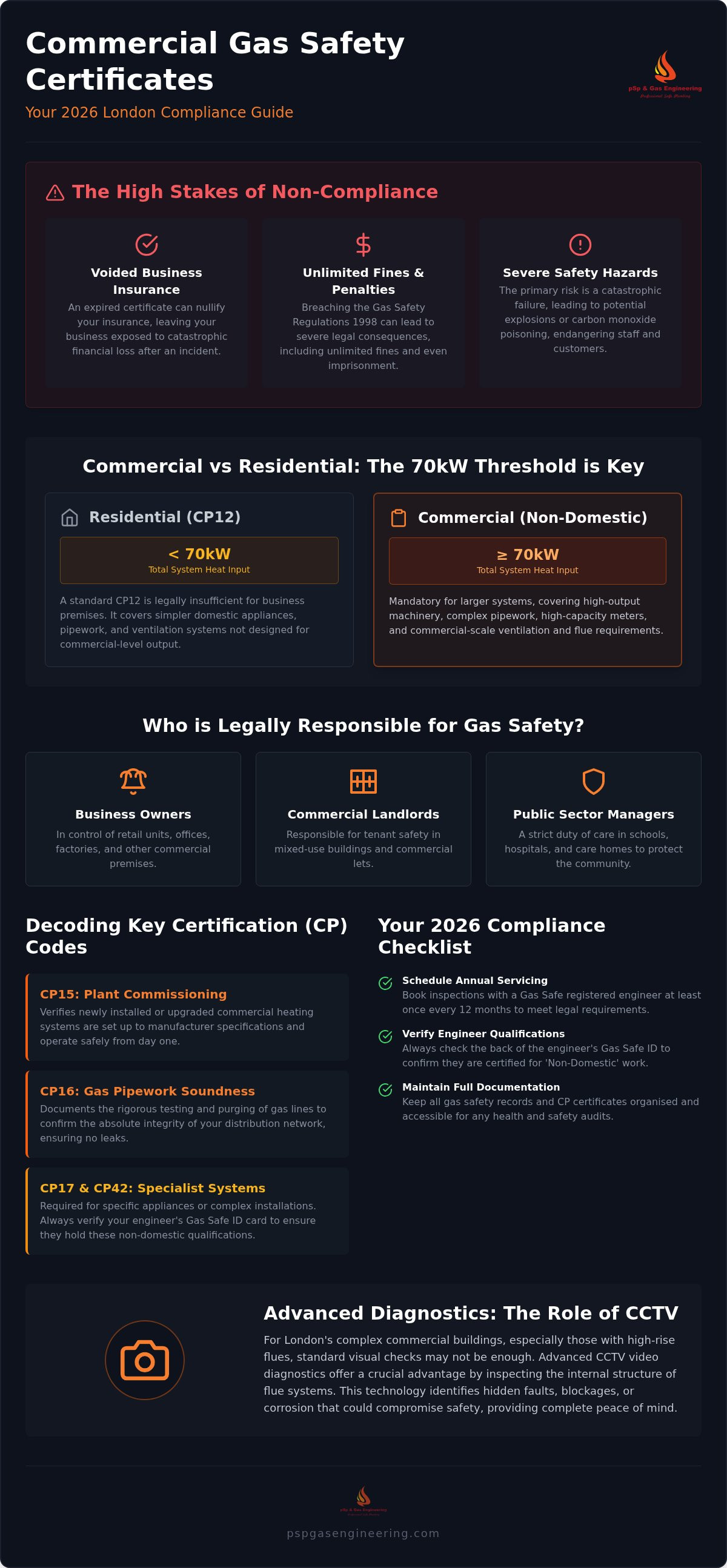
- Understand why a standard residential CP12 is insufficient for business premises and how non-domestic records provide the necessary legal protection.
- Decode the complex "CP" numbering system, from CP15 to CP42, to ensure every part of your commercial gas installation is correctly documented.
- Navigate the unique technical challenges of operating in London, including managing high-rise flue systems and maintaining safety in high-density areas.
- Streamline your path to a commercial gas safety certificate London by following a professional compliance checklist and scheduling annual servicing to prevent system failures.
- Discover how advanced CCTV video diagnostics can identify hidden structural faults in complex commercial flues that standard visual checks might overlook.
Understanding the Commercial Gas Safety Certificate in London
A commercial gas safety certificate London, formally known as a non-domestic gas safety record, is a legal requirement for any business using gas appliances. It isn't just a piece of paper. It's a professional verification that your entire gas infrastructure, from the meter to the final exhaust point, meets rigorous safety standards. Unlike a standard domestic check, this inspection covers high-output machinery and complex distribution networks found in commercial environments.
The foundation of this requirement is the Gas Safety (Installation and Use) Regulations 1998. These laws demand that every gas appliance is inspected by a Gas Safe registered engineer at least once every 12 months. With the 2026 HSE updates, the focus on technical precision has never been higher. Compliance ensures your business operates within the law, protecting you from the risk of explosions or carbon monoxide poisoning.
Ignoring these duties leads to more than just safety risks. You could face unlimited fines or even imprisonment. From a commercial perspective, an expired certificate often voids your business insurance. If a gas-related incident occurs, your provider will likely refuse to pay out, leaving your company's future in jeopardy. Securing a commercial gas safety certificate London is not a one-off task; it's a commitment to ongoing operational excellence.
Who Legally Requires a Commercial Gas Certificate?
The responsibility for gas safety rests with the person in control of the building. This includes business owners in retail units, offices, and factories. Commercial landlords must also provide these records for their tenants in mixed-use developments. Additionally, public sector managers in schools, care homes, and hospitals have a strict duty of care to maintain these certifications for the safety of the community.
Commercial vs Residential: Key Technical Differences
You can't rely on a residential CP12 for a business environment. The primary threshold is 70kW. If your system's total heat input exceeds this, it's legally classified as commercial. These installations involve significantly more complex pipework and high-capacity meters that domestic engineers aren't qualified to handle. Commercial-scale ventilation is also a critical factor; the air supply needed for a large boiler is far greater than a home system. Flue requirements are equally stringent, often involving long vertical runs in London's high-rise buildings that require specialist diagnostics to ensure they're exhausting safely, whilst ensuring adequate air supply for combustion.
Key Certification Codes: CP15 to CP42 Explained
The Commercial Protocol (CP) numbering system is the industry standard for documenting gas safety in non-domestic settings. Unlike residential properties where a single CP12 usually suffices, commercial sites often require multiple forms to cover the full scope of their infrastructure. This complexity is why it's vital to ensure your engineer holds the correct categories on their Gas Safe register entry. Following the HSE Approved Code of Practice (L56), every distinct element of your system, from the meter to the boiler plant, must be accounted for.
To secure a valid commercial gas safety certificate London, you must match the engineer’s credentials to your specific equipment. An engineer qualified for domestic boilers cannot legally sign off on a 150kW commercial plant room. Always check the back of a technician's Gas Safe ID card to verify they're authorised for 'Non-Domestic' work before any inspection begins. This verification provides the peace of mind that your complex technical tasks are being handled by a qualified expert.
Plant Rooms and Pipework: CP15 and CP16
If you've recently installed a new heating system or upgraded your existing boilers, you'll require a CP15. This is the Commercial Plant Commissioning Certificate. It proves that the equipment was set up according to manufacturer specifications and is operating safely. For ongoing maintenance or following repairs to your gas lines, the CP16 becomes essential. CP16 is the vital safety check for gas pipework soundness. It involves rigorous testing and purging to ensure there are no leaks within the distribution network. If you're unsure which documentation your facility needs, you can consult with our specialist engineers for guidance on your specific site requirements.
Specialist Certification: CP17 and CP42
While the plant room is the heart of the system, individual appliances need their own records. The CP17 covers the installation and servicing of non-domestic gas appliances like overhead radiant heaters or large-scale water heaters. For businesses with kitchens, the CP42 is the standard for commercial catering environments. Even if an engineer doesn't sell catering equipment, they can perform the safety inspection to ensure the extraction and gas interlock systems are functioning correctly. These individual reports often feed into a master Non-Domestic Gas Safety Record, providing a comprehensive overview of your property's compliance status. This layered approach ensures that no technical detail is overlooked, maintaining the high safety standards expected in the London business community.
Navigating Londons Unique Commercial Gas Challenges
Operating a business in a high-density urban environment presents technical hurdles that standard gas inspections rarely encounter. In areas such as Croydon, Thornton Heath, and the financial centre, the sheer concentration of infrastructure complicates the path to a commercial gas safety certificate London. Basement plant rooms in Victorian-era heritage buildings often suffer from restricted ventilation, requiring bespoke engineering solutions to meet modern standards. Managing these risks across a multi-site property portfolio demands a methodical approach to ensure every boiler and meter is accounted for without disrupting daily operations.
High-Rise Flue Systems and Venting
Flue integrity is the primary safety concern for London’s commercial buildings. The vertical nature of our city means that exhaust gases must often travel through several floors before reaching the atmosphere. If a flue isn't structurally sound, carbon monoxide can seep into occupied spaces. This risk is amplified in older, converted properties where shared flues might be in use. If your system shows signs of deterioration, you may need Professional Flue Relining Services London to restore safety and efficiency. Regular inspections ensure that draught levels remain sufficient to clear combustion by-products safely, preventing dangerous build-ups within the building's core.
Access and Parking Logistics for London Inspections
Securing a commercial gas safety certificate London involves more than just technical skill; it requires precise logistical planning. Controlled Parking Zones (CPZ) and strict security protocols in Central London buildings can easily delay an inspection if not managed correctly. Professional engineers organise their visits to work around your business hours, ensuring minimal disruption to your staff or customers. This includes coordinating with building security for out-of-hours access to plant rooms. Because commercial gas emergencies don't stick to a schedule, having access to 24/7 emergency support is a vital safety net for any London-based enterprise. This level of local expertise ensures that even the most restricted sites remain compliant and safe for everyone involved.
Your 2026 Compliance Checklist for Commercial Gas Safety
Securing a commercial gas safety certificate London requires more than just an annual appointment. Preparation is key to a smooth inspection. Before your engineer arrives, ensure all gas appliances are accessible and any previous safety records are available for review. Under the Gas Safety (Installation and Use) Regulations 1998, you're legally required to retain these certificates for at least two years. However, keeping a digital archive for the life of the appliance is a best practice that simplifies future audits and insurance renewals.
Proactive monitoring between inspections is equally vital. You should contact a Gas Safe engineer immediately if you notice warning signs such as yellow or orange flames instead of crisp blue ones, soot marks around boilers, or excessive condensation in the plant room. These indicators often suggest incomplete combustion or flue issues that could compromise your next certification if left unaddressed. Consistent annual servicing is the most effective way to maintain the validity of your certificate and extend the lifespan of your commercial infrastructure.
The Inspection Process Step-by-Step
- Visual Assessment: A thorough check of all appliances, pipework, and flues to identify obvious signs of wear, corrosion, or damage.
- Tightness Testing: A critical pressure test to confirm there are no leaks within the commercial gas line or distribution network.
- Ventilation Check: Ensuring the combustion air supply and extraction rates are adequate to prevent the dangerous build-up of carbon monoxide.
- Safety Device Testing: Verifying that flame failure valves, interlock systems, and emergency shut-offs respond correctly under fault conditions.
Post-Inspection: Understanding Your Report
Once the inspection is complete, your engineer will categorise any faults found. An 'Immediately Dangerous' (ID) classification means the appliance or system poses a life-threatening risk and must be disconnected straight away. An 'At Risk' (AR) classification indicates a fault that could become dangerous; whilst not an immediate threat, it requires urgent remedial work to maintain compliance. Understanding these terms is essential for prioritising repairs and ensuring your business remains operational.
For a more detailed breakdown of what to expect during your visit, refer to our Gas Safe Compliance Certificate Checklist. If your system requires remedial work or you are due for your annual inspection, you can book a comprehensive gas safety inspection with our registered experts today to ensure your property meets every legal standard.
Advanced Diagnostics: The Role of CCTV in Commercial Safety
Standard visual inspections often stop at the appliance connection or the visible terminal on the roof. In complex London buildings, this leaves metres of internal flue pipework unexamined. For a comprehensive commercial gas safety certificate London, relying on external appearances isn't enough. Advanced CCTV diagnostics allow engineers to inspect the entire length of a flue system, identifying issues that are physically impossible to see from the outside. This level of technical precision ensures that high-stakes safety decisions are based on visual evidence rather than assumptions.
Detecting Blockages and Structural Failures
Large-scale commercial chimneys and flues are prone to 'invisible' risks that can compromise building safety. Internal collapses, debris, or mortar deterioration in older brick chimneys can restrict the flow of dangerous combustion gases. CCTV video inspections provide a clear, high-definition view of these internal structures, allowing for an accurate assessment of their integrity. This evidence is invaluable during property surveys or when supporting insurance claims after a suspected incident. CCTV surveys prevent costly, unnecessary strip-out work by pinpointing the exact location of a fault within a wall or ceiling void.
Integrating Diagnostic Tech with Annual Certification
Incorporating video diagnostics into your annual safety routine shifts your strategy from reactive repairs to proactive management. By combining your annual gas safety check with a video survey, you gain a data-driven overview of your system's health. This information allows you to plan long-term maintenance and schedule repairs before they lead to emergency boiler failures or a failed commercial gas safety certificate London. It provides a permanent record of the flue's condition, which is a vital asset for health and safety audits. This methodical approach guides you through your technical requirements with total clarity.
Our specialist approach focuses on using this technology to provide a "safe pair of hands" for your business. We don't just tick boxes; we use advanced tools to ensure your infrastructure is genuinely durable and compliant. If you're managing a complex site and need a thorough evaluation of your gas infrastructure, contact PSP & Gas Engineering for a comprehensive commercial safety assessment.
Secure Your Business Compliance for 2026 and Beyond
Maintaining a valid commercial gas safety certificate London is a fundamental pillar of responsible business management. By understanding the specific CP certification codes and the technical demands of high-output systems, you protect your premises from legal risk and operational failure. We've explored how advanced CCTV diagnostics reveal hidden structural faults in complex London flues, providing a level of security that standard visual checks simply cannot match. Proactive maintenance remains the most effective strategy to ensure your gas infrastructure remains durable whilst meeting every health and safety standard.
As a local Croydon-based business, our Gas Safe Registered experts serve all London boroughs with a safety-first mentality. We specialise in complex flue systems and high-precision video inspections, offering 24/7 emergency support to keep your operations running smoothly. You can rely on our seasoned professionals to provide a comprehensive guarantee of competence and care for your property. Book your professional commercial gas safety inspection with PSP & Gas Engineering today to ensure your business stays compliant, safe, and protected throughout the year ahead.
Frequently Asked Questions
How often does a commercial gas safety certificate need to be renewed?
A commercial gas safety certificate London must be renewed every 12 months as mandated by the Gas Safety (Installation and Use) Regulations 1998. This annual inspection ensures that all appliances, pipework, and flues remain in a safe operating condition. It's best to schedule the visit up to two months before the current certificate expires. This approach maintains the original expiry date whilst ensuring you're never without valid legal documentation for your business.
Is a CP12 the same as a commercial gas safety certificate?
No, a CP12 is a Landlord Gas Safety Record designed specifically for domestic properties. For business premises or multi-occupancy buildings with high-output boilers, you require a Non-Domestic Gas Safety Record. These commercial inspections are significantly more rigorous. They cover larger pipework, complex ventilation requirements, and industrial-grade appliances that a standard domestic check doesn't account for. Always ensure your engineer is qualified for non-domestic work before they start.
What happens if my business fails a gas safety inspection?
If your premises fail an inspection, the engineer will categorise the faults as 'Immediately Dangerous' or 'At Risk'. Dangerous appliances will be disconnected to ensure safety. You must then carry out the necessary remedial work to fix the defects. Once repairs are complete, a follow-up inspection is required to issue a valid commercial gas safety certificate London. Prompt action prevents prolonged business disruption and avoids potential legal penalties or insurance invalidation.
Can any plumber issue a commercial gas safety certificate in London?
No, only a plumber who is a Gas Safe registered engineer with specific commercial qualifications can issue these certificates. Domestic registration doesn't authorise an engineer to work on non-domestic systems or appliances exceeding 70kW. You should always verify an engineer's credentials by checking the back of their Gas Safe ID card. This card lists the specific types of gas work they're legally permitted to perform in a commercial environment across London boroughs.
How much does a commercial gas safety inspection cost in 2026?
The cost of a commercial gas safety inspection depends on the number of appliances and the complexity of the system infrastructure. Most providers in London offer tiered pricing based on the total count of boilers, heaters, and meters. Whilst basic checks for a single appliance are common, large plant rooms or multi-site portfolios typically require bespoke quotes. It's advisable to check if your provider offers combined service packages to improve value and streamline your compliance.
Do I need a certificate if I only have one gas boiler in my office?
Yes, you legally require a certificate even if you only have one gas appliance. The law applies to any commercial premises where gas is used, regardless of the number of boilers or heaters. Even a single small boiler in a retail unit or office must be inspected annually to ensure it's exhausting correctly and operating safely. This protects your staff and ensures your commercial insurance remains valid in the event of an incident.
What is the difference between a CP15 and a CP17 certificate?
A CP15 is a Commercial Plant Commissioning Certificate used when a new gas system is first installed or significantly upgraded. It confirms the installation meets manufacturer specifications. In contrast, a CP17 is used for the annual servicing and safety inspection of non-domestic appliances already in use. Whilst a CP15 is a one-off document for new equipment, the CP17 is the recurring record that maintains your ongoing compliance with national safety regulations.
Are gas safety checks mandatory for empty commercial properties?
Yes, gas safety checks remain mandatory if the gas supply is active, even if the property is currently unoccupied. Landlords and property managers are responsible for ensuring that the pipework and any remaining appliances don't pose a risk to the building or neighbouring units. If you intend to leave a property empty for an extended period, you might choose to have the gas supply professionally capped to simplify your safety obligations and reduce maintenance.


