
Could a hidden defect behind a Victorian chimney breast be the only thing standing between you and a legal rental property? For many London landlords, the annual gas safety check feels like a high-stakes gamble where the rules shift every season. Understanding the specific CP12 certificate requirements is no longer just about ticking a box; it's about navigating a landscape where the Renters' Rights Act 2025 has made absolute compliance more critical than ever.
It's natural to worry about failing an inspection or facing unexpected remedial costs, particularly when dealing with the intricate flue systems common in older properties. You need a reliable way to ensure your tenants are protected whilst keeping your rental income secure. This guide provides a definitive roadmap to mastering current safety standards, ensuring your London property remains fully compliant without the stress of hidden surprises. We'll explore the mandatory checks for 2026, the benefits of the two month renewal window, and how modern video technology provides the ultimate peace of mind for complex installations.
Key Takeaways
- Identify the legal framework of the CP12 as the formal Landlord Gas Safety Record mandated by the Gas Safety (Installation and Use) Regulations 1998.
- Master the specific CP12 certificate requirements for 2026, including mandatory appliance inspections and rigorous pipework tightness testing.
- Gain clarity on compliance terminology such as "At Risk" (AR) to understand when immediate remedial action is necessary for tenant safety.
- Stay organised with updated record-keeping standards, including the transition to digital certification and the requirement to retain records for at least two years.
- Learn why specialised video equipment is essential for inspecting hidden flue systems common in older Croydon and South London properties.
What is a CP12 Certificate? Understanding Gas Safety Requirements in 2026
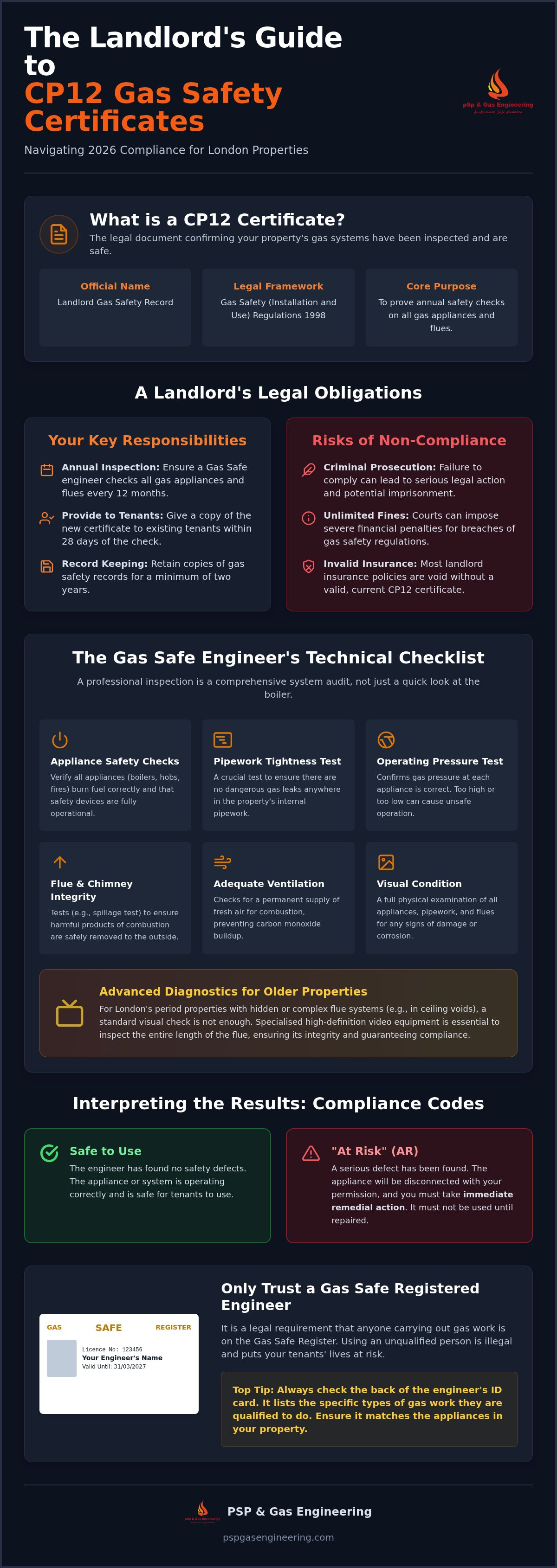
The term CP12 originates from "CORGI Proforma 12," a legacy title from the era before the Gas Safe Register became the UK’s official gas registration body. Professional engineers and property managers still use this shorthand today when discussing CP12 certificate requirements. Legally, the document is known as the Landlord Gas Safety Record, and it remains a statutory requirement under the Gas Safety (Installation and Use) Regulations 1998. Simply put, a CP12 is the official record confirming that gas appliances and flues have been checked for safety by a registered engineer. This document acts as your primary proof of compliance during property audits, insurance claims, or tenant disputes.
The Legal Necessity for Landlords
Compliance isn't a choice; it's a fundamental duty. Landlords must provide a copy of this record to tenants within 28 days of the inspection. Failing to meet these CP12 certificate requirements can lead to unlimited fines or criminal prosecution. Most insurance policies are void without a valid landlord gas safety certificate London landlords need for protection. Current rules allow checks up to two months early whilst preserving the original deadline.
Who Can Issue a CP12 Record?
Only an engineer currently listed on the Gas Safe Register can legally perform these inspections. When an engineer arrives, always check the back of their ID card for specific appliance competencies. It's a mistake to assume every plumber is qualified for all gas work. Using a professional who understands the specific gas safe compliance certificate standards is essential for a valid inspection.
By choosing a specialist who focuses on methodical engineering standards, you avoid the risks associated with cut-price, superficial checks. A professional inspection identifies potential issues before they become life-threatening hazards, providing a genuine sense of security for your property investment and your tenants. This "safe pair of hands" approach ensures your London property remains a secure, legal, and habitable environment throughout the year.
The Technical Checklist: What Your Gas Safe Engineer Must Inspect
A professional safety check is a methodical engineering audit designed to identify faults before they become hazards. When evaluating CP12 certificate requirements, an engineer doesn't just look at the boiler; they perform a comprehensive system analysis. This process begins with a physical examination of every gas appliance in the property, including hobs, ovens, and gas fires. Each unit is tested to confirm it is burning fuel efficiently and that the internal safety devices are fully functional and responsive.
Tightness testing is a critical step in the procedure. By monitoring the gas meter under controlled conditions, the engineer ensures there are no leaks within the internal pipework system. They also verify that the gas pressure is correct at each appliance. If the pressure is too low, the appliance won't operate safely; if it's too high, it could lead to premature component failure. Ensuring a permanent supply of fresh air is equally vital for combustion. To understand the full scope of your legal duties for landlords, you must recognise that poor ventilation is a leading cause of dangerous carbon monoxide buildup.
Flue and Chimney Integrity
The flue is the property's primary defence against toxic fumes. Engineers perform flue flow and spillage tests to ensure products of combustion are discharging safely to the outside atmosphere. Whilst a visual inspection covers visible sections, London’s older housing stock often features flues that are difficult to access or routed through shared chimneys. If an engineer cannot verify the integrity of a chimney, the property cannot meet the necessary CP12 certificate requirements. This is why local expertise in Croydon’s diverse architecture is so valuable for maintaining compliance.
Advanced Diagnostics: Video Flue Inspections
In many modern London apartments and refurbished period homes, flues are routed through ceiling voids or internal shafts. A standard visual check cannot see through plasterboard or masonry. We use high-definition CCTV cameras to perform video inspections, allowing us to see the internal condition of the entire flue run. This identifies cracks, loose joints, or structural failures that others might miss entirely. If defects are found, we provide flue relining services London landlords trust to restore safety and efficiency. For a thorough assessment of your system, you can book a technical inspection with our Croydon-based team to ensure your property remains a safe pair of hands.
Interpreting the Results: Compliance Codes and Remedial Actions
Once the inspection is complete, the engineer issues a report using standardised industry codes. These classifications determine whether your property meets the current CP12 certificate requirements or if immediate intervention is necessary. A "Pass" status confirms that every gas appliance and flue is safe for continued use. This provides a clear 12-month window of compliance, ensuring your tenants are protected and your legal duties are fulfilled.
If a fault is identified, it will be categorised as either "At Risk" (AR) or "Immediately Dangerous" (ID). An AR code suggests the appliance has a defect that could become dangerous if left unaddressed. Whilst the appliance might remain in service, we strongly advise scheduling remedial work to prevent a total failure. Conversely, an ID code signifies an immediate threat to life, such as a major gas leak or toxic fume spillage. In these high-stakes scenarios, the engineer has a strict duty of care under the legal requirements for gas safety to disconnect and cap off the appliance. This physical isolation is a non-negotiable safety measure to protect the occupants from harm.
What Happens if an Appliance Fails?
Receiving a warning notice shouldn't be viewed as a frustration. It is a critical prevention of a potential disaster. The engineer will provide a detailed breakdown of the required repairs and the steps needed to restore compliance. In cases where components are obsolete or repairs are no longer cost-effective, we facilitate a smooth transition to a professional boiler installation Thornton Heath landlords trust for efficiency. This methodical approach ensures your property returns to a safe standard with minimal disruption to your tenants.
The "Stay Set" Window: Planning Your Renewal
Organised property management relies on the "Stay Set" rule. This regulation allows you to conduct the annual check up to two months before the current certificate's expiry date without losing any time on the 12-month cycle. It functions much like an MOT for a vehicle. By using this two-month window, you avoid the stress of last-minute bookings during the busy winter period. This flexibility ensures you always meet CP12 certificate requirements whilst allowing ample time for any necessary remedial work. It is the most effective way to maintain a continuous narrative of safety and professional reliability for your rental portfolio.
Legal Obligations and Record-Keeping for London Landlords
Meeting CP12 certificate requirements involves more than just the physical engineering check; it requires meticulous administration. You must keep every gas safety record for a minimum of two years. Whilst paper records are still legally valid, the 2026 rental market has shifted almost entirely to electronic certification. Digital records are harder to lose, easier to archive, and can be shared instantly with local authorities or insurance providers if a claim arises. For new tenancies, you're legally required to provide a valid record before the tenant moves into the property. For existing tenants, you must issue the new certificate within 28 days of the inspection date.
London’s housing market features a high volume of holiday lets and short-term rentals. These properties aren't exempt from gas safety laws. Every property with a gas supply, regardless of the length of the tenancy or the platform used to book it, must have a valid Landlord Gas Safety Record. Failing to provide this documentation can prevent you from using certain possession grounds if you ever need to regain control of your property.
Managing Access Issues with Tenants
Conflicts often arise between a landlord's statutory duty to inspect and a tenant's right to quiet enjoyment. You must provide at least 24 hours' written notice before an engineer arrives. If a tenant refuses entry, you must document "reasonable steps" taken to gain access. This includes keeping copies of all letters, emails, and logs of attempted phone calls. Maintaining a clear communication trail is your best defence if a local authority questions your compliance status. You can't simply force entry; you must show a persistent and documented effort to fulfil your safety obligations.
Carbon Monoxide Alarm Requirements
The 2026 standards require a carbon monoxide (CO) alarm in any room containing a fixed combustion appliance. This includes boilers and gas fires but typically excludes gas cookers. An alarm is a vital secondary safety measure, but it never replaces the annual engineering check. During our visit, we check the expiry dates of these alarms amongst our other technical tasks. Most CO alarms have a lifespan of seven to ten years. If yours is nearing its end, it needs replacing to ensure your tenants remain protected from this silent, odourless threat.
If you're managing multiple properties and need a reliable partner for your portfolio, you can book your annual gas safety inspections with our Croydon-based team. By choosing a specialist who understands the intricacies of London properties, you ensure your records are always accurate and your tenants stay safe. This proactive approach transforms a legal chore into a comprehensive guarantee of property health and professional reliability.
Professional Gas Safety Inspections in Croydon and South London
Croydon's diverse architecture, from sprawling Victorian terraces in Thornton Heath to modern high-rise apartments, demands a specialist who understands local infrastructure. A generic check often overlooks the technical difficulties inherent in older chimney stacks or complex shared flues. We provide a safe pair of hands for landlords, prioritising precision over speed. Our methodical approach ensures that meeting CP12 certificate requirements involves a thorough engineering audit rather than a superficial visual inspection. National call centres rarely offer the same level of technical scrutiny as a dedicated local specialist who knows the area's specific property challenges.
If a critical fault is discovered, you need more than just a report; you need a solution. We offer 24/7 emergency assistance to handle gas safety crises, ensuring your tenants are never left in a vulnerable position. As local leaders in boiler installation Croydon landlords rely on us for safety audits that go beyond the basics. We don't just identify problems; we resolve them with technical expertise and professional calm, ensuring your property remains a secure investment.
Why a Croydon Expert Matters for Your CP12
Thornton Heath and surrounding South London areas feature a high density of period properties. These buildings often have intricate venting challenges that modern standards must accommodate. Our engineers are familiar with the specific flue configurations found in these Victorian and Edwardian homes, ensuring they meet all CP12 certificate requirements despite structural age. This local knowledge allows us to provide rapid, project-based solutions if a boiler fails its safety check, preventing long-term vacancy or legal disputes. We understand the unique pressures of the South London rental market and work to keep your property functional and safe.
Book Your 2026 Gas Safety Inspection
Proactive management is the key to maintaining a compliant portfolio. By scheduling your inspection early, you take full advantage of the two-month renewal window that preserves your original expiry date. This organised approach removes the stress of last-minute bookings and provides ample time for any necessary remedial work. Our team is committed to the welfare of the Croydon community, providing a service that blends technical intricacies with a safety-first mentality. Ensure your property is compliant by booking a CP12 inspection with PSP & Gas Engineering today.
Ensuring Long-Term Safety and Compliance for Your London Portfolio
Navigating CP12 certificate requirements in 2026 demands a shift from reactive maintenance to proactive engineering oversight. By utilising the two-month "Stay Set" window and embracing digital record-keeping, you transform a statutory obligation into a streamlined part of your property management. Modern safety standards require more than a quick visual check; they necessitate technical diagnostics that identify hidden faults in complex London flue systems before they become hazardous.
Our team of Gas Safe Registered Engineers provides a methodical approach to every inspection, acting as a "safe pair of hands" for landlords across South London. As specialists in video flue diagnostics, we ensure even the most inaccessible systems are thoroughly vetted and safe for your tenants. Should an urgent issue arise, our 24/7 emergency support ensures your property remains protected around the clock. Secure your valid CP12 Certificate with our Croydon Gas Safe experts today and gain the peace of mind that comes from professional, local expertise. Protecting your investment and your tenants is a commitment we take seriously, ensuring your property remains a safe and legal home for years to come.
Frequently Asked Questions
How long does a CP12 gas safety inspection typically take?
A standard gas safety inspection typically takes between 30 and 60 minutes to complete. This duration varies based on the number of gas appliances in your property and the accessibility of the flue system. An engineer must conduct a tightness test at the meter and perform individual safety checks on each unit. If you have complex flue configurations or multiple appliances like hobs and fires, the process may take slightly longer to ensure full compliance.
Is a CP12 certificate the same as a boiler service?
No, a CP12 is a mandatory safety inspection, whereas a boiler service is a maintenance procedure. The safety check confirms that your appliances meet the legal CP12 certificate requirements and are safe to operate. A service involves cleaning components and optimising performance for longevity. Whilst they are different, many landlords choose to have both performed during the same visit to ensure the system is both safe and efficient.
What happens if I lose my gas safety certificate?
If you lose your record, you should contact the Gas Safe registered engineer or the company that performed the inspection. Most professional providers now issue digital certificates and can easily re-send a PDF copy of your Landlord Gas Safety Record. Remember that you're legally required to keep these records for at least two years. Having a digital backup ensures you can always provide proof of compliance to tenants or local authorities.
Do I need a CP12 for an empty rental property?
You still need a valid certificate if the property has a gas supply and is intended for rental. Even if the property is currently vacant, the gas appliances must be safe for when a new tenant moves in. You cannot legally allow a tenant to start their residency without providing them with a valid gas safety record. If the gas supply is permanently capped at the meter, the requirements change, but most active systems require annual checks.
Can a tenant refuse entry for a gas safety check?
Tenants can occasionally be uncooperative, but you have a statutory duty to ensure the property is safe. You should provide at least 24 hours' written notice and attempt to find a mutually convenient time. If they continue to refuse entry, you must document all "reasonable steps" taken to comply with the law. This includes keeping a log of all correspondence. You shouldn't force entry; instead, seek professional advice if access remains an issue.
How much does a landlord gas safety certificate cost in London?
In the London market, the cost of a gas safety certificate varies depending on the number of appliances and the complexity of the inspection. Industry data from 2026 indicates that prices in the capital typically start from £57.99 for a single appliance. These costs can increase if you require additional checks for hobs, gas fires, or advanced flue diagnostics. Many landlords find that fixed-fee services from local specialists offer the best balance of thoroughness and value.
Will the engineer turn off my gas if they find a fault?
Yes, an engineer is legally obligated to disconnect an appliance if they identify an "Immediately Dangerous" (ID) fault. This is a non-negotiable safety measure designed to prevent explosions or carbon monoxide poisoning. The engineer will cap the gas supply to the dangerous unit and issue a formal warning notice. They'll explain the specific faults found and provide clear advice on the remedial work required to meet CP12 certificate requirements and restore the gas supply.
Does a CP12 cover gas hobs and cookers as well as the boiler?
A CP12 inspection covers every gas appliance provided by the landlord for the tenant's use. This includes the boiler, gas hobs, ovens, and any gas fires located within the property. The engineer must verify that each appliance is burning fuel correctly and that all safety devices are functioning as intended. It's important to list all gas appliances when booking your inspection to ensure the engineer allocates enough time to check the entire system thoroughly.


