
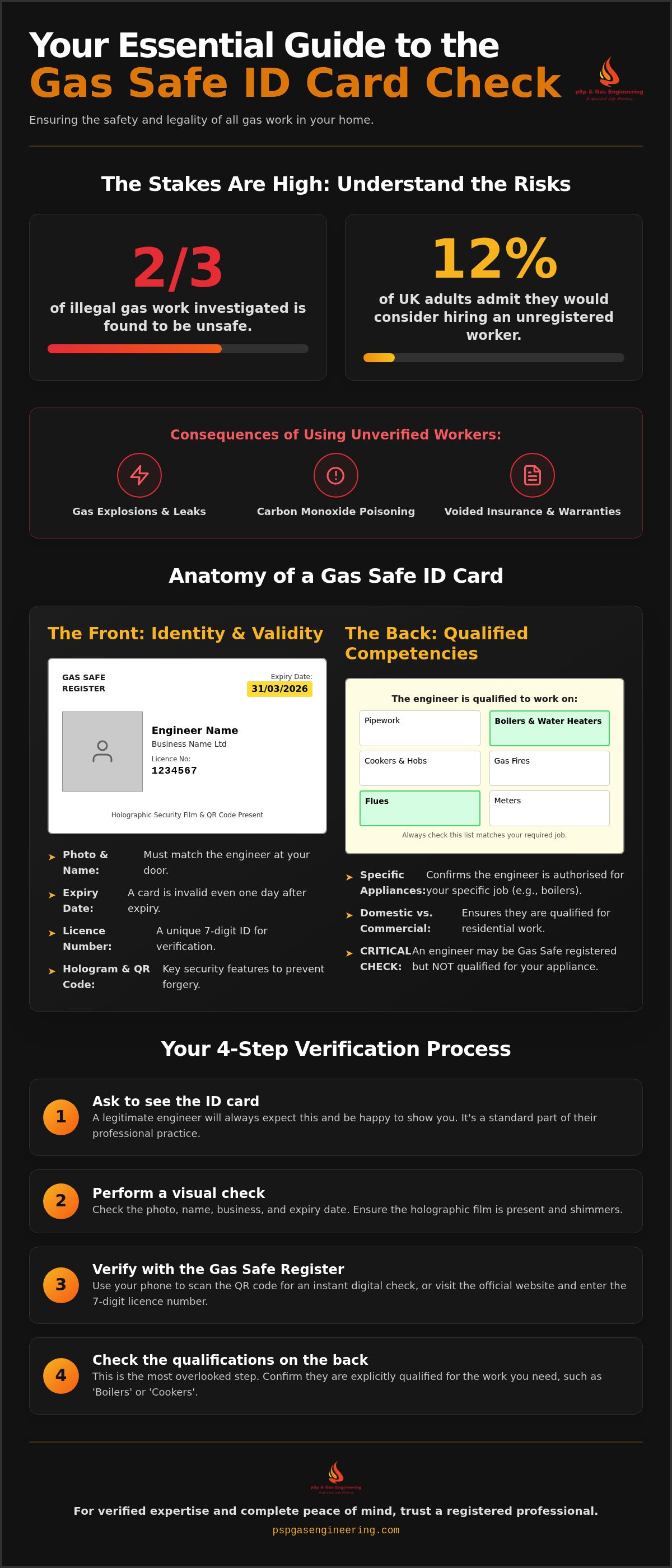
Did you know that two-thirds of illegal gas work investigated by the Gas Safe Register is found to be unsafe? In 2026, a worrying 12% of UK adults admit they would consider hiring an unregistered worker to save money, making a rigorous Gas Safe ID card check more vital than ever. It's a risk that can lead to devastating consequences, from carbon monoxide leaks to voided home insurance. You likely feel a sense of unease when a new tradesperson enters your home, wondering if they truly possess the skills to keep your family safe.
Performing this check is the most effective way to replace that anxiety with professional confidence. This guide will teach you exactly how to verify an engineer's credentials so your home remains safe, legal, and compliant with current regulations. We'll examine the latest 2026 digital licence cards, explain how to use the new verification QR codes, and show you how to check the specific categories of work an engineer is authorised to perform. By the end of this article, you'll have the peace of mind that comes from knowing your gas appliances are in a safe pair of hands.
Key Takeaways
- Understand why a Gas Safe ID card check is a legal necessity for all domestic gas work to maintain your home insurance and safety standards.
- Learn to identify the 2026 security features on both physical and digital licence cards, including holographic branding and instant-verification QR codes.
- Master the process of using the official Gas Safe Register tool to verify an engineer's identity and current registration status in seconds.
- Gain the confidence to inspect the reverse of the card to ensure the engineer is authorised for your specific appliance, such as a boiler or flue.
- Discover why reputable specialists always encourage homeowners to ask for credentials as part of a transparent, safety-first service.
Why a Gas Safe ID Card Check is Your First Line of Defence
The Gas Safe Register is the official list of gas businesses legally permitted to carry out work on gas appliances across the United Kingdom. It isn't merely a directory; it's a statutory requirement. Under the Gas Safety (Installation and Use) Regulations, anyone performing work on gas fittings or appliances must be competent and registered. This legal framework exists because gas is inherently volatile. A simple Gas Safe ID card check acts as your primary safeguard against catastrophic failures like gas explosions or the silent, odourless threat of carbon monoxide poisoning.
Many homeowners mistakenly believe that every plumber is qualified to fix a boiler. This is a dangerous assumption that can have fatal consequences. Whilst many gas engineers are also skilled plumbers, the reverse isn't always true. Plumbing involves water systems, whilst gas engineering requires specialised certification to handle combustible fuel. Hiring a plumber who lacks the necessary gas credentials is both illegal and life-threatening.
Understanding the Gas Safe Register
The Gas Safe Register replaced the previous CORGI registration scheme in 2009. This transition marked a shift towards even more stringent safety standards and regular competency assessments. To earn a place on the register, an engineer must complete rigorous training and pass comprehensive examinations to prove they can work safely with gas. These qualifications aren't permanent. Engineers must renew their registration every 12 months, ensuring their technical knowledge remains up to date with the latest industry standards and safety protocols. This continuous vetting process provides the security you need when someone is working on high-stakes technical tasks in your home.
The Risks of Using Unverified Workers
In areas like South London and Croydon, 'cowboy' tradespeople often claim they can "take a look" at a faulty boiler to save you money. However, the financial consequences of using unverified workers are severe. Most manufacturers will immediately void your boiler warranty if the unit has been touched by an unregistered person. Skipping a Gas Safe ID card check might seem like a shortcut, but it often leads to poorly fitted flues that leak toxic fumes into your living space. If you're a property owner, failing to use a registered professional can also jeopardise your landlord gas safety certificate London compliance. This doesn't just result in heavy fines; it can lead to criminal prosecution and invalidate your property insurance in the event of a fire or leak.
Decoding the Card: What Every Homeowner Needs to Spot
A physical or digital Gas Safe ID card is more than a simple identification badge. It is a regulated security document featuring specific anti-counterfeit measures designed to protect the public. When you perform a Gas Safe ID card check, you should first look for the holographic security film that covers the card's surface. This film should shimmer when tilted, displaying the official logo. The branding must be crisp and clear, without any blurred text or suspicious alterations that might suggest a forged document.
The Front: Personal and Business Details
The front of the card contains the immediate visual proof of identity. You should first verify that the engineer's photo matches the person standing at your door. Alongside the photo, you'll find the engineer's name and the business they represent. If you've booked a service with PSP & Gas Engineering, the card should reflect this association. Every card features a unique 7-digit licence number. This number is the key to verifying the engineer's status via the official register. Crucially, check the expiry date at the top of the card. A card that expired even a day ago is legally worthless, as it indicates the engineer's mandatory annual registration has lapsed. For more details on the Gas Safe ID card, government resources provide a clear breakdown of these specific visual markers.
The Back: Categories and Competencies
The reverse of the card is arguably the most critical part of the Gas Safe ID card check, yet it's frequently overlooked by homeowners. This section lists the specific gas work categories the engineer is qualified to undertake. Just because someone is registered doesn't mean they're authorised for every task. Common categories include:
- Boilers and Water Heaters
- Cookers and Hobs
- Gas Fires
- Pipework and Metering
It's vital to ensure the engineer's competencies align with the work you need. For instance, an engineer qualified only for cookers isn't legally permitted to provide flue relining services London or install a complex central heating system. Each category on the back has its own 'Valid To' date. Always check that the specific competency required for your job is still within its validity period. At PSP & Gas Engineering, our specialists take pride in their extensive qualifications. We encourage you to review our engineers' credentials upon arrival to ensure total peace of mind before any work begins.
How to Verify an Engineer: Visual Checks and the Official Register
Many homeowners feel a slight hesitation when asking a tradesperson for identification. You might worry about appearing distrustful. However, a professional gas engineer expects a Gas Safe ID card check as part of a standard site arrival protocol. It's a routine safety measure that protects both the resident and the engineer's professional integrity. At PSP & Gas Engineering, our team is trained to present their credentials before you even have to ask. This transparency is the hallmark of an authoritative specialist who takes safety seriously.
The 3-Step Visual Verification Process
Verification begins the moment the engineer arrives at your door. You should follow a methodical three-step process to ensure total peace of mind. First, request to see their licence card immediately. Don't feel pressured to let them start work until you've held the card yourself. Second, inspect the security features and the expiry date on the front. In 2026, these cards feature updated holographic branding that's difficult to replicate. Third, turn the card over to confirm they're authorised for your specific appliance. If you've booked a boiler installation or a specialised video flue inspection, the corresponding category must be listed and currently valid on the reverse of the card.
Online Verification via the Gas Safe Register
Digital tools have made verification even more efficient. The Gas Safe Register website features a prominent 'Check an Engineer' search bar designed for public use. You can input the 7-digit licence number found on the front of the card to view the engineer's full profile. This database confirms if the engineer is currently 'Active' and linked to a registered business. In 2026, many engineers carry digital licence cards in their smartphone wallets. These digital versions include a secure QR code. Scanning this code with your phone provides an instant link to their official registration page. This cross-referencing ensures the person in your home is fully insured and backed by a legitimate firm.
A legitimate Croydon specialist will never take offence at these checks. They understand that safety standards are the foundation of high-quality engineering. If an engineer makes excuses or claims they left their card in the van, you should politely decline the service. Your safety is non-negotiable, and a valid ID is the only proof of competence that matters. By taking these steps, you ensure your home remains a protected environment managed by qualified experts.
The Dangers of Illegal Gas Work: Why Credentials Cannot Be Ignored
Unauthorised gas work is a serious criminal offence in the UK. When an individual performs gas work without being on the Register, they aren't just breaking the law; they're creating life-threatening hazards. According to 2026 research, two-thirds of illegal gas work investigated by the Gas Safe Register was found to be unsafe. These individuals, often referred to as 'cowboy' builders, bypass critical safety protocols, which frequently leads to fires, explosions, and lethal carbon monoxide leaks. The Health and Safety Executive (HSE) serves as the primary enforcement body, actively prosecuting illegal fitters with penalties that include heavy fines and custodial sentences.
Identifying these workers requires a vigilant Gas Safe ID card check. There are several red flags to watch for during your initial interaction. If an engineer claims they forgot their card or insists on a cash-only payment to avoid a paper trail, you should be immediately suspicious. A refusal to provide a formal CP12 record or an invoice is a clear indicator of illegal activity. Professional engineers, like those at PSP & Gas Engineering, provide transparent documentation for every task, from a simple boiler service to complex flue inspections.
Landlord Compliance and Legal Liabilities
Property managers and landlords face particularly high stakes. You have a legal responsibility to ensure that any engineer working on your property is fully registered. Hiring an unverified worker can immediately invalidate your landlord gas safety certificate London, leaving you vulnerable to prosecution. Compliance isn't a one-time task; it requires verifying that the engineer's specific competencies match the CP12 certificate requirements for the appliances in the building. As of 2026, penalties for commercial non-compliance can range from £500 to £5,000 per violation, with repeated failures potentially resulting in prison time.
What to Do If an Engineer Fails the Check
If an engineer cannot produce a valid ID or if the details don't match the person at your door, you must act decisively. Politely refuse them entry and terminate the service immediately. Don't be swayed by excuses about lost cards or pending renewals. Once the individual has left, you should report the suspected illegal worker to the Gas Safe Register via their official website or helpline. This helps protect the wider community from similar risks. To ensure your home remains safe, you should then contact a verified local expert to inspect any work the previous individual may have touched. If you have concerns about a recent installation or need a professional audit, you can book a Gas Safety Inspection with our fully registered team to rectify any unsafe work and restore your peace of mind.
Choosing Verified Expertise with PSP & Gas Engineering
PSP & Gas Engineering operates on a foundation of absolute transparency. We believe that a Gas Safe ID card check should never be an awkward encounter for the homeowner. Instead, our engineers are instructed to present their credentials as the first step of any site visit. This proactive behaviour demonstrates our commitment to the high standards required by the Register and provides immediate reassurance that your property is being handled by a qualified expert. Whether we are conducting a routine service or a complex flue relining, our identity and registration status are always front and centre.
Our commitment to safety extends beyond simple identification. We specialise in high-stakes technical tasks that require specific competencies often missing from general plumbing services. Our engineers are particularly adept at video flue inspections, using advanced equipment to ensure that every ventilation path is clear and structurally sound. By performing a Gas Safe ID card check on our team, you'll see that our competencies are specifically tailored to these advanced safety procedures, ensuring that your home remains fully protected under current 2026 regulations.
The PSP Standard of Professionalism
Our team undergoes continuous technical training to stay ahead of evolving safety regulations. We manage both residential and commercial projects with the same methodical precision. This "safe pair of hands" approach is particularly vital during a boiler installation Thornton Heath, where correct fitting and rigorous testing are essential for long-term efficiency. By maintaining up-to-date registration and performing rigorous internal audits, we ensure that every gas safe compliance certificate we issue is legally bulletproof and fully compliant with HSE requirements.
Local Trust in Croydon and South London
As a Croydon-based specialist, we understand the specific architectural challenges of South London homes, particularly regarding older flue systems. Property owners in Thornton Heath and the surrounding areas often prefer local independent experts over large national franchises because we offer a more personalised and accountable service. We've built a reputation for precision in technical areas that many general plumbers avoid, such as specialised video flue inspections. These inspections allow us to identify internal blockages or structural failures that traditional methods might miss, ensuring your heating system is truly safe.
Our 24/7 emergency assistance means that help is always available when you need it most, backed by the same guarantee of professional certification. Choosing a local specialist ensures that your engineer isn't just a face on a card but a dedicated member of the community committed to safety. If you require a verified professional for your next gas project, contact PSP & Gas Engineering today to experience a service where safety and transparency are the standard, not the exception.
Securing Your Home with Certified Gas Expertise
Protecting your property starts with a simple, rigorous verification of credentials. By performing a consistent Gas Safe ID card check, you ensure that every engineer entering your home is not only registered but specifically authorised for the task at hand. Remember that a valid licence is your primary defence against the significant risks of carbon monoxide and illegal installations. Whether you're checking the holographic security film on a physical card or scanning a 2026 digital QR code, these steps remain the most effective way to maintain safety and legal compliance.
At PSP & Gas Engineering, we take pride in being Croydon's trusted local experts. Our Gas Safe registered engineers carry valid ID at all times and provide 24/7 emergency gas support to keep your community safe. We encourage every customer to inspect our credentials to ensure total peace of mind. Book a verified Gas Safe engineer from PSP & Gas Engineering today and rest easy knowing your gas appliances are in a safe pair of hands.
Frequently Asked Questions
Is it rude to ask a gas engineer for their ID card?
It's absolutely not rude to request a Gas Safe ID card check; in fact, professional engineers expect it. A qualified specialist views this request as a sign of a responsible homeowner who values safety. At PSP & Gas Engineering, our team is trained to present their licence immediately upon arrival. This transparency is a core part of our professional standard. You should never feel awkward about verifying the credentials of someone working on technical appliances.
What should I do if a gas engineer says they forgot their ID card?
If an engineer cannot produce their ID, you should politely refuse them entry and terminate the service. A professional would never arrive at a job without their licence, as it's their legal proof of competence. Even if they offer to show you a photo on their phone, it's safer to insist on seeing the physical card or a secure digital wallet version with a scannable QR code. Your safety is the priority.
Can a plumber fix my boiler if they aren't on the Gas Safe Register?
No, a plumber cannot legally perform any work on a gas boiler unless they're also on the Gas Safe Register. Whilst many tradespeople hold both qualifications, they're distinct disciplines. Working on gas appliances without the correct registration is a criminal offence in the UK. Using an unregistered worker will void your manufacturer's warranty and likely invalidate your home insurance. Always ensure the individual is authorised for gas work before they touch your heating system.
How often do Gas Safe ID cards expire?
Gas Safe ID cards expire every 12 months, coinciding with the engineer's annual registration renewal. This mandatory yearly update ensures that every professional on the register remains compliant with the latest safety standards and technical regulations. When you perform a Gas Safe ID card check, always look at the 'Valid To' date on the front. If that date has passed, the engineer is no longer legally authorised to carry out gas work, regardless of their previous experience.
What do the different symbols on the back of the Gas Safe card mean?
The symbols and text on the reverse of the card indicate the specific types of gas work the engineer is qualified to perform. Common categories include domestic boilers, pipework, gas fires, and cookers. It's vital to cross-reference these symbols with the job you need doing. An engineer might be qualified to install a gas hob but not authorised for complex flue relining or boiler installations. Always check that the specific competency is listed.
Can I check an engineer's Gas Safe registration by their name only?
You can search for an engineer by name on the official Gas Safe Register website, but using their 7-digit licence number is far more accurate. Searching by name alone can be difficult if the individual has a common surname or if they're registered under a business name rather than their personal one. The licence number is a unique identifier that provides an instant, direct link to their current registration status and their full list of competencies.
What is the difference between a Gas Safe licence number and a registration number?
The registration number belongs to the business as a whole, whilst the licence number is unique to the individual engineer. A single company may have several engineers, each with their own distinct 7-digit licence number shown on their ID card. When verifying a professional at your door, you should check their individual licence number. This ensures that the specific person performing the work is personally qualified and currently authorised by the Register.
Do I need to check the ID card if the engineer is from a well-known company?
Yes, you should always check the ID card regardless of the company's size or reputation. Even large, well-known firms may occasionally use subcontractors or junior staff whose individual qualifications must be verified. A professional from a reputable business will have no issue showing their credentials. Taking a moment to verify the person standing in your home provides an essential layer of security, ensuring that the high standards you expect are actually met.


