
A standard retail detector cannot stop carbon monoxide from escaping into your home; it simply sounds an alert once toxic fumes are already present. If you rely solely on an off-the-shelf buzzer for protection, you aren't alone. It is natural to assume that mounting a wall sensor keeps your family safe, particularly against an invisible, odourless gas that nobody can detect without specialist equipment. However, waiting for an audible alarm means reacting to an active hazard. Only a comprehensive, professional carbon monoxide safety check can identify compromised flues, incomplete fuel combustion, and hidden blockages before dangerous emissions build up.
This guide separates lethal misconceptions from critical facts, clarifying the vital difference between a routine boiler service and an exhaustive flue safety inspection. You will discover exactly what certified Gas Safe registered engineers evaluate during a physical assessment, alongside practical protocols for detector placement, testing, and annual maintenance to guarantee genuine peace of mind.
Key Takeaways
- Discover how incomplete fuel combustion generates toxic emissions and why adequate ventilation is fundamental to appliance safety.
- Learn why an engineer-led carbon monoxide safety check combines physical burner assessments with electronic flue gas analysis to resolve hazards before they escalate.
- Debunk critical misconceptions regarding domestic gas odorants and standalone detectors to ensure your home maintains dependable protection.
- Understand the structural flue risks common in Victorian and Edwardian London properties, including deteriorating chimney mortar and shared stacks.
- Explore how advanced video diagnostics uncover internal flue blockages and defects that standard visual evaluations miss entirely.
What Is a Carbon Monoxide Safety Check and Why Is It Vital?
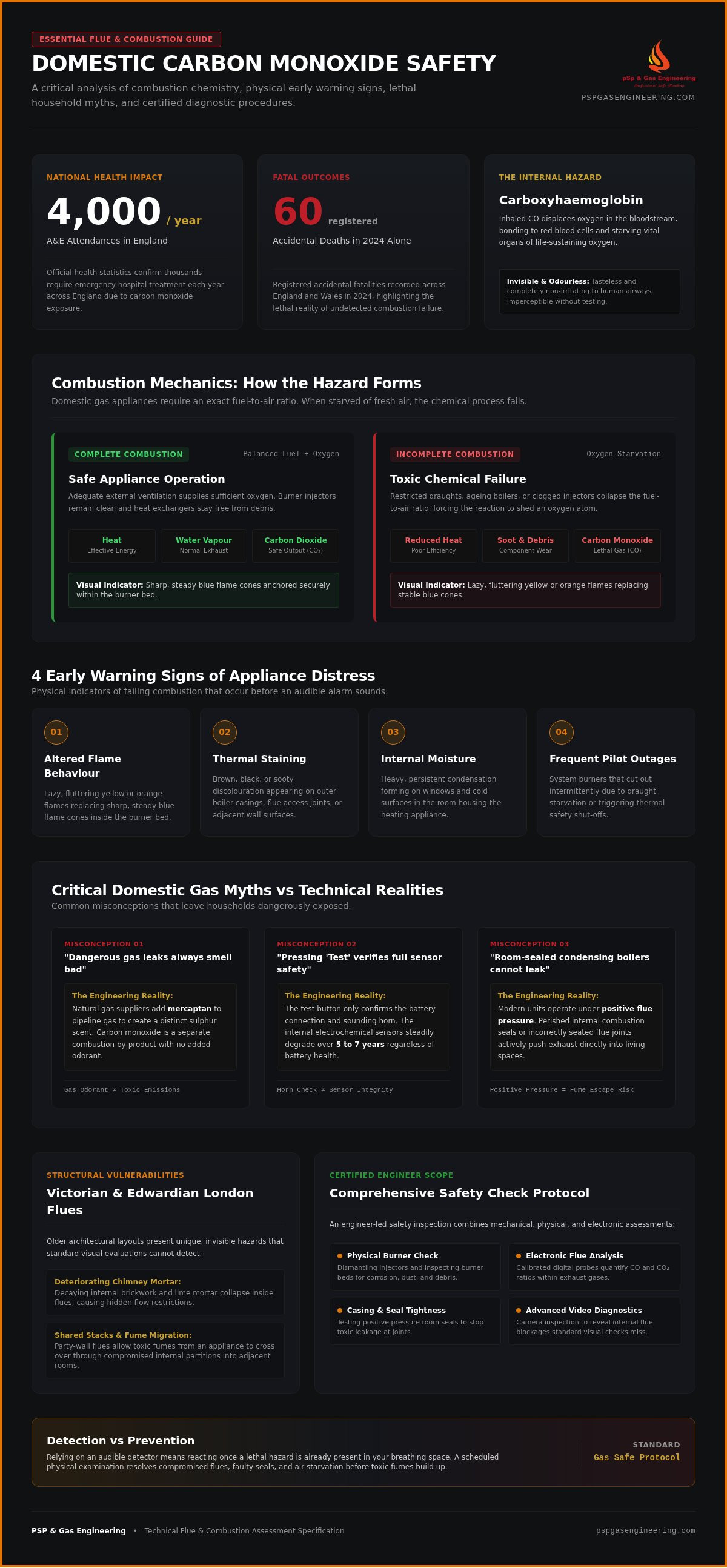
A professional carbon monoxide safety check is a meticulous engineering assessment of how cleanly a fuel-burning appliance combusts gas and how effectively its exhaust system removes toxic by-products. Unlike a simple alarm test, this physical inspection examines the entire operational cycle of your heating system. Domestic fuels such as natural gas require an exact ratio of oxygen to burn safely. When an appliance is starved of fresh air, incomplete combustion occurs. This chemical failure replaces harmless carbon dioxide with carbon monoxide (CO), a lethal compound that enters living spaces entirely undetected.
The danger lies in its stealth. The gas is invisible, odourless, tasteless, and completely non-irritating to human airways. Medical research on carbon monoxide poisoning confirms that inhaled CO displaces oxygen in the bloodstream, forming carboxyhaemoglobin and depriving vital organs of life-sustaining oxygen. According to official health data, approximately 4,000 people attend A&E each year in England due to exposure, with 60 registered accidental deaths occurring across England and Wales in 2024 alone. A scheduled physical examination ensures these chemical failures are identified long before ambient levels threaten household health.
The Mechanics of Combustion: How the Silent Killer Forms
Clean combustion produces heat, water vapour, and carbon dioxide. However, when burner injectors clog, heat exchangers collect debris, or flues suffer structural impairment, the air-to-fuel ratio collapses. Ageing boilers, unserviced fires, and restricted external draughts starve the appliance of oxygen. This disruption forces the chemical reaction to shed an oxygen atom, converting what should be benign exhaust into lethal carbon monoxide.
Early Warning Signs of Flue and Appliance Distress
Appliances under internal stress often exhibit subtle physical indicators before triggering an audible detector. Homeowners should arrange a qualified carbon monoxide safety check immediately upon noticing:
- Altered flame behaviour: Lazy, fluttering yellow or orange flames replacing sharp, steady blue flame cones within the burner bed.
- Thermal staining: Brown, black, or sooty discolouration appearing on outer boiler casings, flue access joints, or adjacent wall surfaces.
- Internal moisture build-up: Heavy, persistent condensation forming on windows and cold surfaces in the room housing the heating appliance.
- Frequent pilot outages: System burners that cut out intermittently due to draught starvation or thermal safety trips.
Top Myths About Carbon Monoxide Safety in UK Homes
Widespread misunderstandings regarding domestic gas safety leave thousands of households needlessly exposed. Many homeowners assume an off-the-shelf retail detector guarantees absolute protection. In truth, an alarm serves solely as an emergency alert once a poison has already escaped into your breathing space. Relying on an audible device without booking a regular carbon monoxide safety check is akin to depending on a car airbag while ignoring braking faults. Prevention requires physical inspection, not passive monitoring.
Myth vs Reality: Detectors, Smell, and Appliance Age
A frequent error is trusting that gas leaks smell bad. Natural gas suppliers add mercaptan to pipeline gas to create an unmistakable sulphur scent. Carbon monoxide, however, is a combustion by-product that carries no added odorant; it remains completely imperceptible to human senses. Another misconception involves domestic alarm lifespan. Pressing a "test" button merely verifies the battery and sounding horn, not the electrochemical sensor inside. These internal sensors degrade steadily over five to seven years regardless of battery condition.
Equally dangerous is the assumption that modern, room-sealed condensing boilers cannot leak. High-efficiency boilers operate under positive flue pressure. If an internal combustion seal perishes or an engineer fails to seat an inner flue joint correctly during a hurried repair, toxic exhaust escapes straight into the living space. Booking regular Gas Safety inspections ensures certified engineers verify casing integrity and flue tightness before micro-fissures develop into catastrophic leaks.
Recognising Carbon Monoxide Poisoning Symptoms
Victims frequently dismiss initial poisoning symptoms as a routine viral infection or seasonal fatigue. Official NHS advice on carbon monoxide highlights distinctive early warnings, including persistent tension headaches, nausea, dizziness, vomiting, and cognitive disorientation without an accompanying high temperature.
- Location-dependent relief: Physical symptoms lessen significantly when leaving the property or spending time outside in fresh air.
- Synchronised household illness: Multiple family members or co-living occupants experience identical lethargy and headaches at the exact same time.
- Vulnerable household members: Young children, elderly residents, and family pets succumb to carboxyhaemoglobin toxicity far more rapidly than healthy adults.
For rented domestic accommodation, ensuring compliant detector placement and appliance integrity is a statutory duty. Review our comprehensive guide to obtaining a Gas Safe compliance certificate to ensure your tenancy meets every current legal and physical standard.
What Happens During a Professional Carbon Monoxide Inspection?
A professional carbon monoxide safety check is an exacting engineering procedure designed to verify the physical integrity and combustion mechanics of your heating system. Gas Safe registered engineers begin with an exhaustive physical examination. They dismantle key components to inspect the burner assembly for debris, evaluate the main heat exchanger for micro-fractures, and test all internal rubber and silicone seals for thermal hardening. Engineers also review permanent room ventilation pathways and test flame failure devices to ensure automatic shut-off valves trip instantly if a burner extinguishes. Upon completion, the engineer issues a formal Gas Safety Record detailing the operating status, specific test measurements, and any remedial actions required.
Diagnostic Testing with Electronic Flue Gas Analysers
Beyond visual assessments, engineers use calibrated electronic flue gas analysers (EGFAs) to measure combustion chemistry inside the flue terminal. By inserting a specialised probe into the exhaust stream, the instrument calculates the exact ratio of carbon monoxide to carbon dioxide (CO/CO2 ratio). British Standards define strict operational limits; if this ratio exceeds defined tolerances (typically 0.0040 on domestic condensing boilers), the appliance is burning fuel unsafely and requires immediate servicing or isolation. Engineers also perform differential pressure testing on gas pipework using digital manometers to guarantee zero pressure drop across the entire fuel supply network.
Venting and Flue Route Verification
Safely expelling exhaust gases requires continuous, uninterrupted flue runs. Modern installations must satisfy statutory guidelines set out in the UK building regulations for flues, which govern routing, clearance distances, and inspection hatches for concealed ductwork. In properties where chimneys or flues traverse ceiling voids and internal partitions, physical inspection can prove difficult.
Specialist diagnostics overcome this challenge. Engineers employ flexible, high-resolution endoscopes and CCTV push-cameras to examine inaccessible internal runs, identifying joint dislocations, internal corrosion, or debris blockages that external visual checks miss completely. If structural deterioration or mortar degradation is detected inside a masonry chimney chimney run, property owners should consider professional flue relining services London to restore reliable draft and safeguard against toxic blow-back.
Protecting London Properties: Flues, Building Layouts, and Regulations
London architecture introduces unique heating risks that standard suburban installations rarely encounter. In boroughs across Greater London, Victorian and Edwardian townhouses converted into multi-occupancy flats present intricate venting arrangements. In Croydon, Thornton Heath, and surrounding urban areas, heating appliances often vent into shared party chimneys or lengthy horizontal duct runs. Over decades, structural settling and internal thermal cycling degrade older brickwork. Scheduling a comprehensive carbon monoxide safety check ensures these regional architectural challenges are thoroughly inspected before structural faults compromise air quality.
Venting Complexities in London Period Conversions
Early twentieth-century brick chimneys were constructed using soft lime mortar, which crumbles over time when exposed to the acidic condensation produced by modern appliances. In converted flats, a fractured brick mid-feather wall can allow combustion gases from a ground-floor appliance to seep into first-floor bedrooms through disused fireplace recesses. Retrofitting a modern condensing boiler into these existing masonry flues demands specialised twin-wall flexible liners. Where flues pass through concealed ceiling voids or shared vertical shafts, non-invasive video camera surveys are essential to confirm structural integrity without damaging historic plasterwork.
Detector Positioning: Avoiding Critical Placement Mistakes
Audible alarms only work effectively when positioned according to British Standard BS EN 50292 guidelines. Poor positioning leads to slow response times or false alarms. Apply these statutory installation rules:
- Appliance proximity: Mount the detector between one and three metres horizontally from the fuel-burning appliance.
- Ceiling placement: If fitted to a ceiling, keep the unit at least 300 millimetres away from any supporting wall or light fixture.
- Wall placement: When fixing to a wall, position the unit higher than any door or window, but at least 150 millimetres below the ceiling.
- Airflow dead zones: Never install sensors directly above cooking hobs, beside extractor fans, or next to draughty exterior doors where fresh airflow disperses gas before it reaches the sensor.
Landlord Legal Compliance Across London Boroughs
Private and social landlords in England face stringent statutory duties under the Smoke and Carbon Monoxide Alarm (Amendment) Regulations 2022. Landlords must install a dedicated carbon monoxide alarm in every room used as living accommodation that houses a fixed combustion appliance, excluding standalone gas cookers. Under the Renters' Rights Act 2026, failing to address serious environmental hazards can incur local authority fines of up to £7,000.
Statutory compliance mandates an annual gas inspection by a licensed professional, alongside delivering an official record to existing tenants within 28 days of testing. Consult our detailed guide on obtaining a landlord gas safety certificate London to keep your properties fully compliant. To book an assessment for your property portfolio today, arrange your Gas Safety inspections with PSP & Gas Engineering.
Securing Your Home: Professional Safety Checks with PSP & Gas Engineering
Protecting your property against toxic combustion gases demands certified engineering expertise and thorough diagnostic methods. PSP & Gas Engineering delivers specialised Gas Safety Inspections conducted exclusively by certified Gas Safe registered engineers across Croydon, Thornton Heath, and Greater London. Our inspection methodology pairs advanced electronic combustion analysis with specialised video camera surveys to verify the entire exhaust route. While standard visual assessments stop at the outer appliance casing, our non-invasive optical equipment explores concealed chimney interiors and hidden floor voids to uncover flue degradations that others miss completely.
Every assessment produces an official, detailed safety inspection record that confirms appliance status, records precise diagnostic readings, and details clear steps if remedial action is necessary. When critical appliance or flue faults emerge unexpectedly, 24/7 emergency response is available to isolate hazards swiftly and secure your property without delay.
Why Local Engineering Expertise Delivers Greater Safety
Navigating the complex heating pipework and legacy chimney runs found in South London homes requires deep familiarity with local building practices. Our registered engineers understand the unique ventilation demands of Victorian terraces and high-density flat conversions. If an inspection uncovers structural chimney decay or an unsealed flue joint, our team possesses the technical capabilities to execute immediate solutions, from full Flue Relining to complete modern Boiler Installations. Homeowners receive transparent, safety-focused advice without confusing jargon or high-pressure upselling.
Arranging Your Comprehensive Safety Check
Proactive maintenance eliminates hazards before heavy winter heating places intense strain on aging components. Arranging an engineer-led inspection ensures that every boiler, gas fire, and connecting gas run operates within safe statutory parameters.
- Exhaustive appliance evaluations: Comprehensive burner cleaning, seal verification, and flue integrity checks.
- Specialised internal surveys: Video diagnostics for inaccessible voids, shared party walls, and concealed flues.
- Complete plumbing and gas peace of mind: Professional servicing that protects both your family and your property investment.
Do not wait for a standalone alarm to alert you to an active gas escape. Protect your household by choosing certified technical precision; contact PSP & Gas Engineering to arrange your safety check today.
Safeguard Your Home with Certified Technical Precision
A standalone alarm sounds only after dangerous fumes enter your breathing air. Genuine domestic protection relies on stopping incomplete combustion and flue failures at the source. Regular physical assessments evaluate burner efficiency, verify pipework tightness, and confirm that exhaust passages safely vent every toxic by-product away from your living spaces.
When you arrange a comprehensive carbon monoxide safety check with PSP & Gas Engineering, you secure the proven expertise of Gas Safe registered engineers. From advanced video diagnostics that reveal hidden fractures within older London chimneys to dedicated 24/7 emergency response across Croydon, Thornton Heath, and Greater London, our team delivers strict regulatory compliance and dependable technical care. Proactive maintenance eliminates dangerous hazards before cold weather places severe demands on your heating system. Protect your home and family—book a certified inspection with PSP & Gas Engineering.
Frequently Asked Questions
Is an audible retail alarm sufficient, or do I still require a professional carbon monoxide safety check?
No, an audible alarm is strictly an emergency alert device, not a preventative measure. It warns occupants only after toxic gas has already contaminated ambient air. A certified carbon monoxide safety check evaluates appliance mechanics, burner cleanliness, and flue passage integrity to prevent toxic production entirely. Relying solely on a retail detector leaves mechanical degradation and early combustion failure completely unaddressed.
Can modern combi boilers produce carbon monoxide if they are operating without visible faults?
Yes, modern room-sealed condensing combi boilers can generate dangerous emissions even while running quietly. Internal seals, heat exchanger gaskets, and positive-pressure flue joints degrade naturally over time. If internal casing seals fail or intake ducts become partially restricted, carbon monoxide can escape directly into living areas without displaying any visible operational error on the boiler screen.
How often should a homeowner arrange a certified carbon monoxide safety check in the UK?
Homeowners across Croydon and Greater London should arrange a certified inspection at least once every twelve months. Annual servicing ensures engineers detect gradual burner wear, thermal stress, and flue draught issues before heavy winter heating cycles begin. For private landlords, an annual check is an absolute statutory obligation under UK housing regulations, requiring delivery of an official Gas Safe record to tenants.
What happens if a Gas Safe engineer detects a carbon monoxide leak during an inspection?
The engineer will immediately isolate the affected appliance from the gas supply to eliminate the active hazard. Under Gas Safety (Installation and Use) Regulations, the engineer attaches a formal warning notice and classifies the equipment as Immediately Dangerous or At Risk. They will clearly explain the precise remedial repairs or flue work required to restore safe operation before reconnecting the gas supply.
Where should carbon monoxide alarms be fitted in a multi-storey house?
Fit an alarm in every room containing a fuel-burning appliance, positioned between one and three metres horizontally from the unit. For multi-storey properties, additional alarms should be installed on every habitable level, especially near primary sleeping quarters. Ensure wall-mounted sensors sit at least 150 millimetres below ceilings, and keep them well away from windows, draughty doors, or cooker extractors.
How much does an annual carbon monoxide and gas safety inspection typically cover?
A comprehensive safety inspection assesses all domestic gas appliances, connecting pipework, and exhaust systems. Engineers physically examine burners, verify flame failure devices, conduct digital tightness tests across the fuel pipework, and perform electronic flue gas analysis to record combustion ratios. In properties across Croydon with concealed chimneys, engineers also check venting routes to ensure total structural compliance.
Can a blocked chimney or bird nest cause carbon monoxide to enter living spaces?
Yes, flue blockages represent a primary cause of domestic carbon monoxide poisoning. When nesting birds, falling masonry, or soot restrict an unlined chimney, toxic combustion gases cannot exit the building. Instead, back-draughts force dangerous fumes back down the flue and through structural gaps into adjoining rooms. In older Croydon brick properties, video camera surveys quickly confirm whether internal chimney passages remain clear.


