

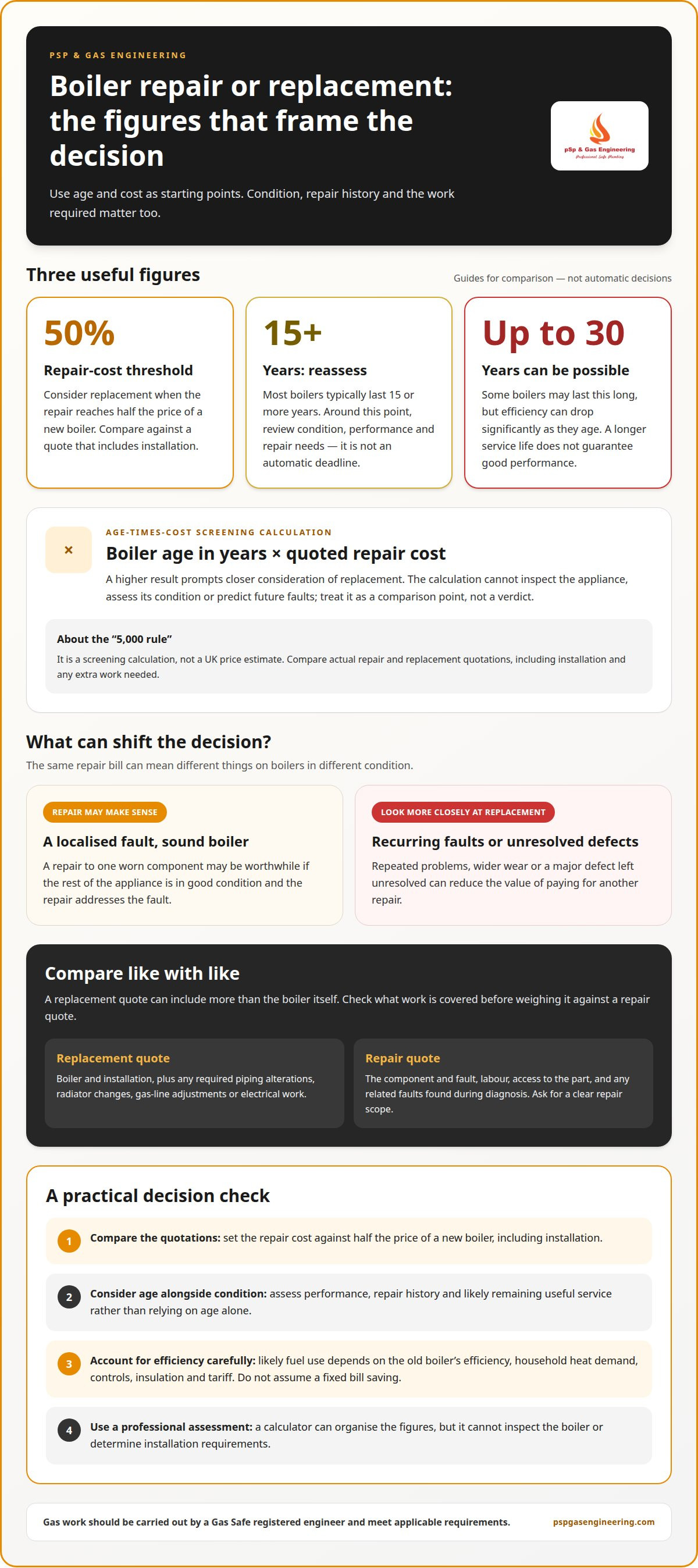
The cheapest repair can cost more over time. A calculator for deciding whether to repair or replace an old boiler gives you a useful starting point, but the age-times-cost rule is only a guide: consider replacement when a repair reaches half the cost of a new boiler.
It’s understandable to focus on the immediate bill, especially when a repair seems straightforward. But the boiler’s age, likely remaining lifespan, repair history and efficiency all affect whether fixing it makes sense or replacement may offer better value.
This article explains how to weigh those factors, what a boiler’s expected lifespan means for your decision, and why a professional assessment matters. You’ll have a clearer basis for choosing between repair and replacement, rather than relying on one calculation alone.
Key Takeaways
- Weigh a boiler’s age alongside the likely repair bill; neither factor gives a reliable answer on its own.
- Use repair-cost comparisons as a guide, then consider how repeated faults could affect the value of another repair.
- Expected lifespan can help you judge whether a repair is likely to provide useful service or simply postpone replacement.
- A professional evaluation can identify the boiler’s condition and help determine whether repair or a new installation is the more practical option.
How Does the Age of Your Boiler Affect the Decision?
Boiler age matters because a repair may restore heating without resolving wider wear. Compare the repair cost with the replacement option, rather than deciding by age alone.
Boiler age and repair costs
Boiler age is the number of years the heating system has been in service, considered alongside its condition and repair needs. It matters because faults can become more significant as components wear. A boiler nearing the end of its expected lifespan deserves closer scrutiny than one with a localised fault and sound overall condition. The repair’s value depends on what it fixes and what risks remain.
The age-times-cost replacement threshold
The age-times-cost formula multiplies the boiler’s age in years by the quoted repair cost. It gives you a comparison point, not a verdict: a higher result prompts closer consideration of replacement, but the formula cannot assess condition or predict future faults. For a fuller comparison, weigh the repair against the cost of replacing the heating system, including installation and any work needed to accommodate the new boiler. A calculator can organise these figures, but it cannot inspect the appliance.
For example, repairing one worn component may be worthwhile if the rest of the boiler is in good condition. The same repair can be poor value after recurring faults or if it leaves a major defect unresolved. The key question is what the repair will fix, not simply how old the appliance is.
Replacement costs, regulations and support
Replacement costs depend on the boiler selected, installation requirements and changes needed to connect it to the existing heating system. UK replacement work must meet applicable building regulations and gas-safety requirements. Gas work should be carried out by a Gas Safe registered engineer. An A-rated boiler’s effect on energy bills depends on the old boiler’s efficiency, household heat demand, controls, insulation and tariff. Compare likely fuel use rather than assuming a fixed saving.
Grant support is separate from the repair calculation. Eligibility depends on the relevant scheme’s rules and household circumstances, so count support only when eligibility is established. A repair-versus-replacement comparison should weigh the appliance’s condition, quoted work and expected heating performance, not an assumed grant or bill reduction.
The 5,000 rule for comparing repair costs with replacement
The 5,000 rule is a screening calculation, not a UK price estimate. For a sound decision, compare the repair quotation with a replacement quotation and account for any extra work.
Applying the 5,000 rule
The 5,000 rule multiplies boiler age by repair cost, then uses the result to flag when replacement deserves consideration. A more practical comparison is the repair-versus-replacement threshold: replacement may be preferable when a repair reaches 50% of a new boiler’s price.
For example, compare the repair quote with half the price of a new boiler, including installation. If the repair reaches or exceeds that amount, consider whether replacement could also improve efficiency and avoid a large spend on an ageing appliance. A small fault may still justify repair when the boiler is otherwise in good condition.
Additional work and cost factors
A boiler quotation can change if installation requires work beyond the appliance itself. Piping alterations, radiator changes, gas-line adjustments and electrical work can all affect the replacement cost. The condition of existing connections and the new boiler’s location also influence the work required.
Repair costs vary depending on the component and fault. A thermostat or ignition issue differs from a problem with a circulating pump, printed circuit board or cracked heat exchanger. Labour, access to the component and any related faults found during diagnosis also matter. Ask for a clear repair scope showing which parts and work the quote covers.
Weighing costs with a calculator
A repair-or-replacement calculator organises the comparison, but it cannot inspect the boiler or assess installation requirements. Enter the repair and replacement quotes, then include any identified piping, radiator, gas-line or electrical work. Compare like with like, including whether the replacement quote covers installation.
Also consider efficiency: an older appliance and a new model may use fuel differently, affecting the longer-term value of each option. Treat the calculator’s result as a prompt to examine the evidence, not a decision by itself. For a replacement-focused comparison, explore boiler installation options.
Boiler lifespan
Most boilers typically last 15 or more years, but age alone doesn’t determine replacement. Consider replacement around that point if performance declines or faults become more frequent; a well-maintained boiler may remain serviceable longer.
Boiler lifespan and replacement timing
A boiler’s lifespan is the period it can provide useful heating before wear makes continued operation less practical. This matters because a repair near the end of that period may offer less lasting value than one on a newer boiler.
A boiler’s useful lifespan can vary, so age alone may not determine when replacement is appropriate. Some can last up to 30 years, although efficiency drops significantly as they age. Homeowners should therefore consider both the appliance’s material and its current condition, rather than assuming every boiler reaches the same endpoint.
Annual professional boiler servicing can help maintain a boiler. Regular attention may identify developing issues before they affect reliability, while the boiler’s operating history can help show whether it is nearing the end of its useful service.
Boiler age as a replacement consideration
Age is one indicator of replacement timing, not a standalone instruction to replace. If you’re asking how old a boiler should be before replacement, 15 years is a useful point to reassess, not an automatic deadline. The decision still depends on condition, performance and repair needs.
A cast-iron boiler at 18 years sits within the typical 15-to-20-year lifespan range, but its remaining usefulness depends on its condition. A boiler that has reached 15 years and develops repeated faults may warrant earlier replacement consideration than one that continues to operate reliably.
Consistent temperatures can also help you assess performance. Uneven heating may signal a problem that needs investigation, but it does not by itself show that the boiler has reached the end of its life. Consider the appliance’s age alongside its service history and current operation before deciding.
Annual professional servicing is a practical maintenance measure. It cannot undo the effects of age, but it can help support reliable operation and inform decisions about future savings and replacement timing.
Professional repair-or-replacement evaluations
A professional assessment adds a physical inspection to the age-and-cost calculations. It considers the boiler’s condition, efficiency, safety and suitability, helping distinguish a repairable fault from wider deterioration that a calculator cannot identify.
Efficiency is one important check. Older boilers often operate at 60-70% efficiency, while new models can reach 95% or higher. These figures provide context, not a guaranteed bill saving. An engineer can assess the existing appliance’s performance and compare it with the expected efficiency of a replacement, alongside the home’s heating requirements.
Safety checks matter as much as performance. A Gas Safe registered engineer can inspect the appliance and installation as part of a gas safety inspection. This helps identify safety concerns that should take priority over which option appears cheaper. Any repair recommendation should explain the fault and the work needed to address it.
Sizing also matters if replacement is recommended. A new boiler may be two to three times larger than a home needs if it is selected simply by matching the old boiler’s nameplate. An assessment should consider the property’s actual heating needs, rather than assuming the existing appliance’s output is the right specification.
Ask for the findings to link the fault, proposed repair and replacement requirements. A thermostat problem, for example, calls for a different assessment from heat exchanger damage. The engineer’s explanation should clarify what the repair resolves and whether other condition or sizing issues affect the recommendation.
Arrange a professional gas safety inspection to assess safety alongside your repair-or-replacement decision.
PSP & Gas Engineering: Boiler Installations
PSP & Gas Engineering provides Boiler Installations when an assessment shows that replacement is the practical next step. A new installation should reflect the property’s heating requirements, rather than simply matching the old boiler’s output.
For an existing boiler, a Gas Safety Inspection can help assess safety as part of your decision. PSP & Gas Engineering’s Gas Safe Registered engineers carry out the work. Video Inspections and Flue Relining are also available when the flue or related installation needs attention.
If replacement is appropriate, contact PSP & Gas Engineering to discuss a boiler installation for your property.
Make your next boiler decision with confidence
Before committing to a repair or replacement, keep the inspection findings and written quotations together. A calculator to help decide whether to repair or replace an old boiler can organise the figures, but the next step is understanding what work each option covers. This makes it easier to discuss your decision clearly and avoid relying on a single calculation.
If replacement is appropriate, PSP & Gas Engineering offers Boiler Installations. Gas Safety Inspections can address safety concerns, while Flue Relining may be relevant if the flue needs attention. The right service depends on the assessment findings, so focus your conversation on the boiler’s condition and required work.
Move forward with a clear account of the options and their practical implications. Contact PSP & Gas Engineering to discuss your boiler and the next step for your home.
Frequently Asked Questions
Is There a Rule for Deciding Between Repair and Replacement?
There’s no single UK rule that decides every case. A useful financial threshold is to consider replacement when a repair reaches half the cost of a new boiler. Treat this as a comparison guide, not a legal requirement or guarantee. Compare like-for-like quotations, including installation and necessary system alterations. A modest repair may still make practical sense if the boiler is otherwise in good condition.
Is it worth repairing a boiler that is 20 years old?
It can be worth repairing a 20-year-old boiler if the fault is limited and the appliance remains safe and reliable. Age alone doesn’t establish that replacement is necessary. Consider whether faults are recurring, whether the repair addresses the cause, and whether performance has deteriorated. A professional assessment can help distinguish a contained issue from wider wear that may make replacement more suitable.
Is it better to repair or replace an old boiler in the UK?
Repair is often more practical for an isolated fault on a boiler that operates reliably. Consider replacement if faults recur, a repair is substantial, or the appliance’s condition raises safety or reliability concerns. In the UK, have gas work assessed and carried out by a Gas Safe registered engineer. The best choice depends on the fault, condition and scope of work.
What is the average cost to repair a boiler in the UK?
Repair costs depend on the fault and work required, so a single average may not reflect your situation. A thermostat issue, for example, differs from a major component failure. The cost depends on the job and is provided in a quote; factors include parts, labour, access to the boiler and whether diagnosis identifies related faults. Review what the quotation covers before comparing options.
How much does a new boiler installation cost in the UK in 2026?
There isn’t one installation price that applies to every UK home in 2026. The total depends on the boiler selected, the property’s heating requirements and the work needed to connect the appliance. Existing pipework, flue arrangements and system changes can affect the scope. The price depends on the case and is given after a quote request, so compare quotations that describe the installation work included.
How can I calculate whether boiler repair or replacement is cheaper over five years?
Compare the repair quote, likely further repairs and heating costs over five years with installation, maintenance and heating costs for a replacement over the same period. Use your household’s actual energy bills and expected heating use, keeping assumptions consistent. A calculator for deciding whether to repair or replace an old boiler can organise these figures, but it cannot predict future faults or inspect the appliance.


