
The most efficient boiler isn’t necessarily the right one for every home. Most gas boiler installations take 1-2 days, and a like-for-like replacement is generally more straightforward than changing boiler type or moving the boiler. An energy-efficient boiler installation in Croydon should be planned around your home’s heating and hot-water needs, as well as the work involved in fitting the new system.
It’s reasonable to want clear expectations before an energy efficient boiler installation in Croydon, especially when choosing a suitable boiler and preparing for the work. This guide explains what influences boiler choice, what installation involves and which property details affect the work. It also compares combi, system and conventional boilers so you can understand the options before deciding.
Key Takeaways
- Understand the main stages of a boiler replacement, from removing the old unit to testing and commissioning the new system.
- Match boiler capacity and type to your home’s layout, bathroom use and hot-water demand.
- Compare combi, system and conventional boilers to see which arrangement best suits your household.
- Learn which installation details affect efficiency and why Gas Safe registration matters when choosing an installer.
What Happens During your Boiler Installation?
A boiler replacement in Croydon starts with assessing the existing system, the proposed boiler and the work needed to connect them. The boiler type, its position and the home’s pipework all shape the installation plan.
Boiler Replacement Options
A like-for-like replacement keeps the same boiler type and position, so it is generally more straightforward than changing the system or relocating the unit. Changing the brand or boiler type can affect connections, controls, flue arrangements and hot-water supply, so these details should be assessed before work begins. The right option depends on the property’s heating setup and household demand, not the brand name alone.
Installation Timescales
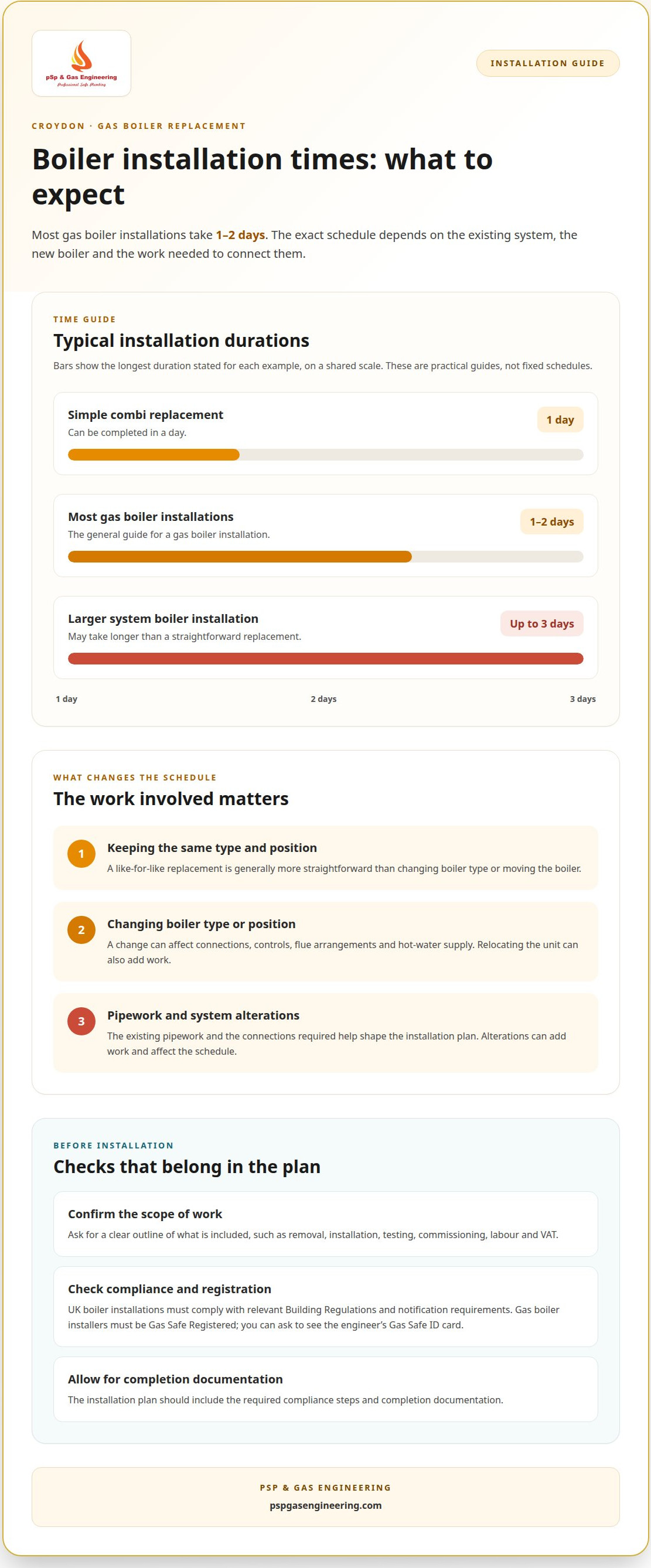
Most gas boiler installations take 1-2 days. A simple combi replacement in Croydon can take a day, while installing a larger system boiler can take up to 3 days. These are practical guides, not a fixed schedule: changing boiler type, moving its position or altering pipework can add work. The installer plans the sequence around the existing system and the connections required.
Regulations and Notification
UK boiler installations must comply with relevant Building Regulations and notification requirements. Gas boiler installers must be Gas Safe Registered, and you can ask to see the engineer’s Gas Safe ID card. The installation plan should include the required compliance steps and completion documentation. These checks matter whether the work is a direct replacement or involves changes to the flue, controls or heating system.
Grant support and finance are separate options, and eligibility depends on current scheme criteria, funding and household circumstances. Check the relevant scheme’s terms to see whether you can apply.
Installation Costs and System Changes
The quote depends on the property and the work involved. A like-for-like replacement generally requires fewer alterations than relocating a boiler or switching system type. A new flue, upgraded controls, complex pipework or power flushing can add work and affect the quote. Ask for a clear scope covering what is included, such as removal, installation, testing, commissioning, labour and VAT.
Choosing a boiler for a home's heating and hot-water needs
Boiler choice depends on the home’s layout, heating system and how residents use hot water. Existing pipework and controls also affect how well an upgrade can work.
Matching Heating and Hot-Water Needs
Start with the number of bathrooms, household routines and whether hot water is often needed at the same time in different rooms. A system boiler with a cylinder can suit larger homes with multiple bathrooms and higher hot-water demand. A combi can suit smaller or medium-sized homes where saving space matters. The heating system’s condition and pipework also help determine the appropriate capacity and installation approach.
For a central heating upgrade, radiator layout and existing connections help establish what needs adapting. Unevenly heated rooms or recurring boiler breakdowns may point to issues that affect replacement choices. A proper assessment considers the whole system, rather than selecting a boiler by brand alone.
Smart Controls and Efficiency
Heating controls determine when the boiler operates and how warmth is managed around the home. A programmer, room thermostat or thermostatic radiator valves can help you match heating to your routine and avoid heating unused spaces unnecessarily. Smart controls allow remote adjustments when compatible with the boiler and system. Their usefulness depends on the setup and how consistently household members use them.
During an upgrade, assess control compatibility alongside the boiler and existing heating system. If heating is inconsistent, the cause may be the controls, circulation or system condition, rather than boiler efficiency alone. Power flushing may be considered where deposits affect circulation; the system’s condition helps determine whether it is appropriate.
Local Upgrade Advice
For a Croydon upgrade, an Energy Performance Certificate (EPC) provides a property energy-efficiency rating on an A-G scale. Use that rating as one starting point, alongside the home’s heating demand, insulation and hot-water use. It can help frame which improvements to consider, but boiler selection still needs to reflect the actual heating system and household requirements.
Separate boiler replacement from wider efficiency improvements when planning an upgrade. Note recurring breakdowns, cold rooms and hot-water demand, then use those details to assess suitable options. Local council or energy-efficiency guidance can inform the wider decision. The property’s EPC rating and heating needs are also practical points to consider.
Combi, system, conventional and electric boilers
Boiler types supply heating and hot water in different ways, so the existing setup matters when planning an upgrade. In Croydon homes, a key distinction is whether water is heated on demand or stored for later use.
A combi boiler heats water on demand at mains pressure and needs no separate storage tank. This can free up space, but hot-water delivery depends on the boiler supplying taps as they are used. A system boiler works with a hot-water cylinder, so stored hot water is available separately from the boiler's heating cycle. The cylinder takes up space, making its location and condition important when planning a replacement.
A conventional boiler, also called a regular boiler, uses separate components for heating and stored hot water. It may suit a property already set up for this system, but changing to another type can require pipework alterations. Electric boilers use electricity rather than gas to heat water. Their suitability depends on the property's needs and existing heating system, so compare the whole setup rather than choosing by boiler type alone.
System cleaning and protection also deserve attention during an upgrade. Sludge or debris in radiators and pipework can affect circulation, so engineers assess the heating system before deciding whether cleaning is needed. Power flushing may form part of wider upgrade work, particularly if the system's condition or complex pipework increases the scope. After cleaning, suitable system protection can help limit corrosion and deposits. The approach depends on the system's condition and the new boiler's requirements.
For homes throughout Croydon, qualified, experienced engineers from PSP & Gas Engineering can assess the boiler type, cylinder arrangement, controls and pipework together. This joined-up assessment helps match the replacement to the property, rather than treating the boiler as an isolated appliance during an energy efficient boiler installation Croydon project.
Energy-efficient boiler installation
An efficient installation combines a boiler suited to the property with correct setup and controls. If you’re planning an energy efficient boiler installation in Croydon, compare product information with your home’s heating requirements, rather than treating a product label as a promise of lower bills.
Boiler Efficiency
Efficiency depends on more than the appliance label. Boiler sizing, system condition, controls and commissioning all influence how effectively heat reaches rooms and hot water reaches taps. An oversized unit may not suit the property’s demand, while an unsuitable setup can undermine the benefits of an upgrade.
Gas Safe Registered engineers should assess the existing heating system and explain how the proposed boiler fits. Installation planning should account for pipework, flue position and controls. After fitting, testing and commissioning confirm that the system operates as intended. Clear explanations of the work and the boiler documentation are also important.
Efficiency Ratings and ErP Labels
Compare the ErP label and product information for each boiler you are considering. Review the space-heating and water-heating information, comparing like with like, such as combi boilers against combis. The label helps show relative product performance, but does not account for every factor affecting energy use in a particular Croydon home.
Check that the model and product details on the label match the proposed appliance. Consider them alongside heating requirements, hot-water demand and the controls included in the installation. An Energy Performance Certificate rates the property on an A-G scale; this is different from comparing boiler product labels. A Gas Safe Registered installer can explain how the selected model fits the system and provide its relevant documentation.
For the right energy efficient boiler installation Croydon homeowners can discuss how a proposed model fits their property with PSP & Gas Engineering.
PSP & Gas Engineering: Boiler Installations
PSP & Gas Engineering provides boiler installations for homeowners replacing an ageing unit or planning a more suitable heating system. Its Gas Safe registered engineers carry out the work, with the installation planned around the property’s boiler type, pipework and hot-water requirements.
Contact the team when you’re ready to replace your boiler, or when a flue concern or inspection needs attention as part of the project. Flue relining and video inspections address specific flue and inspection needs, while gas safety inspections provide a separate check of gas appliances and systems.
Information about your current boiler, its location and any changes you’re considering helps establish the installation requirements. For advice on a boiler replacement or installation in Croydon, contact PSP & Gas Engineering.
Plan the next step for your home
Start by identifying your priority: replacing an ageing boiler, changing the system to suit household routines or addressing a concern with the existing gas setup. This gives the conversation a practical focus and helps shape the work around your home’s needs.
An energy-efficient boiler installation in Croydon is specific to the property, so discuss your existing system and the outcome you want. PSP & Gas Engineering provides boiler installations, gas safety inspections and flue relining for different needs involving boilers and their associated gas and flue arrangements.
Share the boiler type and location, any changes you’re considering, and the main heating or hot-water issue you want resolved. That context helps establish which service is relevant, whether you’re planning a replacement or addressing a separate safety or flue concern. A measured conversation can turn your research into a practical plan without pressure.
Contact PSP & Gas Engineering to discuss the right next step for your home.
PSP & Gas Engineering for Boiler Installation in Croydon
PSP & Gas Engineering provides boiler installations for homeowners considering an energy efficient boiler installation in Croydon. When you’re ready to discuss a new boiler, its installation service is a natural next step.
Its services also include gas safety inspections, flue relining, video inspections and plumbing services. Contact PSP & Gas Engineering to discuss any of these needs.
Frequently Asked Questions
Are your engineers Gas Safe registered?
Yes. PSP & Gas Engineering’s engineers are Gas Safe Registered and Level 2 and Level 3 qualified in gas engineering. For a Croydon boiler installation, these credentials relate directly to work on gas appliances. You can ask to see the engineer’s Gas Safe ID card before work begins, helping you identify the registered professional responsible for the installation.
Can a new boiler reduce my energy bills?
A suitably selected new boiler can use energy more effectively than an older, less efficient appliance. The effect on household bills also depends on how much heating and hot water you use, your controls and how well the property retains heat. For example, a well-set heating schedule can help avoid running the system when rooms are unoccupied.
Which boiler is best for my home?
The right choice depends on your household’s hot-water routine, available space and existing heating arrangement. Consider whether several taps or showers are often used at once, and whether the home already has a cylinder. These details help narrow the options before you select a model. A boiler suited to a compact home may not meet a larger household’s demand.
Which energy-efficient boiler types and models are suitable for homes in Croydon?
Suitable options depend on the property and its heating requirements. PSP & Gas Engineering installs energy-efficient gas boilers, including Worcester Bosch, Baxi, Vaillant and Glow-worm models. These are examples of brands available through its installation service, not a recommendation of one model for every Croydon home. Choose the specific appliance to suit your hot-water use, heating system and installation requirements.
Which Croydon boiler installers are Gas Safe registered and have strong customer reviews?
PSP & Gas Engineering is Gas Safe Registered, and its engineers are Level 2 and Level 3 qualified in gas engineering. The business has a customer rating of 4.8 out of 5 from 41 reviews. These details can help Croydon homeowners assess its credentials and customer feedback when considering a boiler installation.
What steps are involved in replacing a boiler, and how long does installation take?
The installer assesses the existing system, confirms the replacement arrangement, removes the old appliance, fits the new boiler, then tests and commissions it. The work commonly takes 1-2 days; a straightforward combi replacement may be completed in a day. Changing boiler type, relocating the unit or adapting pipework can extend the work, so the installation plan depends on the property.


