
If you live in one of London’s historic properties, is the air inside your home truly safe, or are you simply assuming your boiler is functioning correctly because the heating is still on? Many residents across South London feel an understandable sense of confusion when it comes to gas regulations, often struggling to distinguish between the legal mandates for landlords and the recommended safety standards for themselves. Whilst you aren't legally required to hold a homeowner gas safety certificate London, omitting this annual check can leave your family vulnerable to the silent risks of carbon monoxide and may even jeopardise your home insurance coverage.
We understand that your home is your sanctuary, and maintaining its safety requires a meticulous, expert approach rather than guesswork. This article provides a comprehensive 2026 safety checklist to help you understand exactly what happens during a professional inspection. You will discover how to verify the technical proficiency of your engineer and learn why a structured diagnostic process is the only way to ensure your appliances operate with maximum efficiency. By the end of this guide, you'll have the clarity needed to protect your household and the confidence that your technical requirements are in a safe pair of hands.
Key Takeaways
- Understand the vital distinction between landlord legal duties and the voluntary but essential nature of a homeowner gas safety certificate London to protect your household.
- Learn what a technical inspection entails, from rigorous gas pipework tightness testing to the visual assessment of boilers, hobs, and fires.
- Discover how annual safety records validate your home insurance policies and provide long-term peace of mind regarding the integrity of your gas systems.
- Identify the specific preparation steps needed for your 2026 inspection, including locating meters and ensuring clear access for Gas Safe registered engineers.
- Gain insight into why London’s older property stock demands advanced diagnostic tools, such as video flue inspections, to detect risks that standard checks might overlook.
Why Homeowners in London are Prioritising Gas Safety Checks
Securing a homeowner gas safety certificate London is increasingly viewed by residents as a vital preventative measure rather than a simple administrative task. Unlike a standard boiler service which focuses on mechanical performance, a gas safety check is a comprehensive technical audit of your entire gas system. This process ensures that every appliance, from your central heating boiler to your kitchen hob, operates without posing a risk to your household. In a city where many families reside in Victorian or Edwardian conversions, the integrity of gas pipework and ventilation is paramount. Ageing infrastructure in these historic properties can lead to degraded seals or obstructed flues, making professional monitoring a necessity for long-term safety.
The primary objective of these inspections is the early detection of life-threatening hazards. Carbon monoxide is a tasteless, odourless gas that can leak from poorly maintained appliances or blocked chimneys. Because London properties often feature complex flue runs and shared chimney stacks, a fault in one area can have widespread consequences. A professional inspection involves rigorous tightness testing to ensure no micro-leaks are present in the pipework, providing a level of security that a visual check simply cannot offer. By identifying these issues before they escalate, you protect both your family and your property investment from the devastating effects of fire or gas-related incidents.
The Legal vs. Ethical Responsibility
There is often a misunderstanding regarding who needs a certificate. Whilst the Gas Safety (Installation and Use) Regulations 1998 strictly mandate annual checks for landlords, resident homeowners are not legally bound by the same requirements. However, living in high-density London housing creates an ethical duty of care. When properties are closely packed or vertically stacked, a gas incident in one flat can impact dozens of neighbours. Even modern, high-efficiency boilers aren't immune to wear and tear. Professional oversight ensures these systems remain within safe operating parameters, fulfilling your responsibility as a diligent homeowner to maintain a safe environment for everyone in the vicinity.
Insurance and Warranty Implications
Beyond immediate safety, obtaining a homeowner gas safety certificate London has significant practical benefits. Many UK home insurance providers now look for evidence of regular gas safety inspections when processing claims related to fire or accidental damage. If you can't prove your appliances were safely maintained, your policy might be invalidated. Furthermore, most manufacturer warranties for new boilers are only upheld if the unit undergoes an annual professional check. If you decide to sell your property, having a documented history of safety records demonstrates to potential buyers that the home has been meticulously cared for, often smoothing the path through the survey and conveyancing stages.
What a Professional Residential Gas Safety Check Includes
A comprehensive assessment goes beyond the surface. It begins with a meticulous visual and technical evaluation of every gas appliance in your property. Whether you have a modern combi boiler, a gas-fired range, or a traditional living flame fire, each unit must be inspected for correct installation and physical integrity. We verify that appliances are appropriately positioned and that all internal safety mechanisms, such as flame failure devices, respond instantly to faults. This thoroughness is the cornerstone of a valid homeowner gas safety certificate London, ensuring that your home’s technical infrastructure meets current safety standards.
A core component of the visit is the gas tightness test. This involves isolating the system and using a manometer to detect even the most minute drop in pressure, which would indicate a micro-leak within the pipework hidden behind walls or under floorboards. Simultaneously, your engineer will assess the ventilation and air supply. Gas appliances require a specific volume of fresh oxygen to burn fuel cleanly; insufficient air leads to incomplete combustion and the production of toxic gases. We ensure that all permanent vents are unobstructed and correctly sized for the appliances they serve.
Advanced Flue and Chimney Inspections
In many older London terrace houses, standard visual checks of a flue are insufficient. We utilise specialised video inspections to look inside chimney stacks and concealed flue runs. This technology allows us to identify internal blockages, such as fallen masonry or bird nests, and structural failures that could allow combustion products to seep into living spaces. Ensuring that exhaust gases are safely expelled from the property is a non-negotiable aspect of residential safety, particularly in properties with shared or complex chimney systems.
Performance and Pressure Testing
Technical precision continues with an analysis of the gas rate and burner pressure. By comparing these readings against the manufacturer’s original specifications, your engineer confirms that the appliance isn't over-firing or under-performing. We also conduct a flue gas analysis to measure the ratio of carbon dioxide to carbon monoxide, ensuring efficient and clean combustion. Gas pressure testing is a critical leak-prevention step that confirms the structural integrity of your property's entire gas delivery system. This methodical approach provides a clear technical record of your home's safety status, giving you total confidence in your heating system's operation.
Homeowner vs. Landlord Certificates: Understanding the Differences
Many London residents find themselves confused by the terminology surrounding gas safety documentation. The primary distinction lies in the intended use of the report rather than the technical rigour of the inspection itself. For rental properties, the Landlord Gas Safety Record, commonly known as a CP12, is the legal gold standard. It's a mandatory requirement that landlords must provide to tenants annually. Conversely, for those who own and occupy their property, a homeowner gas safety certificate London refers to a Homeowner Gas Safety Record. This report is tailored for resident owners, providing a clear technical summary of appliance health and system integrity without the specific legal headers required for tenancies.
Despite the different names, the technical process remains largely identical. Every inspection must be carried out by a Gas Safe registered engineer who follows the same safety protocols regardless of the property's tenure. Some homeowners actively choose to request a full landlord-style CP12 check for their own residence. They do this because the CP12 is universally recognised by insurance providers and solicitors. Having this high-level documentation can be particularly beneficial during a property sale, as it offers indisputable proof of professional oversight to cautious buyers.
Frequency and Timing of Checks
Consistency is the foundation of a safe home. Whilst not a legal mandate for residents, following the 12-month rule used by landlords is the most effective way to ensure ongoing safety. Organising your inspection every year allows for the early detection of wear in components like seals or sensors. Many Londoners find it most efficient to synchronise their safety check with their annual boiler service. The ideal time to schedule this is during the summer or early autumn. By avoiding the peak winter rush, you ensure your heating system is verified as safe and efficient before the cold weather places it under maximum strain.
Record Keeping for London Residents
Managing your safety documentation correctly is just as important as the inspection itself. We recommend maintaining a digital archive of your certificates for at least two years. Modern engineering firms typically provide digital copies that are easy to store and retrieve. These historical records are invaluable when you decide to upgrade your heating system, as they provide a clear map of your property's gas infrastructure. If you happen to lose your physical paperwork, don't panic. A reputable Gas Safe engineer will maintain their own records and can usually issue a replacement copy upon request, ensuring your home's safety history remains intact for insurance or warranty purposes.
The 2026 Homeowner Gas Safety Checklist: Preparing Your Property
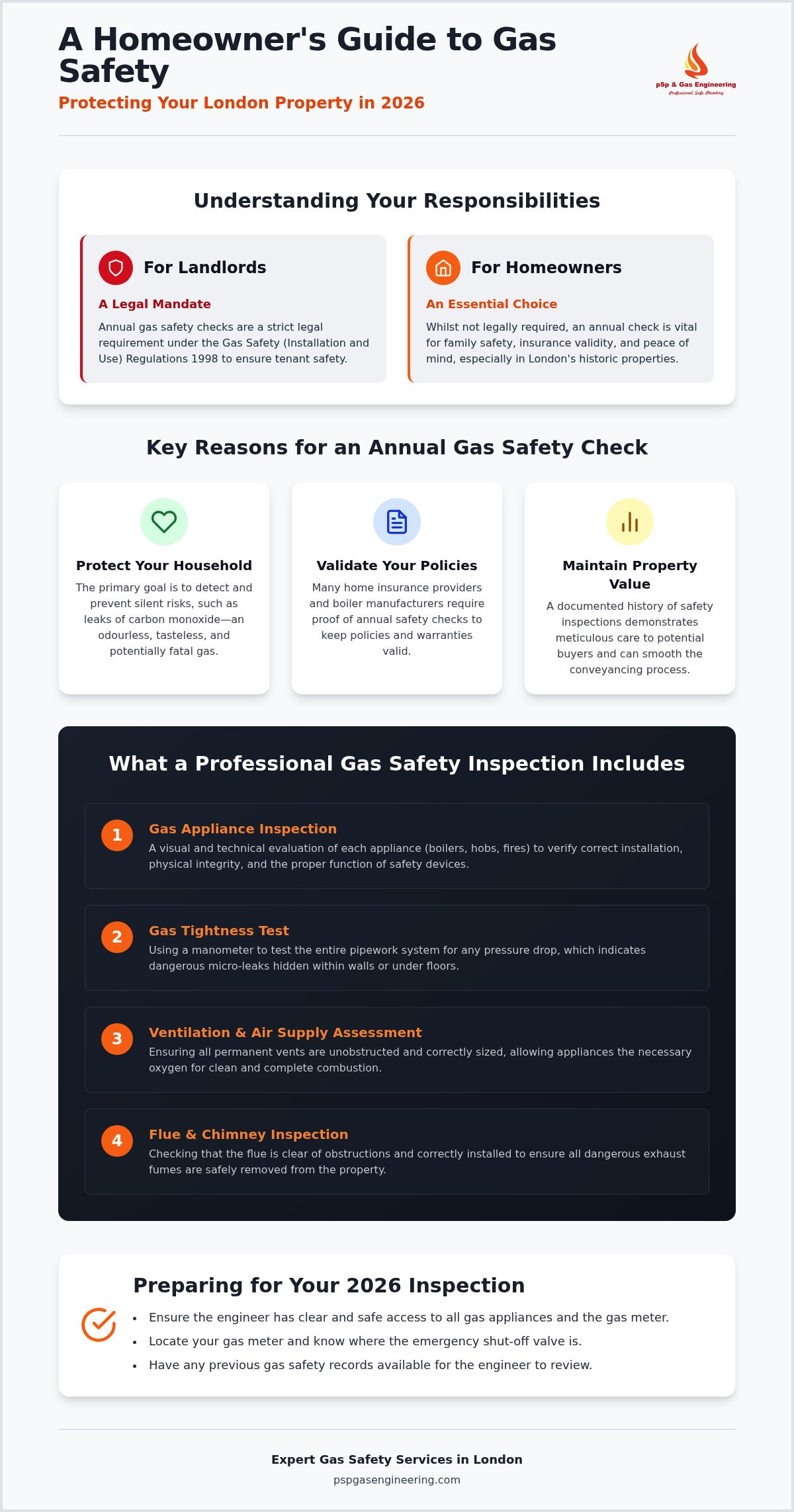
Preparing your property for a technical audit ensures that the process is as thorough as possible. To obtain your homeowner gas safety certificate London, you should first identify every gas appliance in your home. This includes your central heating boiler, gas hobs, ovens, and any decorative gas fires. Locating your gas meter is equally important, as the engineer needs to perform a tightness test at this point to verify the integrity of the entire pipework network. You should ensure the meter is easily accessible and isn't obstructed by storage or household items.
Whilst the engineer will conduct a deep technical analysis, you can perform a preliminary check for visible warning signs. Healthy gas flames should burn a crisp, steady blue. If you notice lazy yellow or orange flames, or if you see dark soot stains around the edges of an appliance, these are indicators of incomplete combustion. Additionally, verify that your carbon monoxide alarms are correctly positioned on every level of your home and that they respond to a test. These devices are your final line of defence, but they shouldn't be viewed as a substitute for a professional safety inspection.
Pre-Inspection Preparation Steps
Clearing the area around your boiler and under-sink pipework is a simple step that significantly aids the inspection process. If your boiler is located in a cupboard or attic, ensure there is a clear path and adequate lighting for the engineer to work safely. Gathering previous service records or installation manuals also provides valuable context for the technical assessment. Providing unobstructed access allows the engineer to move efficiently through the technical testing phases without unnecessary delays.
Identifying Immediate Red Flags
Recognising the early symptoms of a gas fault can prevent a domestic emergency. The most obvious sign is a "rotten egg" odour, which is an additive designed to make leaks detectable. You should also watch for pilot lights that frequently blow out or struggle to stay lit, as this often points to a ventilation or thermocouple issue. Excessive condensation on the inside of windows in rooms with gas appliances is another warning sign of poor air circulation and high humidity. If you notice any of these red flags, you should schedule a professional gas safety inspection immediately to protect your home and secure your homeowner gas safety certificate London.
Securing Your Home with PSP & Gas Engineering’s Expert Services
Based in Croydon and serving the wider London area, PSP & Gas Engineering provides a level of technical oversight that prioritises your family's safety above all else. London’s property landscape is uniquely challenging, often featuring complex Victorian chimney stacks and ageing pipework that demand a specialised approach. Our Gas Safe registered engineers are trained to look beyond the obvious, using advanced technical diagnostic skills to identify latent risks before they become domestic emergencies. This local expertise ensures that your property receives the meticulous attention it deserves, positioning us as a dependable safe pair of hands for your technical requirements.
We believe that a homeowner gas safety certificate London should be a comprehensive health check rather than a simple administrative exercise. Our engineers take immense pride in their workmanship, ensuring that every appliance is tested against the highest industry standards. By choosing a professional service with deep roots in the local community, you benefit from a team that understands the specific nuances of Greater London's diverse housing stock. Our 24/7 emergency assistance further ensures that your household remains protected, providing a constant safety net for your gas infrastructure.
A Detailed Approach to Gas Safety
Our methodology moves beyond the basic requirements of a standard check. We specialise in video flue and chimney inspections, a technical diagnostic tool that allows us to see inside concealed flue runs. This is particularly vital for London homeowners living in converted flats or terrace houses where flues may be shared or poorly routed. By providing clear, jargon-free explanations of our findings, we ensure you understand the health of your property’s gas system. This transparent reporting helps you maintain compliance with insurance standards whilst giving you total peace of mind regarding the safety of your appliances.
Booking Your 2026 Inspection
Booking your residential check is an essential step in your 2026 home maintenance schedule. Our team follows a methodical process, arriving on time and carrying out all necessary tests with minimal disruption to your day. You can expect a thorough evaluation of your boiler, hobs, and fires, followed by a detailed report that serves as a permanent record of your home's safety status. We handle the technical complexities so that you don't have to, ensuring your heating system operates at peak efficiency. Organise your homeowner gas safety certificate with PSP & Gas Engineering today to ensure your technical requirements are handled by a responsible and highly qualified professional.
Prioritising Professional Gas Safety for Your Household
Maintaining the technical integrity of your property is a continuous commitment that extends beyond simple aesthetics. By securing a homeowner gas safety certificate London, you move from passive assumption to active verification of your family's protection. We've explored the critical importance of annual inspections, the technical depth of professional diagnostics, and the specific preparation steps that ensure a smooth safety audit. These measures do more than satisfy insurance requirements; they provide the quiet confidence that your technical systems are operating at peak safety and efficiency.
At PSP & Gas Engineering, we offer a safe pair of hands for your property's complex gas infrastructure. Our Gas Safe registered engineers specialise in high-precision diagnostics, including video flue inspections, to ensure even the most concealed risks are identified. With 24/7 emergency support available across London, your safety remains our absolute priority. Book your expert residential gas safety check with our Gas Safe engineers to secure your home for the year ahead. Taking this proactive step today ensures a warmer, safer, and more secure environment for your household.
Frequently Asked Questions
Is a gas safety certificate a legal requirement for homeowners in London?
No, a homeowner gas safety certificate London is not a legal requirement for those who own and reside in their property. Whilst landlords are strictly mandated to provide an annual CP12 for tenants, resident owners are only encouraged to undertake these checks for safety. However, many residents choose to maintain an annual record to satisfy home insurance conditions and to provide documented evidence of maintenance during the property sale process.
How much does a homeowner gas safety certificate cost in 2026?
In 2026, the industry average for a gas safety certificate in London and the South East typically ranges from £80 to £150. These costs are influenced by the number of appliances being inspected, such as boilers, hobs, and fires. Many homeowners find that combining this inspection with their annual boiler service offers better value, often reducing the total cost compared to booking the two technical assessments separately.
How long does a residential gas safety check typically take?
A standard residential inspection usually takes between 45 and 90 minutes to complete. The exact duration depends on the size of your property and the number of gas appliances that require testing. An engineer will spend time performing technical diagnostics on each unit and conducting a full tightness test on your gas meter. Ensuring clear access to all appliances and the meter before the engineer arrives can help the process move efficiently.
What happens if my gas appliance fails the safety inspection?
If an appliance fails, the engineer is required to issue a warning notice and categorise the fault as either "At Risk" or "Immediately Dangerous." In the interest of safety, an appliance deemed immediately dangerous must be disconnected from the gas supply until repairs are made. Your engineer will provide a clear technical explanation of the failure and outline the specific remedial work needed to return the appliance to a safe operating condition.
Do I need a separate certificate for my gas fire and my boiler?
No, you do not need separate documents for each appliance in your home. A single homeowner gas safety certificate London will list every gas appliance that the engineer has inspected and tested. The report includes the specific technical results for your boiler, gas hobs, and fires on one comprehensive record. This consolidated approach makes it much easier to manage your household safety history and provides a clear overview for insurance purposes.
Can any plumber issue a gas safety certificate in London?
No, only an engineer who is currently listed on the Gas Safe Register is legally permitted to issue a gas safety certificate. Whilst many plumbers have general water pipework experience, they cannot work on gas appliances unless they hold the specific qualifications required by law. You should always ask to see an engineer’s Gas Safe ID card to verify their credentials and ensure they are qualified for the specific appliances in your home.
How often should I have my gas appliances checked as a homeowner?
It is highly recommended that you have your gas appliances checked every 12 months. This frequency aligns with the legal standards set for landlords and ensures that any wear and tear is identified before it becomes a hazard. Regular annual monitoring is the most effective way to prevent carbon monoxide leaks and maintain the long-term integrity of your pipework. Consistency in these checks also helps to preserve your manufacturer boiler warranties.
Will a gas safety check help reduce my energy bills?
Yes, a gas safety check can contribute to lower energy bills by ensuring your appliances are burning fuel as efficiently as possible. During the inspection, the engineer performs a flue gas analysis to check the combustion ratio. If an appliance is found to be burning gas inefficiently, adjustments can often be made to improve performance. This technical precision ensures you aren't wasting fuel, which helps to keep your household running costs under control.


