
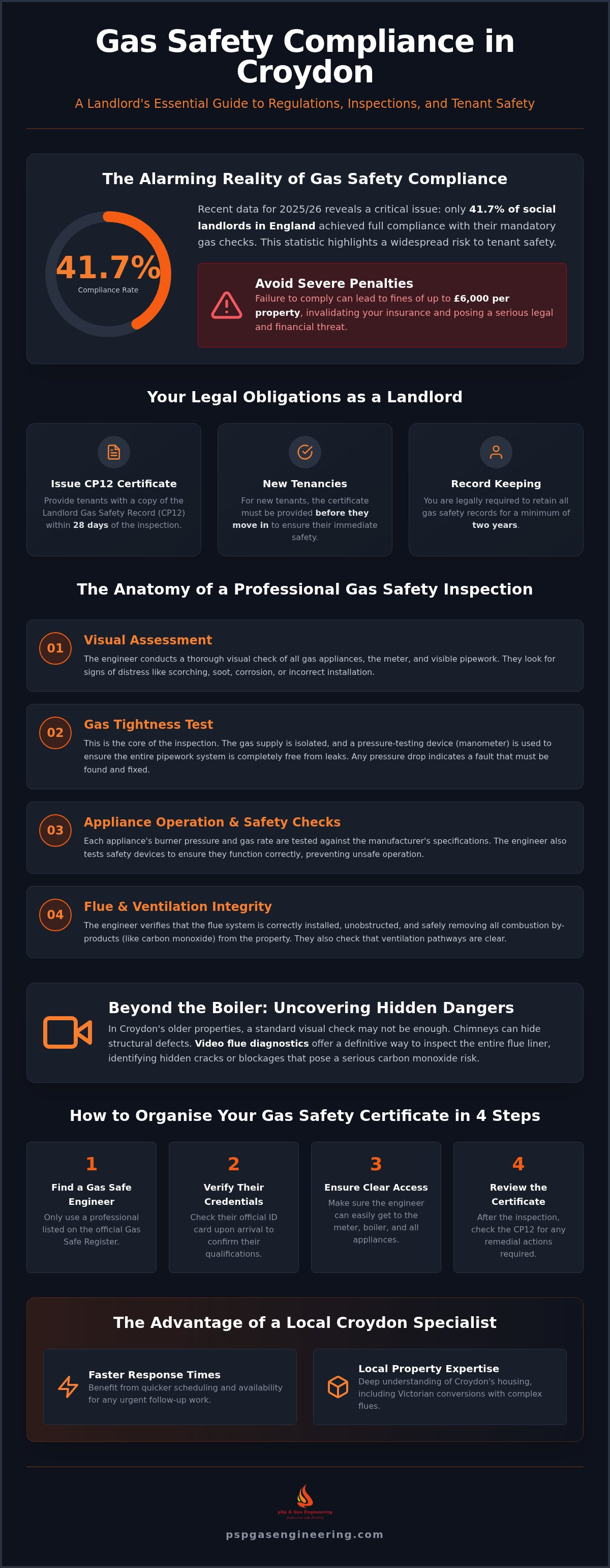
Recent data reveals that in 2025/26, only 41.7% of social landlords in England met full compliance for their mandatory gas checks. For private landlords and homeowners, the pressure to maintain standards is equally high, yet the process often feels buried under confusing technical jargon and the looming threat of £6,000 fines. Arranging a professional gas safety inspection in Croydon shouldn't be a source of stress or a mere clerical hurdle; it's a vital engineering safeguard for your property and your tenants.
You likely agree that your primary concern is the absolute safety of those living in your home, especially regarding the invisible risks of carbon monoxide. We've created this comprehensive guide to help you secure a valid CP12 certificate whilst ensuring your Croydon property remains fully compliant and safe. We will walk you through the essential steps of the inspection, explain what a qualified engineer looks for, and show you how to find a dependable local professional who treats your safety with the meticulous care it deserves. This approach ensures you gain total peace of mind that your technical requirements are being handled by a safe pair of hands.
Key Takeaways
- Understand your legal obligations under the Gas Safety (Installation and Use) Regulations 1998 to avoid severe penalties and ensure tenant security.
- Learn why a professional gas safety inspection in Croydon involves more than a boiler check, including essential gas tightness testing of all pipework.
- Discover how video flue diagnostics can identify hidden structural risks in older chimneys that standard visual assessments often overlook.
- Follow a simple four-step preparation guide to ensure your property is ready and your engineer’s credentials are fully verified.
- Recognise the value of local expertise for faster response times and a deeper understanding of specific property types across the Croydon area.
Understanding Gas Safety Requirements in Croydon for 2026
A professional gas safety inspection Croydon property owners arrange is far more than a cursory check of the boiler. It is a rigorous, mandatory assessment of the entire gas infrastructure within a building, covering every gas-fed appliance, the integrity of the pipework, and the effectiveness of the flues. While many people use the terms interchangeably, a safety inspection is distinct from a standard boiler service. A service focuses on the mechanical efficiency and longevity of a single unit; an inspection is a comprehensive safety audit designed to prevent catastrophic failures, gas leaks, and carbon monoxide poisoning.
For those managing rental properties, this process is governed by strict statutory requirements. Under the primary legislation, the Gas Safety (Installation and Use) Regulations 1998, landlords bear a strict responsibility to ensure all gas fittings and flues are maintained in a safe condition. Even for homeowners who aren't legally bound by these specific regulations, prioritising an annual check is the only reliable way to protect your family from the "silent killer" of carbon monoxide. Recent data from the Health and Safety Executive (HSE) shows that thousands of competence checks are now conducted on engineers annually to ensure these high standards are met across the UK.
Legal Obligations for Croydon Landlords
If you let a property in Croydon, you must provide your tenants with a copy of the Landlord Gas Safety Record (often called a CP12) within 28 days of the inspection being completed. For new tenancies, this record must be handed over before the residents move in. UK law also dictates that you must retain these records for a minimum of two years. Failing to meet these obligations isn't just a clerical error; it carries heavy penalties. Landlords who don't comply face fines of up to £6,000 per property, potential imprisonment, and the immediate invalidation of their landlord insurance policies. This makes the annual inspection a non-negotiable part of responsible property management.
2026 Safety Standards and Compliance
As we move through 2026, the Gas Safe Register has placed an increased emphasis on engineer competence and the rigorous testing of safety devices. Modern compliance now heavily features the placement and functionality of carbon monoxide (CO) alarms, which are a critical secondary line of defence. In Croydon, where many properties feature older Victorian or Edwardian architecture, "staying local" for your inspection is particularly beneficial. Local specialists understand the specific challenges of Croydon’s housing stock, such as the complex flue systems and shared chimneys found in converted flats. These older structures often require a more meticulous approach to ensure they meet the latest 2026 safety benchmarks and local building regulations.
The Technical Process: What Happens During Your Inspection?
A professional gas safety inspection Croydon homeowners book involves a systematic, multi-stage engineering audit. It begins with a thorough visual assessment of all gas appliances to identify obvious signs of distress, such as scorching, soot, or poor installation. This initial step ensures that every piece of equipment, from the central heating boiler to the kitchen hob, is physically sound before more invasive technical tests commence. A meticulous engineer will also inspect the gas meter and the visible pipework to ensure they are correctly supported and free from corrosion.
The core of the inspection is the gas tightness test. By isolating the supply at the meter, an engineer can verify that the property’s entire pipework system is free from leaks. If the pressure drops even slightly on the manometer, it indicates a breach that must be located and repaired immediately. This level of detail aligns with the official government guidance for landlords, which emphasises the necessity of maintaining gas fittings in a safe condition. Beyond the pipework, the engineer checks the burner pressure and gas rate against the manufacturer's data plate to ensure appliances are operating within their designed safety parameters. Finally, we verify that ventilation pathways are unobstructed and that the flue flow is sufficient to carry combustion products safely away from the home.
Appliance-Specific Safety Tests
Every appliance requires a bespoke testing protocol to ensure it remains a safe pair of hands in your home. For boilers, we meticulously assess the heat exchanger and the integrity of combustion seals to prevent carbon monoxide leakage into the living space. Gas fires require a smoke match test to confirm that the chimney pull is strong enough to remove toxic gases. In the kitchen, cookers and hobs are checked for stability and the presence of functioning flame failure devices. These safety components automatically cut the gas supply if the flame is accidentally extinguished, preventing a dangerous build-up of gas.
Addressing Croydon's Unique Property Challenges
Croydon's diverse housing stock presents specific technical hurdles that require local expertise. Victorian terraces in areas like Thornton Heath often feature shared flues, which require extra vigilance to ensure that combustion gases from one property are not leaking into another. In converted South London flats, managing gas meters and complex pipework runs often requires a specialist who understands the nuances of older building layouts. Pipework pressure testing is particularly critical in these older Croydon properties, where decades of settlement or previous DIY work may have compromised the integrity of the gas lines. If you are concerned about the safety of an older installation, booking a professional gas safety inspection provides the clarity and security you need.
Beyond the Boiler: Flue Integrity and Video Inspections
A thorough gas safety inspection Croydon landlords and homeowners invest in must look past the external casing of an appliance. While the boiler might appear to be functioning correctly, the flue system responsible for carrying away toxic exhaust gases is often the hidden weak point. A basic visual check from the hearth or the roofline cannot reveal the internal condition of the ducting. Cracks in the masonry, loose joints, or internal collapses can lead to dangerous "spillage" where carbon monoxide enters the living space rather than exiting the building. We treat flue integrity as a core pillar of gas safety, utilising precision tools to verify every inch of the exhaust path.
Our methodology aligns with the rigorous standards maintained by the Gas Safe Register, ensuring that no technical detail is overlooked. We look for specific red flags that standard assessments often ignore. These include staining on the walls near the chimney breast or a lack of "pull" during a smoke test. By identifying these issues early, we prevent the catastrophic failures that lead to emergency repairs or, worse, health risks for the occupants. This meticulous attention to detail is what defines a truly professional engineering service.
The Benefits of CCTV Flue Inspections
Video technology allows us to provide a level of certainty that was previously impossible without invasive building work. CCTV flue inspections are a non-destructive diagnostic tool; we can navigate the twists and turns of a chimney to spot bird nests, dislodged bricks, or crumbling pargeting. This is especially vital for the Victorian and Edwardian properties common in Croydon, where chimneys have often been modified or shared over decades. The digital footage we capture serves as a definitive record of safety, offering essential evidence for insurance providers or prospective buyers during a property transaction.
When is Flue Relining Necessary?
Relining becomes necessary when a chimney can no longer pass a pressure or integrity test. In many older South London homes, the original brickwork has become porous, allowing gases to seep into upper-floor rooms. We solve this by installing high-grade stainless steel liners, which are specifically designed to withstand the corrosive by-products of gas combustion. This process doesn't just fix a current leak; it future-proofs the installation. It ensures that your gas fire or boiler remains compliant with the latest safety regulations whilst providing a smooth, efficient path for all exhaust fumes.
How to Organise Your Gas Safety Certificate in 4 Steps
Securing a professional gas safety inspection Croydon landlords can rely on involves more than just a phone call. To ensure the process is efficient and the resulting certification is legally robust, property owners should follow a structured approach. Whilst the engineering work itself is highly technical, the preparation and administrative stages require your direct attention to avoid delays or failed assessments. By following these four essential steps, you can transition from a state of regulatory uncertainty to total peace of mind.
Step 1: Preparation and Access
Before the engineer arrives, the first priority is ensuring the environment is ready for a thorough technical audit. You must ensure that the gas meter is easily accessible and, if the property uses a prepayment meter, that there is sufficient credit to run all appliances at full capacity during testing. Engineers cannot complete a gas tightness test without a live supply. It is also vital to clear the space around the boiler, hobs, and any gas fires. If you are a landlord, notify your tenants at least 24 hours in advance to ensure the engineer can enter every room where a gas appliance or flue is located. This preparation allows the professional to focus entirely on safety rather than clearing clutter.
Step 2: Credential Verification
Verification of professional standing is the most critical safety check a property owner can perform. When the engineer arrives, always ask to see their Gas Safe ID card. You should check the front for the yellow 'Gas Safe' logo and an up-to-date expiry date. However, the reverse of the card is equally important; it lists the specific categories of work the individual is qualified to perform. An engineer might be qualified for boilers but not for gas fires or unvented cylinders. Choosing a local Croydon firm like PSP & Gas Engineering ensures a high level of accountability and the quiet confidence that your property is in the hands of a specialist who understands local building standards.
Once credentials are verified, the physical inspection begins. The engineer will conduct the combustion analysis and pressure tests we detailed previously, ensuring every appliance operates within safe tolerances. This is the stage where the technical expertise of the engineer is most visible, as they meticulously check for any deviations from manufacturer specifications.
The final step is the delivery and review of your Landlord Gas Safety Record, or CP12. You must review this document immediately to ensure all appliances are listed and any defects are clearly categorised. If an appliance is marked as 'At Risk' (AR) or 'Immediately Dangerous' (ID), the engineer will explain the necessary remedial actions to bring the property back into compliance. If you are ready to secure your property's safety, you can book your gas safety inspection Croydon today with our expert team.
Why Choose a Local Croydon Gas Safe Specialist?
Selecting a specialist for your gas safety inspection Croydon involves choosing between a faceless national booking platform and a dedicated local expert. While national aggregators offer scale, they often lack the nuanced understanding of Croydon's specific architectural landscape. A local specialist provides significantly faster response times, which is critical if an inspection identifies an immediate safety hazard that requires urgent attention. More importantly, you receive direct communication with the engineer who will actually step onto your property. This ensures that accountability is never diluted by a remote call centre or a complex administrative chain.
Our deep knowledge of property types in Thornton Heath, Purley, and Central Croydon allows us to anticipate technical challenges before they arise. For instance, the specific chimney configurations in Purley’s detached homes differ significantly from the compact flue systems found in Central Croydon's converted flats. By choosing a local expert, you are opting for a "safe pair of hands" that prioritises engineering quality and meticulous detail over high-volume scheduling. This methodical approach is the only way to ensure that every safety device and pipework joint is verified to the highest professional standards.
Personalised Service vs National Aggregators
When you book through a national platform, you often pay inflated fees that do not contribute to the quality of the engineering work. By dealing directly with a local firm, you bypass these administrative costs whilst building a long-term relationship with an engineer who understands your property's history. This continuity is invaluable for annual maintenance and future compliance. Supporting local Croydon businesses also ensures that investment remains within the community, fostering a network of reliable tradespeople who are genuinely invested in the area's safety standards and reputation.
Comprehensive Care from PSP & Gas Engineering
At PSP & Gas Engineering, we provide a total property solution that extends far beyond a simple certificate. If an inspection reveals a fault, we have the immediate capability to provide follow-up repairs or full boiler installations to restore your property's safety. Our dual expertise in plumbing and gas engineering means we can address complex leaks or system failures that a "certificate-only" inspector might overlook. We pride ourselves on offering transparent advice and free quotes for safety improvements, ensuring you never feel pressured into unnecessary work. Our goal is to provide the security and peace of mind that comes from knowing your technical requirements are managed by a truly responsible professional.
Securing Your Property's Safety and Compliance
Maintaining a safe home or rental property requires more than just meeting a legal deadline; it demands a commitment to technical excellence and thorough engineering. By understanding the rigour of the inspection process and the necessity of advanced diagnostics like CCTV flue checks, you move beyond mere compliance toward genuine security. Croydon's diverse architecture, from Victorian terraces to modern flats, requires this meticulous approach to ensure every appliance and shared chimney remains a safe pair of hands for your residents.
When you choose a local specialist, you ensure that your technical requirements are handled with the care and accountability they deserve. Our Gas Safe Registered Engineers are specialists in CCTV flue inspections and provide 24/7 emergency support to keep your property protected at all times. To ensure your building meets the highest standards for 2026 and beyond, Book your expert Gas Safety Inspection in Croydon today with PSP & Gas Engineering. Take this proactive step to secure your Landlord Gas Safety Record and enjoy the peace of mind that comes from true professional expertise.
Frequently Asked Questions
How much does a gas safety inspection cost in Croydon?
The cost of a gas safety inspection Croydon property owners arrange depends on the number of gas appliances requiring a technical assessment. A basic check covering just the gas meter and a single boiler is naturally more efficient than a full audit of a property with multiple gas fires and hobs. We recommend discussing your specific requirements with a local engineer to receive an accurate quote tailored to your property size.
Is a gas safety certificate a legal requirement for homeowners?
Homeowners aren't legally required to hold a Gas Safety Certificate under current UK regulations as this mandate applies specifically to landlords. However, prioritising an annual inspection is a critical safety measure to protect your family from the risks of carbon monoxide leaks. Many building insurance providers also expect regular professional maintenance as a condition of their coverage and valid claims.
How long does a gas safety inspection take for a standard three-bedroom house?
A standard inspection for a three-bedroom house typically takes between 45 and 90 minutes to complete thoroughly. This timeframe allows our engineers to perform the necessary gas tightness tests and individual appliance safety checks. If your property features complex flue systems or multiple gas fires, the process may take slightly longer to ensure every technical detail is meticulously verified.
What happens if my gas appliance fails the safety inspection?
If an appliance fails the inspection, the engineer will categorise the defect as either 'At Risk' or 'Immediately Dangerous'. In cases where a significant safety hazard is identified, the engineer is professionally obligated to disconnect the appliance for your safety until it is repaired. We will always provide clear, transparent advice on the necessary remedial work required to restore your property's compliance.
Can I get a gas safety certificate if I have a prepayment meter?
You can certainly obtain a certificate with a prepayment meter, provided there is sufficient credit on the meter when the engineer arrives. We must be able to fire all gas appliances at their maximum settings simultaneously to accurately test the gas pressure and flow rates. Ensuring your meter is topped up prevents the need for a return visit and additional call-out fees.
How often should I have my gas appliances checked in a commercial property?
Commercial properties must undergo a gas safety check every 12 months to comply with the relevant safety regulations. This annual requirement ensures that all commercial-grade appliances and pipework remain in a safe working condition for staff and the public. Regular checks are essential for maintaining a safe environment whilst protecting the business owner from potential legal liability and insurance issues.
Does the gas safety inspection include a boiler service?
A gas safety inspection Croydon landlords book is a regulatory safety audit and does not automatically include a full boiler service. Whilst the inspection confirms the unit is safe to operate, a service involves cleaning internal components and optimising mechanical efficiency for better performance. Many clients choose to combine these two procedures into a single visit to ensure both safety compliance and equipment longevity.
What is the difference between a Gas Safe engineer and a plumber?
A plumber primarily manages water-based systems such as taps, radiators, and drainage; however, they cannot legally work on gas appliances unless they are on the Gas Safe Register. A Gas Safe engineer has undergone specific training and rigorous assessment to handle gas pipework and combustion equipment safely. Always verify that your chosen professional holds the correct credentials on their ID card before they begin any gas-related work.


