

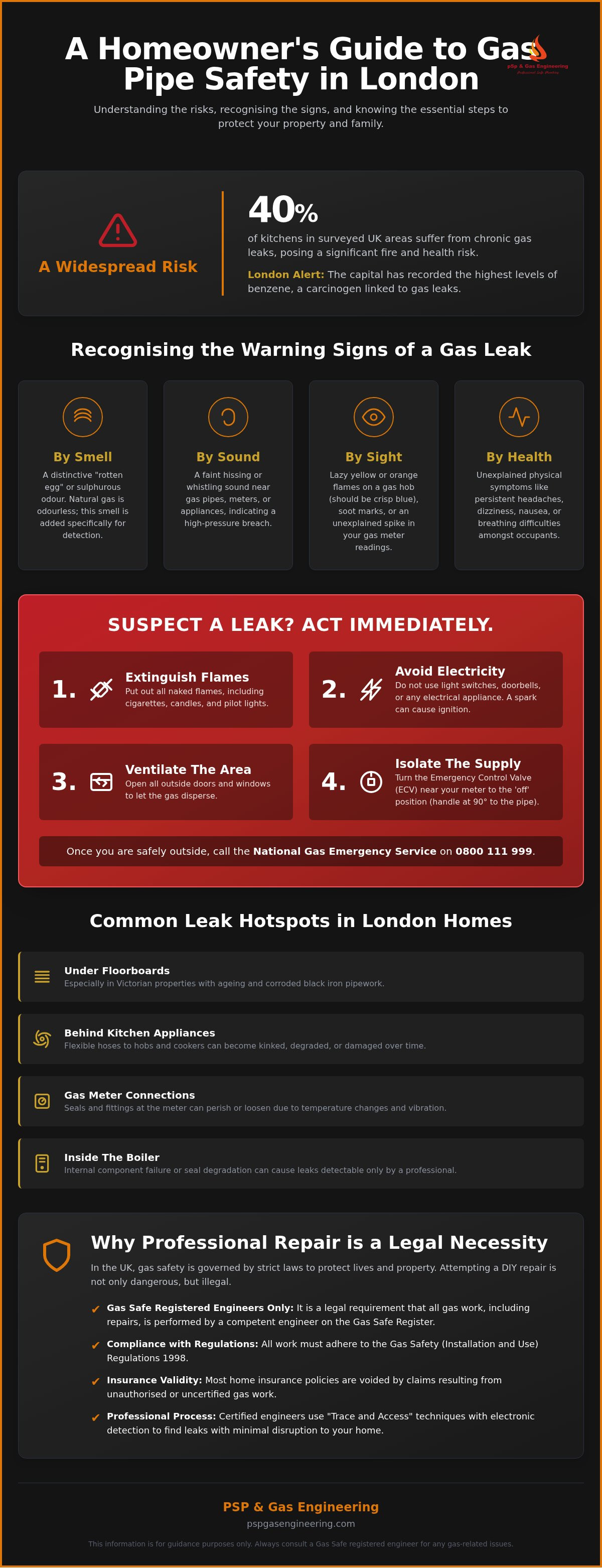
Did you know that a 2026 study found approximately 40% of kitchens in surveyed areas, including the UK, suffer from chronic gas leaks? For residents in the capital, the stakes are even higher, as the highest recorded levels of the carcinogen benzene have been identified right here in London. When you suspect a fault, securing a professional gas pipe repair London service is not just a matter of convenience; it's a critical safety requirement. Whether you're dealing with aging Victorian pipework or a modern system, addressing these hidden vulnerabilities is the only way to protect your property from the risks of fire or carbon monoxide.
It's natural to feel anxious about the potential for explosions or the hidden costs of "trace and access" work behind your floorboards. We understand that navigating the Gas Safe Register requirements and the mandatory IGEM/UP/1B Edition 4 standards can feel overwhelming. This guide will help you identify the early warning signs of a leak, explain the latest safety regulations, and show you how to organise a seamless repair with a qualified engineer. You'll learn how to secure the necessary compliance documentation whilst ensuring your home remains a safe, protected environment for your family.
Key Takeaways
- Learn to recognise the immediate signs of a gas leak, from the distinctive sulfurous odour to subtle acoustic indicators found near your meter or appliances.
- Understand the 2026 legal landscape and why every gas pipe repair London must be performed by a Gas Safe registered engineer to maintain insurance and landlord compliance.
- Discover the specific risks associated with aging infrastructure in Victorian properties, including why lead and iron pipes require modern replacements rather than temporary fixes.
- Gain clarity on the professional "Trace and Access" process, which uses electronic detection to locate leaks with minimal disruption to your property's structure.
- Explore how specialist engineers in Croydon apply technical precision and a safety-first approach to resolve complex gas system failures across Greater London.
Identifying Gas Pipe Leaks in London Properties
Natural gas is inherently odourless and colourless. To ensure it can be detected by the human nose, suppliers add a chemical called mercaptan, which creates the distinctive "rotten egg" or sulfurous smell. If you catch even a faint whiff of this odour, it's the primary indicator that you may require a professional gas pipe repair London service. Beyond the smell, you should listen for audible cues. A hissing or whistling sound near your gas meter cupboard or behind kitchen appliances often suggests a high-pressure breach in the pipework.
Visual indicators are equally telling. On a gas hob, you should always see a crisp, blue flame. If the flames appear "lazy" and yellow, or if you notice soot marks and scorching around the burner, it indicates incomplete combustion. This is a serious safety concern often linked to pipework issues or appliance faults. Similarly, keep an eye on your smart meter. An unexplained spike in gas consumption when your heating is off can point toward a slow, undetected leak within the system. Residents might also experience physical symptoms like persistent headaches, dizziness, or nausea, which are common signs of carbon monoxide exposure or gas inhalation amongst occupants.
Immediate Safety Steps: What to Do Now
If you suspect a leak, your priority is to secure the premises and prevent ignition. Follow these steps immediately before calling for assistance:
- Extinguish flames: Ensure all cigarettes, candles, and pilot lights are put out immediately.
- Avoid electricity: Don't flip light switches, use doorbells, or plug in appliances, as even a tiny spark can trigger an explosion.
- Ventilate: Open all windows and doors to encourage maximum ventilation and disperse the gas.
- Isolate the supply: Locate your Emergency Control Valve (ECV), usually found near the meter, and turn it to the "off" position; this is achieved when the handle is at a right angle to the pipe.
Once these steps are taken, you must leave the property and contact the National Gas Emergency Service (SGN in London) on 0800 111999. Following their safety check, any internal pipework issues must be addressed by a Gas Safe registered engineer in accordance with the Gas Safety Regulations 1998.
Common Locations for Leaks in London Homes
London's diverse housing stock presents unique challenges for gas infrastructure. In older Victorian and Edwardian properties, leaks are frequently found under floorboards where original black iron pipework has succumbed to decades of corrosion. Another common failure point is behind kitchen appliances, particularly where flexible hoses have been kinked or have degraded over time. We also frequently identify leaks at gas meter connection points, where seals can perish due to temperature fluctuations. Within the boiler itself, internal component failure can lead to leaks that are only detectable once the casing is removed by a professional whilst conducting a thorough inspection.
The Legal Framework for Gas Pipe Repair in the UK
Compliance with national safety standards is a legal necessity rather than a recommendation. In the United Kingdom, all work involving gas infrastructure is governed by the official Gas Safety (Installation and Use) Regulations 1998. These regulations mandate that any person performing a gas pipe repair London must be competent and registered with the Gas Safe Register. Attempting a DIY repair on gas lines is not only extremely dangerous but is a criminal offence under the Health and Safety at Work Act. Unauthorised work risks immediate physical danger and can lead to prosecution if safety is compromised.
The Gas Safe Register serves as the official licensing body, ensuring every engineer possesses the technical proficiency to handle volatile fuel systems. Beyond legal penalties, there are significant financial risks. Most home insurance providers explicitly state that any claims related to fire or gas leaks are void if the repairs weren't conducted by a certified professional. Engaging a specialist provides a "safe pair of hands" and ensures you receive the necessary documentation to prove your system meets current 2026 safety standards. If you're concerned about the integrity of your system, our team provides thorough Gas Safety Inspections to identify and resolve issues before they escalate.
Verifying Your Engineer's Credentials
It's your responsibility to confirm that your chosen engineer is qualified for the specific task at hand. Every Gas Safe registered professional carries an ID card. Always check the back of this card to ensure "Pipework" is listed under their valid competencies. You can verify a London business by entering their registration number on the Gas Safe Register website. For significant modifications, such as rerouting main lines, the engineer must also notify local Building Regulations. This ensures the work is recorded and compliant with structural safety codes.
Legal Responsibilities for Landlords vs Homeowners
While homeowners have a general duty of care to maintain a safe system, landlords face stricter statutory requirements. By law, owners of rental properties must secure a landlord gas safety certificate London every twelve months. This annual inspection must cover all pipework and appliances within the property. For those operating business premises, the requirements are equally stringent. A commercial gas safety certificate London is required to ensure the safety of employees and the public. Failing to maintain these records can result in heavy fines or imprisonment, making regular professional maintenance a cornerstone of responsible property management.
Common Gas Pipework Issues in Older London Housing
London’s architectural heritage is a source of pride, yet the aging infrastructure within Victorian and Edwardian terraces often presents complex engineering challenges. Many of these properties still contain original "black iron" pipework. Over several decades, moisture in floor voids causes these pipes to corrode from the outside in, leading to pinhole leaks that are difficult to detect without specialist equipment. When we conduct a gas pipe repair London, we frequently encounter these legacy systems nearing the end of their functional life.
Lead gas pipes represent another significant risk. Under current safety standards, lead pipework is considered obsolete. It is soft, prone to sagging, and can easily be damaged during minor building works. It's essential to understand that lead pipes must be replaced with modern copper or steel equivalents rather than repaired. This approach is reflected in the latest Health and Safety Executive guidance regarding gas infrastructure. We also frequently identify electrolytic corrosion. This occurs when gas pipes come into direct contact with other metal services, such as copper water mains or electrical conduits, in tight London ceiling voids. The resulting chemical reaction weakens the pipe wall over time. Additionally, mechanical damage remains a common issue. "Nail strikes" often occur during DIY floorboard renovations, where a misplaced screw or nail pierces a gas line hidden just beneath the surface.
Victorian and Edwardian Property Challenges
Older homes often feature hidden pipe runs embedded within lath and plaster walls, making access a delicate task. We often find oversized pipes originally designed for low-pressure coal gas that no longer meet modern pressure requirements for high-efficiency boilers. Historical "settlement" of these grand buildings can also place immense stress on rigid gas joints, leading to hairline fractures. Transitions from original lead to modern copper are frequent failure points because the two materials expand and contract at different rates. Our team specialises in navigating these period-specific quirks whilst ensuring the structural integrity of your home remains intact.
Modern Pipework Failures in New London Developments
Modern apartments aren't immune to issues. Corrugated Stainless Steel Tubing (CSST) is popular in new builds but can fail if it's not installed with the correct protective sleeving or earthing. Poorly supported copper runs in modern voids can lead to vibration-induced leaks over time. We also see inadequate ventilation in airtight apartment cupboards where gas meters are housed. This lack of airflow can allow a slow leak to reach dangerous concentrations far more quickly than in older, draftier properties. Whether you are in a contemporary Croydon apartment or a traditional South London house, a professional gas pipe repair London requires a nuanced understanding of these varying failure modes.
The Professional Repair Process: Trace, Access, and Fix
A professional gas pipe repair London follows a strict, step-by-step protocol to eliminate risk and restore system integrity. The process begins with a Gas Tightness Test, where a digital manometer is connected to the system to monitor pressure levels. If the manometer indicates a drop, it confirms that gas is escaping somewhere in the carcass. Engineers then employ electronic leak detectors, sensitive "sniffers" that detect gas traces in the parts per million, alongside Leak Detection Fluid (LDF). This fluid is applied to joints and fittings, where it creates visible bubbles at the exact source of the leak.
To pinpoint the fault, the engineer may isolate sections of the system by closing internal valves, allowing them to test individual runs of pipework. Once the leak is narrowed down, the repair is executed. This might involve precision soldering for copper pipes, threading for steel, or replacing damaged sections entirely. The final stage is a post-repair pressure test and system commissioning, ensuring every appliance is receiving gas at the correct working pressure and that the entire system is 100% leak-free.
Trace and Access: Finding the Hidden Leak
Finding a leak in a London home requires a "safe pair of hands" to avoid unnecessary damage to the property. We lead with non-destructive testing methods before considering more invasive actions like lifting floorboards. Thermal imaging cameras can identify temperature changes caused by gas escaping behind plasterwork, whilst acoustic sensors are used to "hear" leaks in deep-set pipework. These technologies are particularly important in London's period properties, where preserving original features is a priority. In existing gas installations, a permissible pressure drop is a minute, regulated loss of pressure allowed over a specific testing period, provided no smell of gas is present and the system meets all safety criteria.
Pipework Replacement vs Spot Repair
Executing a gas pipe repair London requires a nuanced understanding of both modern and heritage plumbing systems. The choice between a spot repair and a full replacement depends on the age and material of the gas carcass. A single leaking joint is often a straightforward fix, but if the pipework is heavily corroded or made of obsolete materials, a full re-run is the more secure option. It is often practical to review the boiler installation cost Croydon when upgrades are required, as modernising the pipework during a boiler change can be more cost-effective. If you are concerned about the safety of your system, you can organise a professional gas safety inspection to receive an expert assessment of your home's infrastructure.
Expert Gas Engineering and Pipework in Croydon
PSP & Gas Engineering brings a level of technical precision to gas pipe repair London that only a local, specialist firm can provide. Based in Thornton Heath, we understand the specific nuances of South London property layouts, from the sprawling Victorian terraces of Croydon to contemporary apartment complexes. Our approach is defined by professional calm; we recognise that a suspected gas leak is a high-stakes event for any homeowner. By prioritising methodical engineering over hasty fixes, we ensure that every repair is durable and compliant with the latest industry standards.
Crucially, we address the legal necessity for official documentation that many general contractors overlook. Every major pipework alteration or repair we conduct is backed by official Gas Safe documentation. This is not just a formality; it is a vital record for your home insurance, landlord compliance, and property history. In a landscape of tightening regulations, having a clear trail of professional certification is essential for any responsible property owner in the capital.
Comprehensive Safety Inspections
A gas pipe repair London should never be viewed as an isolated task. We believe in a holistic approach to gas safety, which is why we combine our pipework repairs with a full appliance safety check. This ensures your entire system is functioning correctly from the meter to the burner. Our team utilises specialised video inspection tools for flues and chimneys, allowing us to identify internal blockages or liner failures that traditional methods might miss. This thoroughness ensures your home meets the 2026 compliance standards, specifically the updated IGEM/UP/1B Edition 4 requirements for tightness testing. We don't just fix the immediate leak; we fortify your system against future vulnerabilities.
Booking Your Repair in South London
Managing your gas infrastructure shouldn't be a source of anxiety. For planned upgrades or modernising aged pipework, we provide clear, transparent quotes to help you organise your home maintenance effectively. However, we also recognise that emergencies don't wait for business hours. Our 24/7 emergency response service is available across Croydon and Greater London to address urgent leaks the moment they are detected. We maintain a "safe pair of hands" philosophy for all gas engineering work, ensuring that technical expertise and resident welfare are always at the forefront of our service. Whether you require a routine safety inspection or an urgent repair, our Thornton Heath team is ready to restore your peace of mind.
Securing Your Home with Professional Gas Engineering
Maintaining a safe gas system requires a proactive approach to both emergency faults and long-term infrastructure health. Whether you're navigating the complexities of Victorian pipework or ensuring your modern apartment meets the latest 2026 compliance standards, the priority remains the same: protecting your property and family. By understanding the signs of a leak and the legal necessity of professional certification, you can manage your home's gas system with confidence and peace of mind.
When you require a gas pipe repair London, choosing a local specialist ensures that high-stakes technical tasks are handled with the precision they deserve. Our team at PSP & Gas Engineering provides a "safe pair of hands" for residents across Croydon, Thornton Heath, and Greater London. As Gas Safe Registered Engineers (#526715), we offer 24/7 emergency assistance to resolve urgent leaks and conduct thorough safety inspections that keep your system running efficiently.
Book a Gas Safe engineer for your pipe repair or inspection with PSP & Gas Engineering today to ensure your home remains leak-free and fully compliant. Rest assured that your safety and the integrity of your property are our primary commitments.
Frequently Asked Questions
How much does it cost to repair a gas pipe leak in London?
The cost for a gas pipe repair London is influenced by the time required for trace and access work and the materials needed for the fix. Industry data suggests UK repairs typically range from £77 to £920; however, London's operational costs often place repairs at the higher end of this scale. Emergency call-out fees and out-of-hours service also impact the final total. We provide transparent, project-based fees for all our engineering work.
Can any plumber repair a gas pipe in the UK?
Legally, only engineers on the Gas Safe Register are permitted to work on gas infrastructure. While many plumbers handle water systems, they cannot touch gas lines unless they hold the specific Pipework competency. You should always verify an engineer's ID card before work begins. In Croydon, our registered specialists ensure every repair meets the mandatory UK safety standards, providing the safe pair of hands required for high-stakes technical tasks.
How long does a typical gas pipe repair take?
A standard repair typically takes between two and five hours to complete. This duration includes the initial tightness testing, the time spent locating the leak, and the actual physical repair. If the pipework is buried deep within the structure of a Victorian home, the trace and access phase may extend the timeframe. We prioritise methodical work to ensure the system is perfectly sealed before we restore your gas supply and commission your appliances.
What is a 'Gas Tightness Test' and why is it necessary?
A Gas Tightness Test is a regulated safety check that uses a manometer to measure pressure within your gas carcass. It is necessary to confirm that no gas is escaping from any part of the system. Following the mandatory IGEM/UP/1B Edition 4 standards introduced in 2026, this test is a critical component of any inspection. It provides a definitive, data-driven confirmation that your property is safe for continued gas use.
Do I need a new Gas Safety Certificate after a pipe repair?
Landlords are legally required to obtain a new Landlord Gas Safety Record (LGSR) if a repair alters the system's integrity. For homeowners, while a full certificate isn't always mandatory for minor joint fixes, we recommend receiving official documentation for your records. This paperwork is essential for home insurance validity and is often requested during property surveys. We provide official Gas Safe certification for all significant gas pipe repair London projects we undertake.
Will my gas be turned off whilst the repair is being carried out?
Your gas supply will be isolated at the Emergency Control Valve (ECV) for the duration of the work. This is a non-negotiable safety requirement that allows the engineer to perform pressure tests and safely solder or thread new pipework. Whilst this causes a temporary loss of heating and cooking facilities, it's a vital step in ensuring the repair is conducted without risk to the occupants or the property's structure.
Is it possible to repair a gas pipe without lifting floorboards?
Repairs can be conducted without lifting floorboards if the leak is located at an exposed appliance connection or within a meter cupboard. However, if our electronic sensors identify a leak within a floor void, we may need to remove specific sections of flooring to reach the pipework. Our Thornton Heath engineers use precision tools to identify the exact location of the fault, which helps us minimise any disruption to your home's original features.
What should I do if I smell gas but my carbon monoxide alarm hasn't gone off?
You must follow emergency procedures immediately because carbon monoxide (CO) alarms are not designed to detect raw natural gas. Natural gas is an explosion risk, whereas CO is a poisonous byproduct of incomplete combustion. If you smell the distinctive rotten egg odour, you should turn off your gas at the meter, open all windows, and evacuate the building. Contact the National Gas Emergency Service (SGN) once you're safely outside the property.


