

If you’re wondering what is included in a full boiler service, it’s reasonable to want clear answers about what an engineer will inspect, clean and test, especially if the appointment seems brief. A service is about assessing the boiler’s condition and operation, not simply getting the heating running again.
A full service is a model-specific maintenance and safety check, not a promise that every fault will be repaired or that no problem can develop later. It’s also different from a landlord gas safety check, which has a distinct purpose. Knowing what each visit covers can help you understand the engineer’s findings and any recommended next steps.
This 2026 checklist explains the checks commonly carried out, including inspection of boiler components, cleaning of key parts and tests relating to gas pressure, combustion and the flue. It also outlines how a service differs from a repair or gas safety check, and what to expect from the written record afterwards. Gas work should be carried out by a Gas Safe registered engineer, who can explain the findings and recommendations.
Key Takeaways
- To understand what is included in a full boiler service, look for a model-specific assessment guided by the manufacturer’s instructions.
- Typical checks may cover the boiler’s condition, key components and safe operation, but the exact procedure can vary by appliance.
- A boiler service and a landlord gas safety check have different purposes, scopes and paperwork.
- Make the boiler and relevant controls accessible before the appointment, then review the engineer’s findings and any recommended next steps.
- A service record documents the checks carried out; it isn’t a guarantee against future faults or a substitute for the correct safety certificate.
What is included in a full boiler service and its purpose?
A full boiler service is a professional assessment of the boiler’s condition and operation, carried out using the procedure relevant to that appliance. The engineer checks whether accessible components and the boiler’s operation show signs of wear, damage or another concern that may need attention. The precise checks depend on the boiler type, model and manufacturer’s instructions, so there isn’t one universal checklist that applies in exactly the same way to every home.
A full boiler service is a model-specific inspection and assessment of a boiler’s condition and operation. It can identify concerns, but it cannot guarantee fault-free operation in future. Servicing is a considered maintenance step, not a promise that a boiler will never develop a fault or need repair.
Boilers transfer heat to water for heating and, depending on the appliance, domestic hot water. A general overview of how a boiler works can help explain why its components need to be assessed during a service. The engineer’s procedure, however, should be based on the appliance itself rather than a generic description.
Why a boiler service is more than a quick visual check
A visual inspection can reveal obvious signs such as damage, leaks or deterioration, but appearance alone doesn’t show how the boiler operates. A service may also involve appropriate checks and tests of accessible components and boiler operation, following the relevant manufacturer instructions. This gives the engineer a more informed view of the appliance than a visual check alone.
Inspection and testing are not the same as repair work. If a check identifies a fault, a worn component or a part that needs replacing, that work is separate from the routine assessment. The engineer should explain the finding and the recommended next step, so you can distinguish what was checked from any additional work proposed or carried out.
Which boilers need a model-specific service procedure?
Combi, system and regular boilers differ in how they provide heating and hot water, and their internal layouts are not identical. Even boilers in the same broad category can have different designs and service requirements. A checklist that describes one appliance shouldn’t automatically be treated as the correct procedure for another.
The manufacturer’s instructions guide which service checks apply to a specific boiler. The procedure may also vary by fuel type, so a single list cannot accurately cover every make, model and appliance. Treat a general checklist as an outline of typical checks, not a guarantee that every item applies to your boiler.
The purpose is to assess the appliance carefully and identify concerns that may require attention. A service can’t predict every future fault, and it shouldn’t be presented as a guarantee of continued operation. Gas work should be carried out by a Gas Safe registered engineer. A clear explanation of the checks and findings helps you understand what the assessment tells you and where its limits lie.
Full boiler service checklist: the checks an engineer may carry out
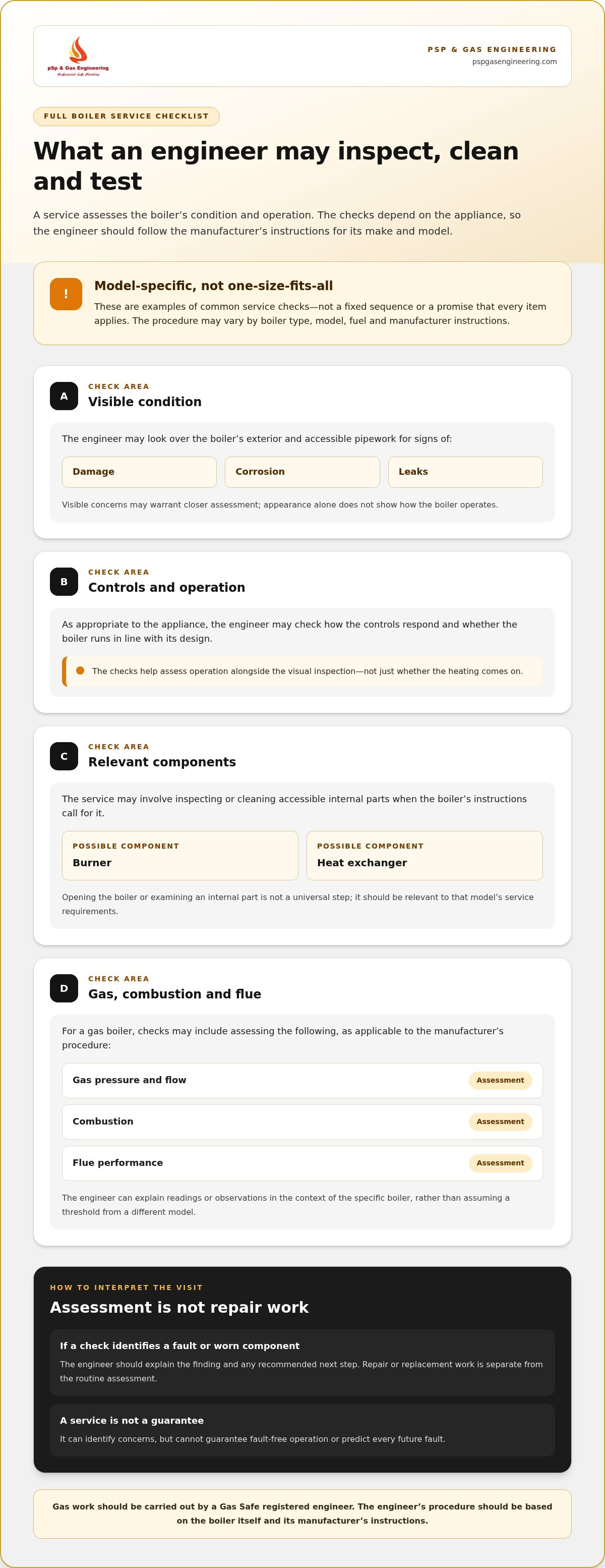
A service checklist is a guide to common checks, not a fixed sequence that applies to every appliance. The engineer follows the boiler manufacturer’s service instructions, which set out the relevant inspection, tests and maintenance for that make and model. This keeps the assessment specific to the appliance rather than relying on a one-size-fits-all routine.
Boiler service checks must be model-specific because the correct inspection and tests depend on the appliance’s design and manufacturer instructions. The examples below show what an engineer may assess and why each check matters. Not every item will apply to every boiler, and the engineer may carry out checks in a different order.
Visual inspection, controls and accessible components
The engineer may inspect the boiler’s exterior and visible pipework for signs such as damage, corrosion or leaks. These observations can reveal visible concerns that might warrant closer assessment. Controls and boiler operation may also be checked as appropriate to the appliance, helping establish whether it responds and runs as expected.
Depending on the manufacturer’s procedure, the service may include inspecting or cleaning accessible internal parts. For example, checks or cleaning involving the burner or heat exchanger may be part of a comprehensive gas boiler service where the appliance instructions call for them. Opening the boiler or examining an internal component isn’t a universal step, so it should relate to the particular model and its service requirements.
Combustion, flue and operational checks
For a gas boiler, checks may include assessing gas pressure and flow, combustion and flue performance, as applicable to the manufacturer’s procedure. These checks help the engineer evaluate how the appliance is operating and whether combustion products are being discharged as intended. The engineer can explain readings or observations in the context of the specific boiler, rather than applying an assumed threshold from a different model.
Typical checks may include:
- Visible condition: Looking for signs of damage, leaks or corrosion around the boiler and accessible pipework.
- Controls and operation: Checking the appliance’s response and operation in line with its design.
- Relevant components: Inspecting or cleaning parts such as the burner or heat exchanger where the instructions specify this.
- Combustion and flue: Assessing safe operation and flue performance using the checks applicable to that appliance.
These checks are an assessment, not a promise that every fault will be found or that a fault won’t develop afterwards. If an inspection identifies a concern, the engineer should explain what was observed and distinguish any recommended repair or replacement from the service checks themselves. That makes it clearer what the visit covered and what may need separate attention.
For a boiler service in Croydon, PSP & Gas Engineering carries out gas work through Gas Safe registered engineers. Find out more about gas engineering services and professional support across Greater London.
Boiler service vs gas safety check: what is the difference?
A boiler service and a landlord gas safety check are separate tasks, even though both relate to the safe operation of gas equipment. A service assesses the boiler’s condition and operation, following its service procedure. A gas safety check focuses on whether relevant gas appliances and flues are safe. One visit may involve safety-related checks, but a service should not automatically be treated as meeting a landlord’s certification responsibilities.
| Comparison | Boiler service | Landlord gas safety check |
|---|---|---|
| Purpose | Assess the boiler’s condition and operation, and identify concerns that may need attention. | Check the safety of relevant gas appliances and flues in a rental property. |
| Scope | Centred on the boiler, with checks guided by its type, model and manufacturer instructions. | Focuses on gas safety for relevant appliances and flues, rather than a full maintenance assessment of the boiler. |
| Audience | Homeowners and others arranging maintenance for a boiler. | Landlords meeting their gas safety responsibilities for rented accommodation. |
| Typical paperwork | A service record or findings may be provided; this is not automatically a landlord gas safety record. | A landlord gas safety record, commonly called a CP12, documents the gas safety check. |
What a boiler service is intended to assess
A service looks at the boiler under its model-specific procedure. The engineer may check relevant components and operation, then explain any signs that warrant further investigation. If a fault is identified, repair work or replacement parts are separate from the routine checks and should be explained as additional work.
The written findings relate to the service carried out. They don’t, by themselves, constitute the landlord gas safety record required for a rented property. Keep the purpose of the visit in view: a boiler service is a maintenance assessment, not automatic certification of every gas appliance and flue in a property.
What a landlord gas safety check and record cover
UK landlords have a separate responsibility to arrange gas safety checks for relevant appliances and flues, with the checks carried out by a Gas Safe registered engineer. A landlord gas safety record documents the outcome of that check. It is not a record of every maintenance task or a detailed service history for the boiler.
Keep the two records distinct. A service record can show what was assessed during boiler maintenance, while the landlord gas safety record documents the relevant safety check. The right paperwork depends on the task arranged, and a routine boiler service should not be assumed to replace landlord certification. For rented-property responsibilities and documentation, see the landlord gas safety certificate guide.
Before, during and after a boiler service: a homeowner checklist
A little preparation can make the appointment more straightforward and help you get a useful explanation of the findings. Keep the boiler and relevant controls accessible, note anything unusual you’ve noticed, and set aside a few minutes afterwards to review the record and any recommended next steps.
Before the appointment: prepare access and information
- Clear access: Make sure the engineer can reach the boiler safely, along with relevant controls such as the thermostat or programmer. Move stored items that obstruct access, but don’t remove boiler panels or attempt to inspect internal parts yourself.
- Gather useful records: If they’re readily available, have the appliance manual, previous service records or details of earlier work to hand. These can provide useful context about the boiler’s history.
- Note changes: Write down any unusual operation, noises, visible leaks or changes you’ve noticed. A clear example, such as when the issue occurs or which control was in use, can help you describe your concern accurately.
During the visit: share concerns and understand the process
Tell the engineer about any changes before the checks begin. You don’t need to diagnose the cause; simply describe what you’ve observed and when it happens. The procedure will depend on the appliance, so the checks carried out may reflect its type, model and manufacturer instructions.
If you’re unsure whether an issue is part of the routine service or needs separate attention, ask for the distinction to be explained. A service assesses the boiler, while further investigation, repairs or replacement parts may be additional work. A clear explanation helps you understand what is being checked and what, if anything, is being recommended.
After the visit: review and keep the findings
Read the written findings rather than filing them away straight away. If a technical term or recommendation isn’t clear, ask the engineer to explain it in plain language. Check that you understand which service checks were completed and whether any concern needs follow-up.
- Separate checks from recommendations: Note what the engineer assessed, what was found and which items are proposed as further investigation or repair.
- Keep the record: Store the service record with previous boiler paperwork. It can help you track maintenance and provide useful information for future warranty enquiries, though it doesn’t guarantee that a warranty is valid.
- Consider wider obligations: A boiler service record isn’t a substitute for other required property documentation. Where broader gas safety responsibilities apply, consult this Gas Safe compliance checklist.
For a clearly explained, safety-focused boiler service in Croydon, PSP & Gas Engineering carries out gas work through Gas Safe registered engineers serving Croydon and Greater London. You can find out more about arranging a boiler service.
Arrange a professional boiler service in Croydon
A useful boiler service starts with the right foundations: a Gas Safe registered engineer, checks guided by the appliance’s manufacturer instructions, and a clear explanation of the findings. This approach helps you understand what the visit covered, what concerns were observed and whether further work has been recommended. It doesn’t mean every boiler has the same checklist or that servicing can prevent every future fault.
PSP & Gas Engineering provides gas engineering across Greater London, including Croydon. The company’s gas work is carried out by Gas Safe registered engineers. If you’re considering what is included in a full boiler service, expect the assessment to be specific to your boiler rather than a generic set of checks applied identically to every appliance.
What to expect from a safety-focused local service
A methodical appointment focuses on the appliance and the service procedure that applies to it. The engineer assesses relevant aspects of its condition and operation, then explains any observed concerns in straightforward terms. If further investigation or a repair is recommended, you should be able to distinguish that next step from the checks completed during the service.
Before the visit, make the boiler and relevant controls accessible, and have any previous service records available if you can. You can also note unusual operation to describe to the engineer. These details provide useful context, while the appliance’s make and model guide the applicable checks. Afterwards, review the findings and keep the written record with your other boiler documents.
When a service identifies a flue concern
A suspected flue issue may need specialist assessment beyond routine servicing. The engineer can explain what has been observed and what further attention is recommended, without treating a service as a substitute for work needed to address a specific concern. Where the issue involves the flue, professional flue relining services may be relevant.
Use the findings to understand the next steps, not as a guarantee that no fault will develop later. A service record documents the assessment carried out; it doesn’t mean recommended repairs have been completed or that every part of a heating system has been certified.
For homeowners in Croydon, choosing an engineer who explains the checks and findings clearly makes it easier to understand the visit and any follow-up recommendations. Keep the boiler model and any service history handy when arranging an appointment. Arrange a boiler service with PSP & Gas Engineering for professional, safety-focused gas engineering in Croydon and Greater London.
Make your next boiler service an informed step
Knowing what is included in a full boiler service helps you approach the appointment with realistic expectations. Use the findings to understand the boiler’s current condition and decide how to handle any recommended follow-up. A service is a point-in-time assessment, not a guarantee against future faults, so keep the record and note any changes in how the appliance operates between visits.
For rented properties, keep maintenance records distinct from any gas safety documentation required for the property. If an engineer identifies a concern, ask for a clear explanation of what was observed and which next steps relate to further investigation or repair. That gives you a practical basis for planning, rather than leaving you to interpret technical notes alone.
PSP & Gas Engineering provides gas engineering, gas safety inspections and boiler installations in Croydon and across Greater London. Gas work is carried out by Gas Safe registered engineers. Arrange a professional boiler service with PSP & Gas Engineering and take the next step towards understanding your boiler’s condition.
Frequently Asked Questions
How often should a gas boiler be serviced?
A gas boiler is generally serviced annually, following the appliance manufacturer’s guidance. Regular servicing provides an opportunity to assess its condition and operation, but it can’t guarantee that a fault won’t develop between visits. If your boiler is covered by a manufacturer’s warranty, check its terms, as an annual service may be a condition of cover. Landlords also have separate legal gas safety responsibilities for relevant appliances and flues in rented properties.
How long does a full boiler service take?
The time required varies with the boiler’s make, model, condition and access, so there isn’t one reliable duration for every appointment. A straightforward service may differ from a visit where the engineer needs to investigate an unexpected concern or explain recommended follow-up work. Keep the route to the boiler and its controls clear, and allow time after the checks to discuss any findings before the engineer leaves.
Does a boiler service include cleaning the boiler?
Cleaning may be included where the appliance’s service instructions call for it, but that doesn’t mean every boiler is opened or every internal part is cleaned at every visit. The work should follow the requirements for your particular model. If cleaning is recommended beyond the routine procedure, ask which component needs attention and whether it is part of the service or separate work.
Will a boiler service keep my warranty valid?
An annual service may be required to maintain a boiler warranty, but the exact conditions depend on the manufacturer and warranty terms. Check the documentation for the required service interval, who must carry out the work and what records you need to retain. Keep service paperwork with proof of installation and any previous warranty correspondence, so you can refer to the relevant dates if you later need to make a claim.
Can a boiler service identify a fault that needs a repair?
Yes. A service may reveal signs of a fault or a component that needs further investigation. For example, an engineer may identify an irregularity during an operational check that requires diagnosis beyond the routine service. Ask what was observed, what further work is recommended and whether the boiler can continue to be used in the meantime. A service can identify concerns, but it can’t predict every fault that may occur later.
What happens if an engineer finds a safety concern during a boiler service?
The engineer should explain the concern and the next steps clearly. Depending on what has been found, they may advise further investigation or recommend that the appliance isn’t used until the issue has been addressed. Follow the specific safety advice given, and make sure you understand whether any repair is required before normal use resumes. Keep the findings with your service records, particularly if another engineer needs to review the issue.
Is a boiler service required when selling a house?
A boiler service is not generally a legal prerequisite for selling a home, but a buyer may ask about the appliance’s maintenance history. A recent service record can help show what was assessed and when, although it isn’t a guarantee of the boiler’s future condition or a substitute for required landlord gas safety documentation. If you’re preparing a property for sale, gather available boiler paperwork so it’s ready to share during enquiries.


