

The most advanced heating system isn’t automatically the right one for your family home. The best heating system for a family home UK households can choose depends on the property’s insulation, layout and heat demand, as well as how your family uses each room.
It’s understandable to be unsure whether a heat pump could work in an existing home or how disruptive a change might be. This guide compares gas boilers, heat pumps and other common options, outlining how they work and what to consider before choosing. You’ll learn how insulation, radiators, hot-water needs and space for equipment can affect the decision. In 2026, there’s no ban on installing a new gas boiler in an existing home, so the right choice comes down to the property and your priorities. If you’re considering a boiler installation in Croydon, start by understanding what your home needs. A correctly specified boiler, professionally fitted and safety commissioned by Gas Safe registered engineers, remains an option for suitable properties.
Key Takeaways
- The best heating system for a family home UK residents choose depends on the property, its heat demand and household priorities.
- Compare boilers, heat pumps and electric heating as whole-home systems, and consider how each fits your existing setup and daily routine.
- Record room use, hot-water demand, comfort issues and planned renovations to make your home assessment more useful.
- A heat pump isn’t automatically the right choice for every existing home. Compare suitable options before deciding whether to replace your current system.
- For a gas boiler installation in Croydon, PSP & Gas Engineering provides system design, fitting and safety commissioning through Gas Safe registered engineers.
Best heating system for a family home UK: what should you prioritise?
The best heating system for a family home UK households can choose is one that suits the property’s heat demand and the family’s priorities. Look beyond headline claims: comfort, fuel access, the existing heating system and any planned improvements all affect which options are practical.
This guide compares central heating systems in the UK, which provide warmth across the property, rather than portable heaters or appliances intended for one room. No system is automatically best for every family. A well-insulated home with a consistent routine may have different needs from a draughty house where rooms are occupied at different times.
What does a family home need from its heating system?
Start with the outcome you want: comfortable warmth in the rooms your household uses, at the times you use them, plus enough hot water for daily routines. A home with several regularly occupied bedrooms, bathrooms and living spaces may have different demands from one where some rooms are rarely heated. Note who is usually at home during the day and when hot-water use is busiest.
Heat demand is not the same as a system’s rated output. Heat demand is the heat a home needs to stay comfortable. Rated output is the system’s capacity to deliver heat. Choosing by output alone, without considering the building and how it’s used, can overlook what the household actually needs. A family that wants quick warmth in selected rooms may also prioritise different controls and routines from one that heats most rooms throughout the day.
Which property details shape the choice?
Insulation, draughts, floor area and the home’s general condition affect how readily it loses heat. Existing radiators, pipework and controls matter too: they distribute and manage heat around the property. Make a note of persistent cold spots, rooms that take longer to warm and parts of the system that don’t meet your household’s needs.
Consider planned improvements alongside the heating decision. If you intend to upgrade insulation, replace windows or alter the layout, the home’s future heat requirements may differ from its current ones. It’s more useful to assess the property as a whole than to choose a system simply because it’s popular or appears suitable on paper.
Before comparing options, make a short household record:
- Which rooms are used regularly, and at what times?
- Where does the home feel too cold or difficult to heat?
- When does the household need hot water, and how often?
- What fuel is available, and which radiators, pipework and controls are already in place?
- Are renovations or energy-efficiency improvements planned?
These details provide a practical starting point. They help separate what the family needs from what the property can support, so you can compare systems against real household requirements instead of assuming one technology suits every home.
How boilers, heat pumps and electric heating work in UK homes
Heating systems differ in how they generate warmth, distribute it around the home and provide hot water. Understanding these differences helps you compare practical options, rather than treating every boiler type as a separate fuel or assuming one technology suits every property.
Gas boiler: Burns gas to heat water, which circulates through radiators or other wet central heating emitters. Depending on the setup, hot water may be produced on demand or stored.
Air-source heat pump: Transfers heat from outdoor air into the home’s heating system. It can provide space heating and, in a suitable configuration, hot water.
Direct electric heating: Uses electricity to produce heat in individual heaters, rather than heating water for a wet central heating circuit.
Oil or LPG heating: Uses oil or liquefied petroleum gas to fuel a boiler-based system. These options may be relevant when a home’s fuel access affects what can be considered.
How do gas boilers and heat pumps deliver heat?
A gas boiler burns fuel to heat water. The water travels through pipework to radiators, warming rooms, and the system can also provide hot water. A combi boiler heats domestic hot water on demand, while a system boiler works with a hot-water cylinder to store it. These are different gas-boiler arrangements, not separate energy sources.
An air-source heat pump takes heat from outdoor air and transfers it into the home’s heating system. Both options need appropriate design and controls, but they operate differently. How well either suits a particular home depends on the system setup and property conditions, so general claims about performance or savings shouldn’t replace an assessment.
Where do electric, oil and LPG systems fit?
Direct electric heating produces warmth at the heater, rather than distributing hot water through radiators as a wet central heating system does. This distinction matters if your household wants to heat several rooms and meet hot-water needs through one coordinated setup. Oil and LPG boilers may be relevant when the property’s fuel access shapes the available options.
Compare each option on the same points:
- Heat source: gas, outdoor air, electricity, oil or LPG.
- Home distribution: wet pipework and radiators, or heat produced directly in individual rooms.
- Hot water: whether it is heated as needed, stored or handled separately.
- Practical dependencies: existing equipment, controls, fuel access and the property’s condition.
This framework helps you identify which systems are worth comparing further. The best heating system for a family home UK households select should be judged against the home’s requirements, not just its fuel. If your assessment points towards replacing a gas boiler, residential boiler installation from PSP & Gas Engineering includes system design, fitting and final safety commissioning by Gas Safe registered engineers.
Gas boiler vs heat pump: which suits your family home better?
Neither system is automatically right for every household. The best heating system for a family home UK families choose depends on the home’s heat demand, existing equipment, available space and future plans. An existing home doesn’t have to switch to a heat pump simply because it’s an option. Compare how each system could work in your property before deciding.
| Consideration | Gas boiler | Air-source heat pump |
|---|---|---|
| Property fit | May suit a home already set up with gas central heating and wet radiators. | Suitability depends on heat demand, system design, property conditions and space for equipment. |
| Existing system | A replacement may be more straightforward where the current boiler and distribution system remain suitable for use. | Existing radiators and pipework need to be considered as part of the proposed system design. |
| Household routine | Consider how the current heating and hot-water arrangements serve the family’s routine. | Assess how the system would meet the home’s heating and hot-water needs in everyday use. |
| Installation planning | Work depends on the home and the replacement system required. | Available indoor and outdoor space, system design and any property changes all need consideration. |
When might a heat pump suit a family home?
A heat pump may be worth considering if the home’s insulation, heat demand, distribution system and available space can support the proposed design. That doesn’t mean every radiator automatically needs replacing. What’s suitable depends on the heat each room needs and how the system is designed to deliver it. A home’s age alone can’t determine whether it’s a viable option, and any required changes vary by property.
When might a gas boiler remain a practical option?
If a home already has gas central heating, replacing its boiler may be a practical route when the existing setup still suits the household and property. The replacement needs to be correctly specified, fitted and commissioned for safe operation. This may make sense for some families, but it doesn’t make gas the best choice for every home.
Don’t decide on a heat pump by applying a blanket rule about radiator size or property age. A property-specific assessment should consider heat loss, insulation, existing emitters, controls, hot water and space for equipment. Equally, don’t assume that an existing gas system needs to be replaced in its entirety when you’re considering a new boiler. Compare the work involved and how each system would serve your household. Avoid relying on general promises about lower bills, emissions or comfort: these depend on the home, the system design and how it’s operated.
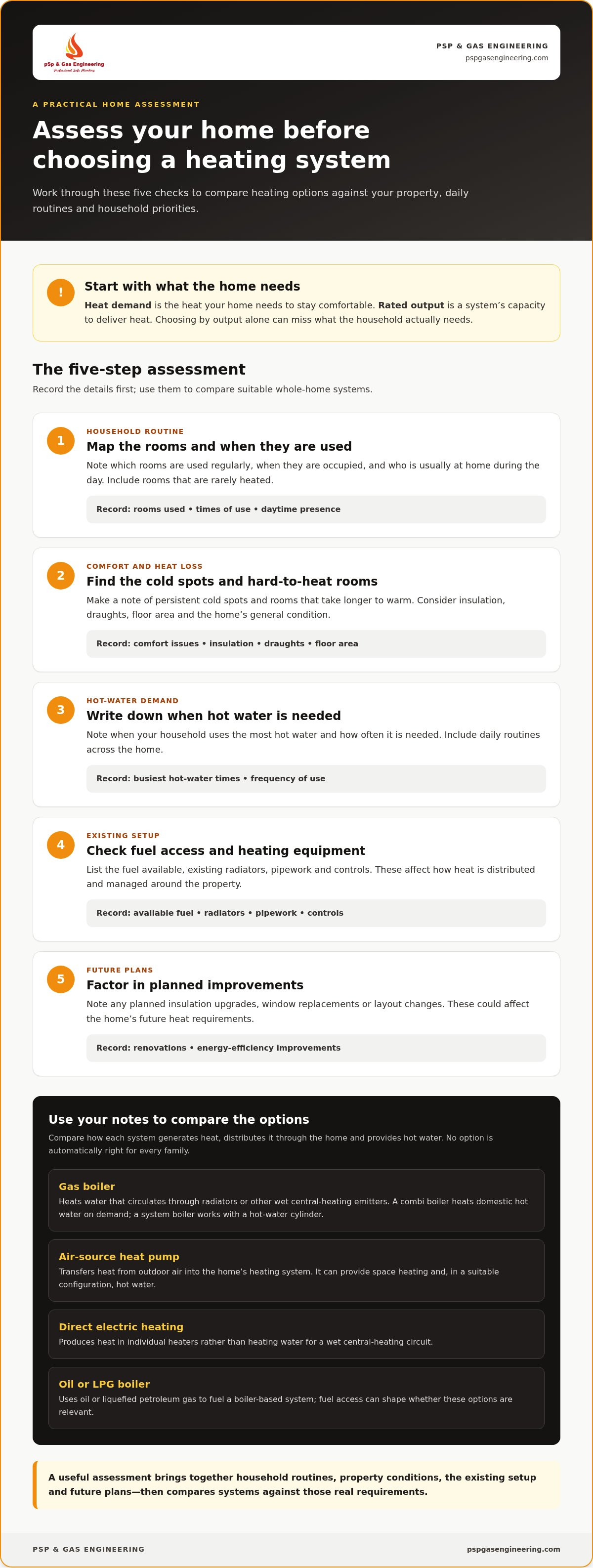
How to assess your home before choosing a heating system
A short, structured review makes it easier to compare heating systems with your household’s needs and property. Gather what you can first. The aim is to create a useful starting point, not to design a system yourself. The best heating system for a family home UK households choose should reflect actual room use, hot-water needs and installation constraints.
- Document the current heating. Note the fuel and system type, the boiler arrangement if you have one, the controls, radiators and any hot-water cylinder. Record recurring issues, such as cold rooms, slow warm-up or difficulty controlling the heat. Gather existing boiler or system documents if available.
- Assess the property. Record the floor area and which rooms are heated, along with any known insulation or draught concerns. These conditions affect how readily the home loses heat and can influence the system required. Note the property’s general condition and any practical limits on where equipment could be installed.
- Define household needs. Write down when rooms are occupied, which spaces need regular warmth, when hot water is used and any comfort problems. Include planned renovations or energy-efficiency improvements, as these may change the home’s requirements.
- Compare viable systems. Consider options that suit the property’s fuel access and installation constraints. Compare them against comfort, disruption, maintenance and household priorities, rather than choosing by technology name alone.
What should you record about your current heating?
Be specific about how the system works in daily use. For example, note whether the living room warms comfortably but a bedroom stays cold, or whether hot water runs short during a busy morning. Record which controls the household uses and whether a cylinder is part of the setup. These observations can help distinguish a system-wide issue from a room-specific comfort concern.
How do you turn those details into a shortlist?
First, set aside systems that don’t match the home’s fuel access or practical space for equipment. Then compare the remaining options with your notes. A household that needs to warm different rooms at different times may weigh controls and routine differently from one that heats the whole home consistently. Consider the disruption installation may involve and the maintenance your household is prepared to manage.
Insulation and draught reduction can affect heat demand, so include known issues and planned improvements in the discussion. You don’t need to prescribe work or calculate system output yourself. Final design depends on a competent assessment of the property and its heating requirements.
If you’re planning a replacement in Croydon, this guide to boiler installation cost in Croydon covers related installation-planning considerations. For a gas boiler replacement that suits your home, discuss a boiler installation with PSP & Gas Engineering. Its Gas Safe registered engineers carry out system design, fitting and final safety commissioning.
Choosing and installing a family-home gas boiler in Croydon
A gas boiler replacement may be suitable if your home assessment shows that the existing gas central heating arrangement continues to meet the property’s needs. It’s one option, not an automatic recommendation. The decision should reflect the home, your heating and hot-water requirements, and any planned improvements.
PSP & Gas Engineering installs gas boilers in residential properties across Croydon and Greater London. Its Gas Safe registered engineers handle system design, fitting and final safety commissioning, planning the installation around the property rather than choosing by boiler type alone.
What should a professionally planned boiler installation address?
System design determines how the replacement should serve the home’s assessed requirements. Fitting puts that design into practice, taking account of the existing heating arrangement and the work needed at the property. Final safety commissioning completes the process by checking and setting up the installed system for operation.
These steps work together. A boiler selected without considering the home’s requirements may not be the right match, even if it appears similar to the existing unit. The installation plan should account for the property and its heating configuration, while commissioning completes the technical work. For background on compliance documentation, see this Gas Safe compliance certificate checklist.
What are the next steps for Croydon homeowners?
Before discussing an installation, gather the details that help describe your home and current system. You don’t need to calculate technical requirements yourself. A clear record of how you use the property and what isn’t working well gives you a practical starting point for discussing a replacement.
- The current boiler and heating arrangement, including the fuel and any hot-water cylinder.
- Which rooms are heated regularly and any persistent cold spots or comfort issues.
- How the household uses hot water during the day.
- Known insulation or draught concerns, and any planned renovation or energy-efficiency work.
- Any existing boiler or system documentation that may help describe the setup.
These observations connect the choice of the best heating system for a family home UK households need with the practical requirements of a particular property. They can also help clarify whether the next step is a straightforward replacement or a discussion that takes the wider system and planned home improvements into account.
For Croydon homeowners whose assessment points towards a gas boiler replacement, PSP & Gas Engineering provides residential boiler installation across Croydon and Greater London. Discuss your gas boiler installation with the team and bring your notes on the current system, comfort concerns and household requirements.
Make your next heating decision with confidence
You don’t need to settle every technical detail before taking the next step. Use what you’ve learned about your household and property to frame a focused discussion: what needs to improve, what should stay, and whether planned home upgrades could affect the decision. This keeps the choice grounded in your family’s needs, rather than pressure to follow a particular technology. The best heating system for a family home UK households choose is one that suits the building and the way it’s lived in.
If replacing a gas boiler appears right for your Croydon home, PSP & Gas Engineering can help plan the installation. Its Gas Safe registered engineers carry out system design, fitting and final safety commissioning across Croydon and Greater London.
Discuss a gas boiler installation in Croydon, and take the next step with a clear understanding of what your home needs.
Frequently Asked Questions
What is the best heating system for a family home in the UK?
There’s no single best option for every household. The best heating system for a family home UK residents choose depends on the property and how it’s used. A family that needs hot water at busy times may prioritise the system’s hot-water arrangement, while a home with limited equipment space may need to weigh installation constraints carefully. Compare comfort, fuel access, maintenance and household routine before settling on a shortlist.
Is a heat pump suitable for an older family home?
Yes, an older home can be suitable for a heat pump, but age alone doesn’t determine whether the system will work well. An assessment should consider the building’s heat demand, insulation, existing heating setup and space for equipment. A period property with insulation improvements, for example, may have different requirements from a similar-sized home with persistent draughts. Suitability depends on the individual property and proposed system design.
Can I keep my existing radiators if I install a heat pump?
Possibly. Existing radiators don’t automatically need replacing, but their ability to meet each room’s heating needs should be assessed as part of the proposed design. Start by noting any rooms that already feel cooler than others and, if known, the sizes or types of their radiators. The outcome may vary across the home. A system assessment can establish whether existing emitters are suitable or changes are needed.
Are gas boilers still an option for family homes in the UK?
Yes. In 2026, installing a new gas boiler in an existing home remains an option. Rules applying to new-build homes are a separate matter. For a family with gas central heating, a replacement may be suitable if the setup meets the property’s and household’s requirements. Consider future plans as well as immediate heating needs, rather than assuming every existing home must switch systems at once.
Does a family home need better insulation before changing its heating system?
Not necessarily. Insulation improvements may reduce heat loss, but there isn’t one rule requiring every home to complete particular work before changing its heating system. If upgrades are planned, include them in the assessment because they may affect the home’s future heat requirements. Note whether loft or wall insulation is present, whether there are persistent draughts, and whether improvements are part of a wider renovation.
What should I compare when choosing a new home heating system?
Compare how each option would meet your home’s heating and hot-water needs, how it fits the existing equipment, and what installation work may involve. Also consider fuel access, available space, maintenance expectations and how the system would fit your household’s daily routine. A family that heats rooms at different times may value different features from one that uses the whole home throughout the day. Include planned renovations in the comparison.
Do I need a Gas Safe registered engineer to install a gas boiler?
Yes. Gas work involved in installing a boiler should be carried out by a Gas Safe registered engineer, who can complete the work and safety commissioning. For homeowners in Croydon, PSP & Gas Engineering carries out residential boiler installations, including system design and fitting. Keep installation records with your home documents, as they may be useful for future servicing, safety checks or property-related queries.


