

A newer boiler can strengthen a buyer’s confidence, but it can’t guarantee a higher sale price. That’s the key distinction when considering adding value to your home with a new boiler: a modern, efficient heating system may improve a property’s appeal, but its effect on value depends on the home as a whole.
It’s understandable to question whether replacement is worth the cost and disruption, particularly if your current boiler still works. The benefits may be clearer in everyday comfort and efficiency than in any promise of a resale return. Buyers may appreciate a dependable, well-presented heating system, but they’ll also consider the property’s condition, energy performance and other features.
This article explains how a new boiler can affect comfort, energy use and buyer confidence, and why appeal isn’t the same as a guaranteed increase in sale value. You’ll also learn what to weigh before replacing, maintaining or keeping your current system, including its condition and how well it meets your household’s needs.
Key Takeaways
- Understand why buyer confidence and perceived upkeep matter, while recognising that a new boiler can’t guarantee a higher sale price.
- See how heating efficiency fits into a home’s wider energy use and EPC assessment.
- Compare replacing your boiler with maintaining it or addressing other efficiency issues before deciding.
- Weigh the system’s condition, your household’s needs and your future plans when considering adding value to your home with a new boiler.
- Learn what professional installation involves, from system design and fitting to final safety commissioning by Gas Safe registered engineers.
Adding value to your home with a new boiler: what “value” really means
Home value isn’t limited to the figure achieved at sale. It can also include how confident a buyer feels about the property, how comfortable it is to live in and whether its essential systems appear likely to need attention. A new boiler may support that broader sense of value, particularly if the existing system is unreliable or visibly dated. But replacing it is only one part of presenting a home well.
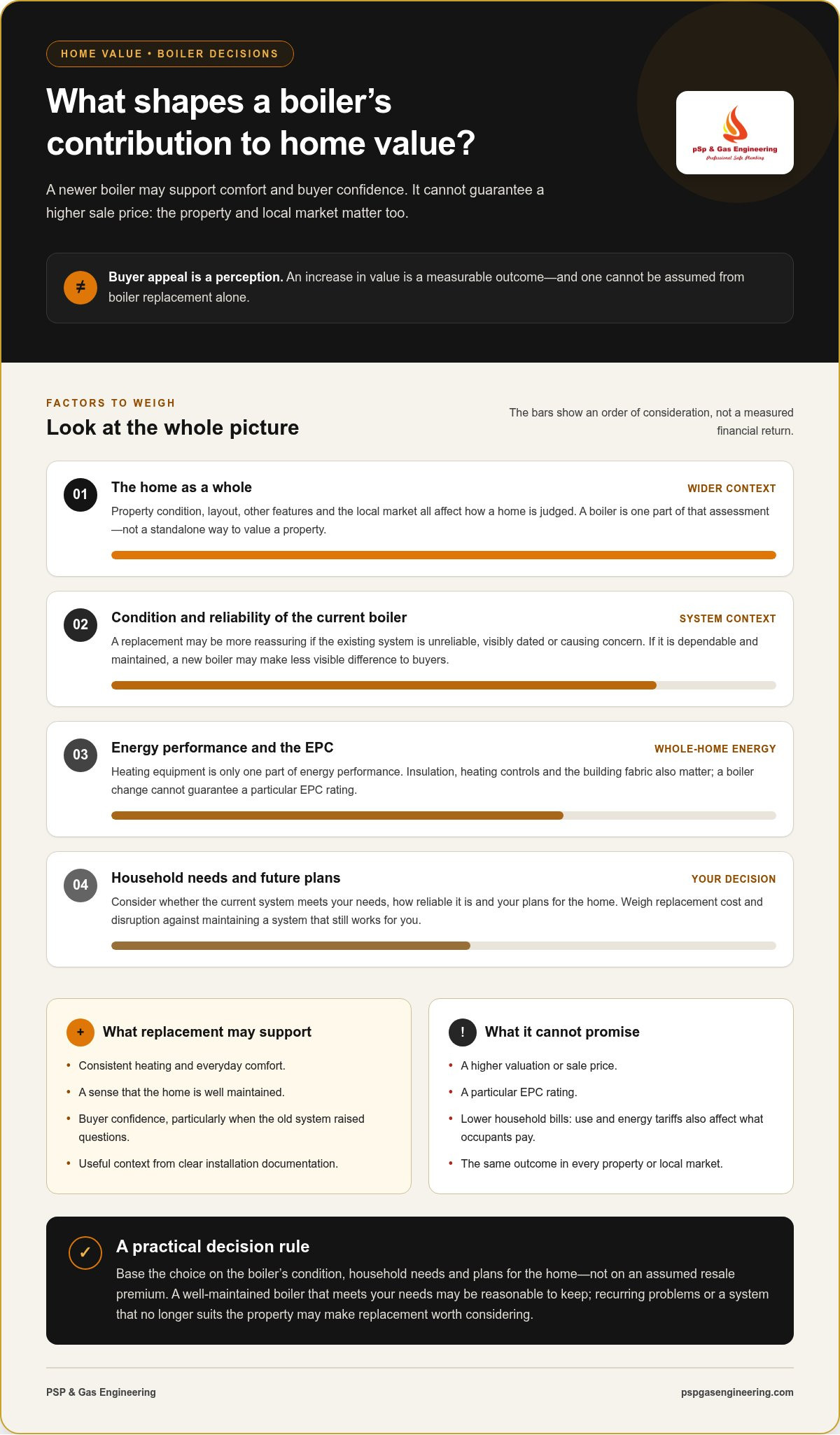
Buyer appeal is a perception; an increase in value is a measurable outcome. A modern heating system may make a property feel better maintained, but that doesn’t prove it will achieve a higher valuation or sale price. The result depends on the condition and features of the whole home, as well as the local market. If you’re weighing adding value to your home with a new boiler, separate practical reassurance from any expectation of a financial return.
Does a new boiler automatically increase a property’s sale value?
No automatic uplift can be assumed for every home or local market. A replacement may make the heating system easier to present to prospective buyers, but that’s different from a formal property valuation. An estate agent or surveyor considers the property as a whole, including its condition, layout and other features. A newer boiler is one factor, not a standalone way to value a home.
Its contribution also depends on what it replaces. If the current boiler is dependable and appropriately maintained, a new one may make less visible difference to a buyer than if the existing system is causing concern. Any judgement about sale value should be based on the particular property, rather than a general claim about boiler replacement.
Why buyers may notice the heating system
Heating is part of everyday comfort, so a system that works consistently can help a home feel ready to occupy. By contrast, visible wear, operating problems or unanswered questions about reliability may leave buyers wondering whether repairs or replacement will be needed. That uncertainty can affect confidence, even if it doesn’t translate into a specific change in the offer they make.
A boiler’s condition can also influence how buyers view the home’s general upkeep. A well-presented system may contribute to an impression of care, while a replacement can provide clearer information about the heating than an older unit with an uncertain history. It’s still only one part of the property’s presentation. For technical background on how boiler efficiency is discussed, consult the linked overview. Efficiency alone doesn’t establish the value of the whole home.
Before deciding, compare the cost and disruption of replacement with your boiler’s condition and reliability. If it continues to meet household needs, keeping it maintained may be a reasonable choice. If it has recurring problems or no longer suits the property, replacement may offer greater day-to-day reassurance. Base your decision on the system’s condition and your plans for the home, not an assumed resale premium.
How a new boiler may affect efficiency, EPC context and buyer confidence
A replacement boiler can change how efficiently a heating system turns fuel into useful heat, but it can’t account for every factor that affects energy use in a home. The result depends on the system selected, how it is installed and operated, and the property’s heating arrangements. Even if the new system uses less fuel for comparable heating, household bills aren’t guaranteed to fall. How much heating is used and the energy tariff also affect what occupants pay.
A boiler can influence an EPC assessment, but it cannot determine a home’s EPC outcome on its own. An Energy Performance Certificate considers the property as a whole, rather than rating the boiler alone. The Energy Performance Certificates (EPCs) guidance explains what an EPC is and its role when selling or renting a home. A replacement may contribute to the overall picture, but it doesn’t guarantee a particular rating or change how buyers respond.
What a boiler can and can’t change about an EPC
Heating equipment is one part of a home’s energy performance. Insulation, heating controls and the building fabric also matter, so the same boiler may contribute differently in two properties. A draughty home, for example, may still lose heat quickly despite having a recently replaced heating system. EPC assessments use an applicable assessment methodology, so don’t assume that changing one appliance will produce a specific rating improvement.
This distinction matters if you’re considering adding value to your home with a new boiler partly because of its EPC. An assessor evaluates more than the boiler, and the rating depends on the property’s recorded characteristics and assessment. If an EPC improvement is central to your plans, consider the heating system alongside other relevant aspects of the home, rather than treating replacement as a standalone route to a higher rating.
Efficiency benefits buyers may value
For prospective buyers, dependable heating can make a home feel more straightforward to move into. Clear installation documentation can also explain what work has been completed and provide useful context about the system. These details may support confidence, but they aren’t proof of guaranteed energy savings or a higher sale price.
The appropriate boiler depends on the home and its existing heating arrangements. A system that suits one property may not be right for another, so replacement should start with the household’s heating needs and how the current system is configured. Installation quality matters too: PSP & Gas Engineering’s Gas Safe registered engineers handle system design, fitting and final safety commissioning for boiler installations in Croydon and across Greater London. Homeowners considering a replacement can explore boiler installation services as part of weighing up the practical benefits.
Efficiency can be one reason to consider a new boiler, while EPC performance and buyer confidence depend on wider property details. Treat potential operating improvements as a practical benefit to assess, not a promise about bills, ratings or resale value.
New boiler or keep the existing one? Compare the options before deciding
A boiler that still works doesn’t automatically need replacing. Base the decision on its condition, reliability and suitability for the household, rather than resale hopes alone. If it heats the home consistently and has a sound maintenance history, continuing to use it may be sensible. If problems recur or some rooms aren’t heating as expected, replacement may be worth considering, but a fault should be assessed rather than treated as proof that a new boiler is necessary.
Use this comparison to identify which option best fits your home. The right choice depends on how the system performs and whether other issues need attention.
| Option | Reliability and system condition | Disruption and buyer reassurance |
|---|---|---|
| Replace the boiler | May suit a system with repeated faults, inconsistent heating or a condition that no longer meets household needs. | Installation involves work in the home, but a properly completed replacement can give future buyers clearer information about the heating system. |
| Maintain the existing boiler | May be appropriate if the boiler remains dependable and its condition and maintenance history support continued use. | Avoids immediate replacement work. Keeping maintenance records can help explain how the system has been looked after. |
| Address other efficiency issues | May be more relevant if the boiler performs adequately but other aspects of the home affect comfort or heat retention. | Work varies according to the issue. Improvements elsewhere may contribute more to the home’s overall presentation than replacing a sound boiler. |
When replacing a working boiler may still make sense
A working boiler may still be unreliable in practice. Repeated faults, uneven heating or disruption to daily routines can make replacement worth assessing, particularly if you expect to stay in the property and value dependable comfort. If you plan to sell soon, weigh that practical benefit against the installation disruption. Age alone isn’t a replacement rule: the system’s condition and performance matter more than an arbitrary cut-off.
When maintaining the current boiler may be the more suitable choice
If the boiler heats the home consistently, appears to be in sound condition and has a reassuring maintenance history, replacement may not be the priority. Consider whether another issue, such as poor heat retention or a general need for repairs, has more influence on comfort and buyer appeal. Before planning a new installation, it can also help to understand the factors that shape boiler installation cost in Croydon.
There’s no single answer for every property. If you’re considering adding value to your home with a new boiler, resale value alone is an incomplete reason to replace a functioning system. Balance its condition and reliability against the work involved, your household’s needs and how long you expect to remain in the home. That’s a more practical starting point than assuming a new boiler will pay for itself at sale.
A practical replacement decision for Croydon homeowners
There’s no universal answer to whether a boiler should be replaced before a home is sold. Local market conditions and buyer priorities vary, so don’t assume a Croydon property will achieve a particular resale premium because its boiler is new. Start with the system in your home, your household’s needs and your plans for the property.
Work through these steps before committing:
- Review the boiler’s condition. Note known faults, repairs, maintenance history and recurring problems with heating or hot water. A record of intermittent issues gives a clearer starting point for assessing reliability than age alone.
- Consider how the system serves the household. Think about whether it heats the property consistently and suits the way you use heating and hot water. An arrangement that works well for one household may not meet another’s needs.
- Set your priority. Decide whether your main concern is reliable operation, comfort, energy efficiency or preparing the property for sale. This helps distinguish a practical reason to replace from a hope that a new boiler will increase the sale price.
- Factor in your property plans. Consider how long you expect to remain in the home. If you plan to stay, day-to-day reliability may carry more weight. If you expect to sell soon, consider whether installation work is worthwhile alongside other priorities for the property.
Questions to resolve before committing to replacement
Bring the details together before deciding: what has gone wrong, how often it happens and whether the problem affects heating, hot water or both. Consider whether the current system suits the home as it is now, including any changes in household routines. A clear priority helps you judge the decision by useful outcomes, rather than relying on resale value as the sole reason to act.
The property’s wider condition matters too. If the boiler is operating reliably, other maintenance or improvements may be more relevant to comfort and buyer appeal. Conversely, recurring faults may make dependable heating a more immediate concern. The right choice depends on the evidence in front of you, not a fixed replacement age or a general claim about what buyers will pay.
How to plan a safe, properly commissioned installation
If replacement suits your circumstances, plan the installation around the property and its existing heating arrangements. PSP & Gas Engineering provides boiler system design, fitting and final safety commissioning across Croydon and Greater London. The work is carried out by Gas Safe registered engineers.
For a Croydon homeowner, adding value to your home with a new boiler is one consideration within a broader property decision. If you’ve reviewed your system and decided replacement is the right step, arrange a boiler installation with PSP & Gas Engineering.
What to expect from PSP & Gas Engineering’s boiler installation service
A boiler replacement is a practical home upgrade, not a guaranteed way to increase a property’s sale price. Its value lies first in how well the system is planned for the home and installed. PSP & Gas Engineering provides boiler installations across Croydon and Greater London, covering system design, fitting and final safety commissioning. The installation is carried out by Gas Safe registered engineers.
How professional installation supports a considered home upgrade
Good planning starts with the property’s heating requirements and existing system. The design stage helps shape an installation around those factors, rather than treating every home as identical. Fitting puts the planned system in place, and final safety commissioning completes the installation service. Together, these stages provide a clear process for homeowners considering adding value to your home with a new boiler, without promising a particular efficiency result or financial return.
Before discussing an installation, note what you want the upgrade to address. You might be responding to recurring reliability concerns, changing household heating needs or preparing the property for a future sale. Sharing relevant details about the existing arrangement and your priorities can help keep the conversation focused on the project. The right scope depends on the home, making considered design an important part of planning.
- System design: considers the property’s heating requirements and existing setup.
- Boiler fitting: carries out the planned installation.
- Final safety commissioning: completes the installation process.
These defined stages offer practical reassurance about how the work is approached. They don’t establish that a boiler will raise a valuation, reduce bills by a set amount or suit every property. Those outcomes depend on the home and its wider circumstances.
Discuss your boiler installation in Croydon
If you’ve reviewed your boiler’s condition and decided replacement fits your household and property plans, PSP & Gas Engineering can discuss a project-specific installation in Croydon and across Greater London. Its Gas Safe registered engineers undertake the design, fitting and final safety commissioning as part of the planned service.
To take the next step, request a free quote online for your property and installation requirements. Describe what you want to achieve and the heating arrangement you have now. This gives you a practical starting point for discussing the work, with the decision based on your home’s needs rather than an assumed increase in sale value.
Make your next step a considered one
Decide what you need the heating system to do for your home, then judge replacement against that priority. If your main aim is adding value to your home with a new boiler, keep the decision grounded in your property’s circumstances rather than assuming it will produce a particular sale price. A well-considered upgrade can still be worthwhile for comfort and confidence, even when its financial effect is uncertain.
Before proceeding, bring together the details that will help shape the project: what you’ve noticed about the current system, how your household uses heating and hot water, and any plans you have for the property. A clear brief makes it easier to discuss an installation suited to your home and decide whether now is the right time to act.
For a project-specific next step, request a free boiler installation quote from PSP & Gas Engineering. Make an informed choice based on your home’s needs, not a promise of resale return.
Frequently Asked Questions
Does a new boiler add value to your home?
It may improve buyer confidence, but a higher sale price isn’t guaranteed. The impact depends on the property, its condition and local market conditions, as well as the boiler itself. When considering adding value to your home with a new boiler, include practical benefits such as dependable heating and a system that suits the household’s needs. Keep expectations measured and weigh the upgrade against other work the property may need.
Will a new boiler improve my home’s EPC rating?
It may contribute to the EPC assessment, but a new boiler alone won’t guarantee a higher rating. The certificate reflects the home’s broader energy performance, so the result also depends on features such as insulation, controls and the building fabric. If you’re planning work partly to improve an EPC, consider the certificate’s recommendations as a whole. A boiler replacement should be considered alongside, not instead of, other relevant improvements.
Is it worth replacing a working boiler before selling a home?
Not necessarily. If the boiler works reliably and suits the property, replacing it solely before a sale may not be the best use of your budget or time. Look at its maintenance history, any recurring faults and your expected sale timeline. For example, a system that regularly leaves rooms cold may warrant attention, while a dependable boiler may be better maintained and clearly documented for prospective buyers.
Can a new boiler make a property easier to sell?
It may help buyers feel more confident about the home’s heating, particularly if the previous system had visible faults or an uncertain history. That can make the property easier to present, but it doesn’t ensure a quicker sale or a higher offer. Buyers consider the home overall, including its condition, location and suitability for their needs. Clear records of work completed can help answer practical questions about the heating system.
Can a boiler be replaced without changing the radiators?
Often, existing radiators can remain, provided they’re in suitable condition and work with the replacement system. Their condition and how they heat each room are relevant: cold spots, leaks or uneven performance may indicate that the wider system needs attention. A design assessment can consider the boiler and existing heating arrangement together. Replacing the boiler doesn’t automatically mean every radiator must also be changed.
What paperwork should I keep after a new boiler installation?
Keep the installation invoice, commissioning records, user instructions and any warranty documents supplied for the boiler. Store them somewhere easy to find, and note the installation date alongside future maintenance records. This gives you a useful history of the system if you need to refer to its setup or explain the work to a future buyer. Keep digital copies as well as paper documents where possible.
How long does a new boiler installation take?
The time required depends on the property, the existing heating arrangement and the installation scope. A straightforward replacement may involve less work than a project requiring changes to pipework, system design or the boiler’s location. There isn’t one reliable duration for every home. Before arranging the work, make sure the project plan accounts for your property’s and household’s specific requirements.


