
A gas safety inspection is far more than a simple visual check; it is a meticulous forensic audit of your property's internal health. Whilst many landlords and homeowners view the process as a mere box-ticking exercise, our Gas Safe registered engineers treat every visit as a vital mission to protect your household from the silent threat of carbon monoxide. With local authorities now able to issue civil penalties of up to £30,000 for safety breaches, ensuring your appliances meet the 2026 standards is no longer just about safety; it's about legal survival.
We understand the anxiety that often accompanies these visits, particularly the fear of failing an inspection or the confusion over complex landlord obligations. This guide will walk you through the precise technical steps we take to verify your system's integrity, giving you total peace of mind that your home is secure. You'll discover exactly what happens behind the scenes, from pressure testing your pipework to conducting specialist CCTV flue examinations, to ensure you receive a valid CP12 certificate and a clear understanding of your property's maintenance needs.
Key Takeaways
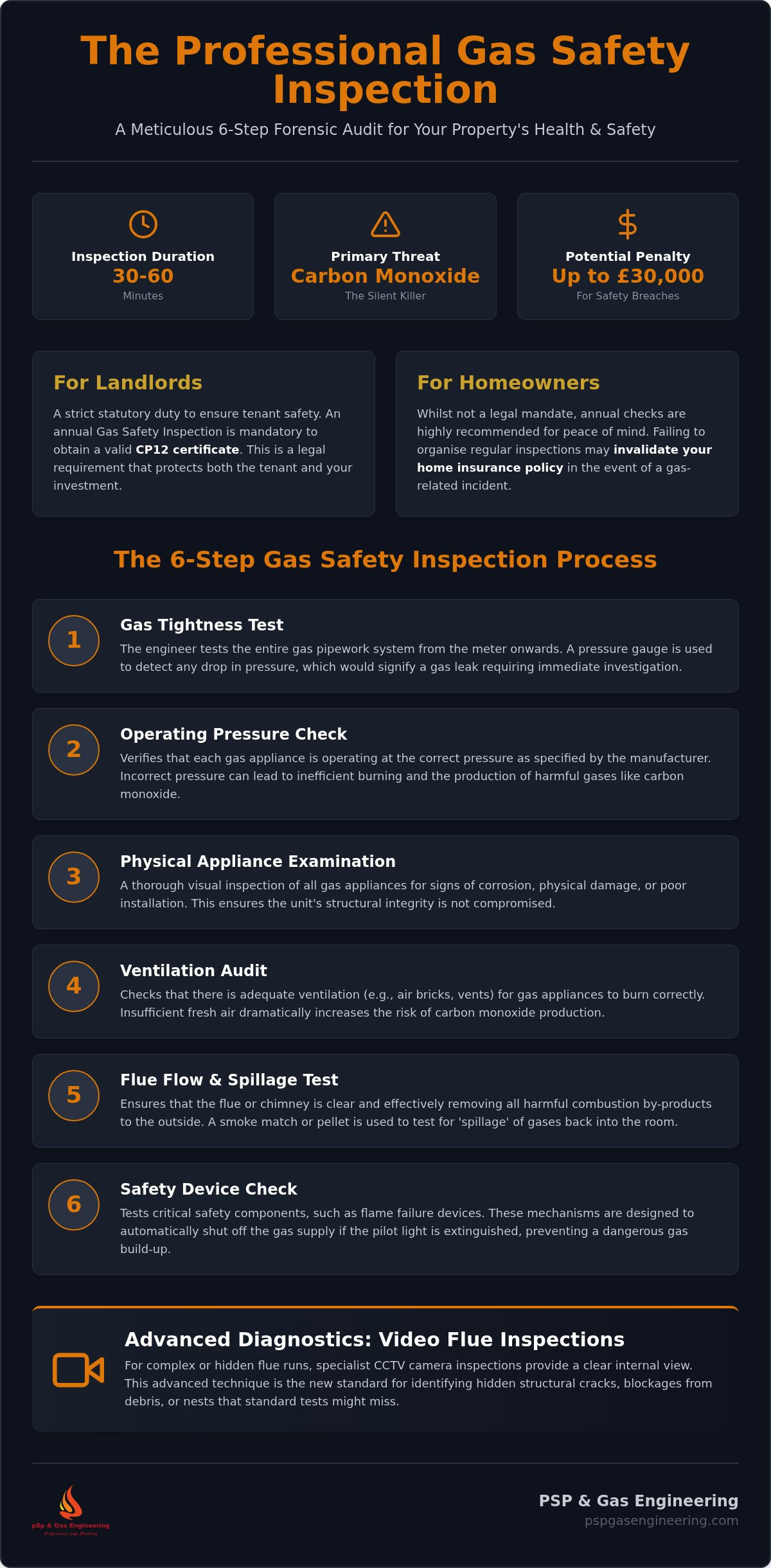
- Understand the meticulous 6-step process of a professional gas safety inspection, which typically takes between 30 and 60 minutes to complete.
- Learn how technical assessments identify hidden hazards such as carbon monoxide risks, gas leaks, and inadequate ventilation.
- Clarify the specific legal liabilities for landlords, including the requirement to inspect pipework serving tenant-owned appliances.
- Discover the advantages of advanced video flue inspections for identifying structural cracks or blockages in hidden chimney runs.
- Gain practical advice on verifying an engineer’s credentials to ensure your property remains fully compliant with 2026 regulations.
Understanding the Gas Safety Inspection: More Than Just a Certificate
A gas safety inspection is a mandatory forensic audit of a property’s gas infrastructure conducted by a registered professional. Whilst many see it as a simple administrative hurdle, it is actually a rigorous technical assessment of every gas-burning appliance, pipework run, and ventilation point in your building. Our engineers don't just look for obvious faults; they use precision instruments like flue gas analysers and pressure gauges to detect issues that remain hidden to the naked eye. The primary goal is to identify potential gas leaks, carbon monoxide risks, and ventilation failures before they escalate into emergencies.
The Legal Difference: CP12 vs. Homeowner Checks
Landlords have a strict statutory duty to provide a safe environment for their tenants. This is documented through a Landlord's gas safety certificate, or CP12, which must be issued annually. This record is more than a piece of paper; it's a legal safeguard that protects both the tenant's life and the landlord's investment. If you are a homeowner, you might think these checks are optional. Technically, they are. However, failing to organise an annual gas safety inspection can lead to your home insurance being invalidated. The Gas Safe Register sets these high standards across the UK to ensure that whether you are renting out a flat in Croydon or living in your own family home, the level of technical scrutiny remains identical.
Safety First: What the Inspector Prioritises
The core of any professional visit is the detection of carbon monoxide, often called the silent killer because it has no smell, taste, or colour. We prioritise testing the combustion process of your boiler and fires to ensure they aren't producing this lethal gas. Beyond this, we verify that the safety devices built into your appliances, such as flame failure valves, are fully operational. These components are designed to cut off the gas supply if the flame goes out, preventing a dangerous build-up of fuel. We also check the stability of the gas supply by testing the pipework for tightness. This ensures there are no microscopic leaks in the joints or fittings that could cause a fire risk over time. Finally, we examine the ventilation routes, ensuring that air bricks and flues are clear so that waste gases can exit the property safely.
The 6-Step Gas Safety Inspection Process: What Our Engineers Check
A professional gas safety inspection is defined by its methodical sequence. Our engineers follow a structured protocol designed to ensure that no single component, however small, is overlooked during the assessment. Typically, the process takes between 30 to 60 minutes, though this varies depending on the number of gas-burning appliances in your property. Throughout the visit, we prioritise cleanliness and minimal disruption, treating your home with the respect it deserves whilst we carry out these critical technical checks.
This rigorous approach isn't just best practice; it's the standard required to meet the Gas Safety (Installation and Use) Regulations 1998. Every step we take is meticulously documented to provide a clear audit trail. This eventually forms the backbone of your final certificate and provides the security you need to manage your property with confidence.
Step 1-3: Tightness, Pressure, and Appliance Integrity
We begin the technical work with a Gas Tightness Test. This involves testing the entire system from the gas meter to ensure there are no leaks present. If the gauge shows a drop in pressure, it indicates a breach in the pipework that requires immediate investigation. Following this, we perform an Operating Pressure Check. It's vital that appliances burn fuel at the correct, safe rate specified by the manufacturer. If the pressure is incorrect, the appliance may produce harmful by-products. Finally, a thorough Physical Examination is conducted. Our engineers look for signs of corrosion, external damage, or evidence of poor previous workmanship that could compromise the unit's integrity.
Step 4-6: Ventilation, Flues, and Safety Devices
The latter stages of the inspection focus on the safe removal of waste products. A Ventilation Audit verifies that there is enough fresh air entering the room for the gas to burn safely and completely. Without adequate oxygen, the risk of carbon monoxide production increases significantly. We then conduct a Flue Flow Test. This ensures that all combustion gases are being extracted correctly to the outside of the property. We often use smoke pellets to visually confirm that the flue is pulling air effectively. The final check involves Flame Failure Device Testing. We verify that the gas supply shuts off automatically if the flame goes out, preventing a dangerous build-up of unburnt gas.
Maintaining this level of detail is why many local residents trust us as a safe pair of hands for their property. If your appliances are due for their annual check, you can easily book a professional gas safety inspection to maintain your home's compliance and safety.
Compliance for Landlords vs Peace of Mind for Homeowners
Whilst landlords are bound by strict statutory requirements, homeowners often view a gas safety inspection through the lens of preventative maintenance and personal security. Landlords amongst our clients often seek clarity regarding tenant-provided appliances. It is a common misconception that if a tenant brings their own gas cooker, the landlord has no further obligation. In reality, the legal requirement covers the installation and any gas pipework supplying that appliance. Ensuring the integrity of the supply line remains your responsibility as the property owner, even if you don't own the unit itself.
For homeowners, the motivation is different but equally vital. A regular gas safety inspection is the most cost-effective way to prevent emergency breakdowns and identify minor faults before they transform into expensive repairs. According to the official Gas Safe Register, these assessments provide the expert verification needed to ensure your home remains a safe environment for your family.
Landlord Obligations in 2026
The legal framework for 2026 remains rigorous. Landlords must provide a copy of the Gas Safety Record to their tenants within 28 days of the check being completed. For new tenancies, this document must be handed over before the tenant moves in. UK law also requires you to keep these records for a minimum of two years. If an engineer identifies a fault, they will categorise the appliance as "At Risk" (AR) or "Immediately Dangerous" (ID). An ID classification means the appliance poses an immediate threat to life and must be disconnected from the gas supply until it is made safe. Dealing with these issues promptly is the only way to maintain your legal compliance and protect your occupants.
Homeowner Benefits: Beyond Compliance
If you have recently invested in a new boiler, an annual safety check is usually a non-negotiable requirement to keep your manufacturer’s warranty valid. Without this documented proof, you could face significant costs if a major component fails. Beyond warranty protection, our engineers often identify inefficient appliances that are silently increasing your energy bills. A boiler that isn't burning fuel correctly wastes money every time the heating comes on. Most importantly, the peace of mind that comes from a professional carbon monoxide check is invaluable. It's the only way to be certain that your appliances aren't leaking this invisible, odourless gas into your living spaces.
Advanced Diagnostics: Why Video Flue Inspections Are the New Standard
While a standard gas safety inspection involves a visual check of the flue terminal, this often only scratches the surface of potential venting issues. In many properties, particularly older London homes, the flue runs through internal voids or within original chimney stacks where visibility is zero. Video diagnostics remove the guesswork from flue integrity testing. By utilising high-definition CCTV cameras, our engineers can navigate these hidden pathways to ensure that combustion gases are being safely evacuated from your living spaces.
This advanced approach is particularly critical for properties in Croydon and Thornton Heath, where Edwardian and Victorian architecture often features shared or lined chimney stacks. In these complex structures, a visual check from the fireplace or the roof isn't enough to guarantee safety. We prioritise technical precision, using specialised equipment to peer into the heart of your home's infrastructure, ensuring that every joint and seal remains airtight and fit for purpose.
Identifying Blocked Flues and Structural Faults
Internal blockages are a primary cause of carbon monoxide incidents, yet they are frequently invisible from the outside. Natural debris, bird nests, or crumbling masonry can create a lethal restriction within the stack, forcing dangerous gases back into the property. Using high-resolution camera footage, we pinpoint the exact location of any venting issue. This prevents unnecessary damage to your walls or ceilings, as we don't have to guess where the problem lies. This evidence is also vital when planning flue relining or repairs, providing a clear roadmap for the necessary engineering work.
Technical Reporting and Flue Integrity
We believe in providing our clients with absolute clarity regarding their system’s condition. Following a video inspection, we provide visual proof of the flue's internal state, showing you exactly where cracks or joint failures might be occurring. This ensures that your venting system is properly sealed and fully compliant with modern building regulations. For complex London properties where flues take convoluted routes, these technical diagnostics offer a "safe pair of hands" that traditional checks simply cannot match. It’s about replacing assumptions with verified data, ensuring that your property is truly safe.
If you suspect an issue with your chimney or own an older property that requires a more thorough assessment than a visual check can provide, you can book our specialist video inspections to gain total confidence in your home's safety.
Booking Your Inspection in Croydon: Ensuring Gas Safe Compliance
Selecting a local specialist for your gas safety inspection offers distinct advantages, particularly in South London. Croydon and Thornton Heath feature a unique mix of Edwardian terraces, converted flats, and modern developments, each with specific plumbing and gas layouts. Local engineers are intimately familiar with these property types, from the placement of meters in communal hallways to the idiosyncratic flue runs found in older chimney stacks. This regional expertise ensures that the assessment is both efficient and technically thorough.
Before the engineer arrives, you can facilitate a smooth visit by ensuring clear access to the gas meter and all appliances. This includes clearing cupboards where the boiler may be housed and ensuring that gas fires or cookers aren't obstructed by furniture. If we identify a critical fault during the visit, PSP & Gas Engineering provides 24/7 emergency assistance for safety failures, ensuring that your property is never left in a vulnerable state.
Verifying Gas Safe Credentials
Your safety depends entirely on the proficiency of the individual performing the work. You should always verify that your engineer is on the Gas Safe Register before allowing them to begin. Every qualified professional carries a Gas Safe ID card, which you should inspect closely. It isn't enough to see the logo on the front; you must check the back of the card to confirm the engineer is qualified for the specific appliances in your home, such as boilers, fires, or cookers. Using an uncertified plumber for gas work is a significant risk that can lead to criminal liability for landlords and physical danger for occupants. A valid inspection will always result in documentation bearing the official Gas Safe logo, serving as your primary evidence of compliance.
What to Expect After the Inspection
Once the technical checks are complete, you'll receive a Landlord Gas Safety Record (LGSR), frequently referred to as a CP12. This document provides a clear audit trail of every test performed and the current status of each appliance. If an appliance is found to be non-compliant, it will be classified as "At Risk" or "Immediately Dangerous," requiring prompt remedial action to restore safety. We provide these records in a clear, digital format, making it easy for landlords to share them with tenants or local authorities. To maintain your legal standing and peace of mind, we recommend setting up an annual reminder. This proactive approach ensures you never miss a deadline, keeping your household secure and your property fully compliant with 2026 regulations.
Securing Your Property with Expert Engineering
Maintaining a safe and compliant property requires more than just a cursory glance at your boiler. By following a methodical six-step protocol and utilising advanced tools like CCTV cameras for hidden flues, we ensure that every potential hazard is identified and mitigated. Whether you are a landlord managing statutory obligations or a homeowner prioritising family safety, a professional gas safety inspection provides the definitive evidence of security you need. These technical audits replace guesswork with verified data, ensuring your heating system remains efficient and your household remains protected.
As your local specialists in Croydon and Thornton Heath, we combine technical authority with a commitment to your peace of mind. Our team consists of Gas Safe Registered Engineers who specialise in CCTV flue diagnostics and provide 24/7 emergency assistance for safety failures. Book your expert Gas Safety Inspection with PSP & Gas Engineering today to ensure your infrastructure remains in peak condition throughout 2026 and beyond. We look forward to providing the meticulous care and professional oversight your home deserves.
Frequently Asked Questions
How long does a gas safety inspection take for a standard house?
A professional gas safety inspection typically takes between 30 and 60 minutes to complete. This duration depends on the number of gas appliances in your property, such as your boiler, gas fire, and cooker. Our engineers work methodically to ensure every component is tested thoroughly without causing unnecessary disruption to your day.
What happens if my boiler fails the gas safety check?
If your boiler fails, the engineer will categorise the fault as either "At Risk" or "Immediately Dangerous". An appliance marked as "Immediately Dangerous" poses an immediate threat to life and must be disconnected from the gas supply until it is repaired. We will provide a clear explanation of the faults found and the specific technical steps required to make your system safe again.
Do I need a gas safety certificate if I am not a landlord?
Homeowners are not legally required to hold a certificate, but an annual gas safety inspection is highly recommended for personal security. Whilst the legal mandate only applies to rental properties, many insurance providers require evidence of regular safety checks to maintain your coverage. It is the most reliable way to ensure your appliances aren't producing lethal carbon monoxide.
Can any plumber carry out a gas safety inspection?
No, only engineers who are currently listed on the Gas Safe Register are legally permitted to perform these inspections. It is a criminal offence for an uncertified individual to carry out gas work or issue safety documentation. You should always check the back of an engineer’s ID card to verify they are qualified for the specific types of appliances in your home.
How often should a gas safety inspection be performed?
You should arrange an inspection every 12 months to ensure continued safety and compliance. For landlords, this is a strict legal requirement under UK law. Homeowners should follow the same annual schedule to identify minor wear and tear before it leads to a dangerous system failure or an expensive emergency repair.
Is a gas safety inspection the same as a boiler service?
A gas safety inspection is a technical audit focused on safety, whilst a service is a maintenance procedure designed for performance. The inspection verifies that the appliance is safe to operate and the flue is clear. A service involves cleaning internal components and adjusting settings to improve energy efficiency and extend the boiler's lifespan.
Do I need to be present whilst the gas engineer is working?
You don't need to be present during the inspection as long as the engineer has clear access to the gas meter and all appliances. However, someone must be available to let the engineer into the property and receive the final report. If any "At Risk" issues are identified, it is helpful to be available so the engineer can explain the findings immediately.
What is a CP12 and why is it called that?
A CP12 is the traditional name for the Landlord Gas Safety Record. The term stands for "CORGI Proforma 12", which was the original document used when CORGI was the UK’s regulatory body for gas safety. Even though the Gas Safe Register replaced CORGI in 2009, the term CP12 remains the standard shorthand used by landlords and letting agents across the UK.


