

Could the simple act of increasing your radiator's surface area be the most effective way to slash your heating bills this winter? While many homeowners in Croydon focus solely on their boiler, the truth is that your radiators often dictate how hard your entire system has to work. If you are tired of shivering in rooms with persistent cold spots or worrying about the energy price hikes of 2026, you are certainly not alone. Many residents find that their existing single panel units simply cannot provide the consistent warmth required for modern comfort.
This guide explains how upgrading single to double radiators can significantly enhance your home heating efficiency and comfort without the need for messy or expensive pipework changes. By choosing a double panel design, you allow your system to run at lower, more efficient temperatures while maintaining a cosy environment. We will walk you through the essential BTU requirements, the latest 2026 design trends like aluminium models, and how to decide between a DIY installation or hiring a Gas Safe registered specialist to ensure your system remains fully compliant with Building Regulations Part L1B.
Key Takeaways
- Learn how to calculate precise BTU requirements to ensure your new radiators are perfectly sized for your room dimensions and boiler performance.
- Understand the technical differences between Type 11 and Type 22 units when upgrading single to double radiators to maximise heat output and surface area.
- Discover how to utilise existing pipe centres and adjustable valves to avoid the cost and disruption of invasive pipework modifications.
- Identify essential safety checks for wall integrity and projection depths to ensure your home's structure can safely support heavier double-panel models.
- Gain confidence in knowing when a project requires a Gas Safe engineer to prevent technical failures such as system airlocks or structural damage.
Understanding the Difference: Single vs Double Panel Radiators
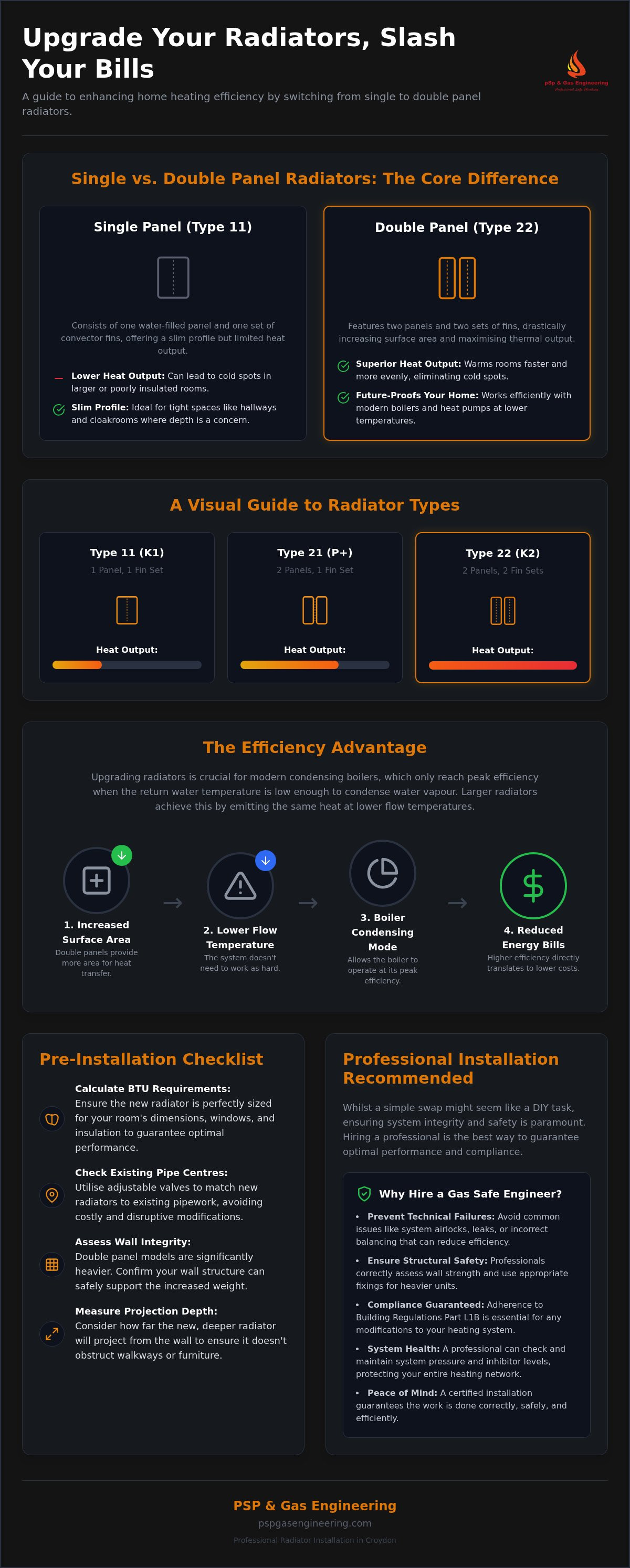
Selecting the right hardware for your heating system requires a clear understanding of how different radiator types operate. To grasp the technical shift involved, one must first consider the fundamental principles of heat transfer. What is a radiator? In a domestic setting, it is a heat exchanger that uses a combination of radiation and convection to warm a room. The most common varieties found in Croydon homes are classified by their panel and fin configurations, typically referred to as Type 11, Type 21, and Type 22.
A single panel radiator, or Type 11 (K1), consists of one water-filled panel and one set of convector fins welded to the back. These fins are the engine of the unit; they increase the internal surface area, allowing air to heat up and rise through the top of the casing. Whilst single panels are slim and unobtrusive, they provide a limited surface area for heat to escape. In contrast, double panel radiators like the Type 21 (P+) and Type 22 (K2) add a second water-carrying panel. The Type 22 is the most powerful common domestic model, featuring two panels and two sets of internal convector fins to maximise thermal output.
When is a Single Panel Radiator Sufficient?
Single panel units remain a practical choice for specific areas where space is at a premium. They are ideally suited for small cloakrooms, narrow hallways, or well-insulated modern apartments where the heat demand is relatively low. Their slim profile is particularly beneficial in tight London corridors where a deeper radiator might obstruct a walkway. However, these units often struggle in the high-ceilinged Victorian properties common across South London. In these larger spaces, a single panel often lacks the necessary surface area to overcome heat loss through original windows or external walls, leading to persistent cold spots even when the boiler is running at full capacity.
The Advantages of Upgrading to Double Panels
The primary motivation for upgrading single to double radiators is the substantial boost in British Thermal Unit (BTU) output. By doubling the panels and fins, you can often achieve significantly more heat from a unit with the same width and height as your old one. This is a game-changer for homeowners who want a warmer room without having to find extra wall space for a wider radiator.
Beyond immediate warmth, this upgrade is a crucial step in future-proofing your home. Modern condensing boilers and renewable systems, such as air-source heat pumps, operate most efficiently at lower flow temperatures. A larger surface area allows the radiator to emit the required amount of heat even when the water inside isn't scalding hot. This transition ensures your system remains effective and compliant with evolving energy standards whilst providing a more stable and comfortable environment.
The Science of Efficiency: BTUs and Boiler Performance
Heating efficiency isn't just about the boiler on your wall; it's about how effectively that heat is transferred into your living space. Every room in your Croydon home has a unique heat loss profile based on its dimensions, window types, and insulation levels. This requirement is measured in British Thermal Units (BTUs). When upgrading single to double radiators, the primary goal is to match the unit's output to these BTU requirements as accurately as possible to ensure every corner of the room reaches a comfortable temperature.
One common misconception is that a boiler always operates at its peak efficiency. In reality, modern condensing boilers only reach their stated efficiency when the return water temperature is cool enough to allow the heat exchanger to condense water vapour. If your radiators are too small, your boiler must work at higher temperatures to keep you warm, which actually stops it from condensing. By increasing the surface area through upgrading single to double radiators, you allow the system to run at a lower flow temperature while still meeting the room's heat demand.
This technical approach aligns with global minimum efficiency requirements for modern heating systems. Lowering the flow temperature doesn't just make the room more comfortable by providing a more consistent heat; it directly reduces energy consumption and lowers monthly bills by allowing the boiler to stay in its most efficient operating mode for longer periods.
Matching Radiators to High-Efficiency Boilers
Correct radiator sizing is a critical component of a high efficiency boiler installation London. If the radiators are undersized, the boiler will frequently "cycle"—turning on and off rapidly—which causes unnecessary wear and wastes gas. After an upgrade, it's vital to perform system balancing. This ensures that hot water is distributed evenly across all radiators, preventing some rooms from being tepid whilst others are too hot. If you're unsure about your current system's performance, a professional system assessment can identify where efficiency is being lost.
Impact on System Pressure and Pump Speed
A common concern for homeowners is whether a larger radiator will strain the central heating pump. While a double panel radiator holds more water, it doesn't necessarily require a more powerful pump. Most modern pumps are more than capable of handling the increased volume, provided the system is properly bled and pressurised. Using Thermostatic Radiator Valves (TRVs) alongside your new double radiators further optimises performance. These valves allow each room to be controlled independently, ensuring you aren't heating empty spaces and keeping your energy usage as lean as possible.
Practical Considerations: Space, Weight, and Aesthetics
Transitioning from a single to a double panel unit involves more than just selecting a higher BTU output; it requires a careful assessment of your room's physical layout. The term "projection" refers to the total distance from the wall to the front face of the radiator. While a standard single panel (Type 11) is slim and unobtrusive, a double panel (Type 22) extends significantly further into the room. This added depth is a functional necessity to accommodate the dual water channels and the internal convector fins that drive the efficiency gains required by modern UK building regulations for heating.
Weight is another critical factor that homeowners often overlook. A double radiator is not only heavier as a dry steel unit but also holds roughly double the water volume of its single-panel predecessor. A large Type 22 radiator, when full, can exert considerable strain on its fixings. While a solid masonry wall can support this load with ease, internal plasterboard partitions require a much more technical approach. Failure to account for this weight can lead to structural damage or, in extreme cases, the radiator pulling away from the wall entirely, causing significant water damage.
Managing the Extra Depth in Small Rooms
In compact spaces like home offices or spare bedrooms, the extra depth of a Type 22 radiator can interfere with your daily environment. You should expect a Type 22 to project between 100mm and 130mm from the wall, compared to the 50mm to 75mm of a single panel. This change might require you to adjust furniture placement; keeping sofas or curtains at least 100mm away is vital for maintaining the convection currents that heat the room. If floor space is particularly tight, vertical double radiators are an increasingly popular choice in South London. They utilise wall height to meet heat demands, allowing you to achieve the necessary thermal output without sacrificing valuable square footage.
Wall Brackets and Fixings for Heavy Radiators
When upgrading single to double radiators on stud walls, standard "plug and screw" methods are rarely sufficient. Professional installers prioritise safety by using heavy-duty toggle bolts that spread the weight across a larger area of the plasterboard. Ideally, brackets should be fixed directly into the timber studs or noggins for maximum security. If the wall structure is particularly weak, floor-standing radiator supports can be used. These supports transfer the weight of the unit directly to the floorboards, providing peace of mind that the installation is permanent and secure. Taking these precautions ensures that your heating upgrade is a long-term improvement rather than a maintenance liability.
Installation Guide: Can You Use Existing Pipework?
One of the most common concerns when upgrading single to double radiators is whether the existing copper pipes will align with the new unit. In a perfect scenario, you would select a double radiator with the exact same width as your old single panel. However, because double radiators are deeper, the distance from the wall to the pipe entry point often changes. This shift can create a technical challenge where the pipes no longer line up vertically with the valves. Whilst some online forums suggest simply bending the pipes to fit, this is a practice we strongly advise against; it puts undue stress on joints and can lead to slow, hidden leaks behind your skirting boards.
To bridge small gaps of up to 50mm, telescopic radiator tails are a common professional solution. These adjustable extensions slide into the radiator and allow for a degree of flexibility without the need to drain the entire system and move the pipework. They are an efficient way to manage the transition, although they can be more visible than standard fixings. If the discrepancy is larger, or if you are moving from a very old imperial-sized radiator to a modern metric one, a full re-pipe of that section may be the only way to ensure a leak-free, professional finish that meets current safety standards.
Step-by-Step Measurement for a Seamless Swap
Achieving a precise fit starts with accurate measurements before you even purchase your new hardware. Begin by measuring the distance from the centre of the left valve to the centre of the right valve. Pipe centres are the horizontal distance between the centres of the two radiator valves. Next, identify the inlet and outlet positions on your chosen double radiator; most modern units are "bottom opposite end" (BOE). Finally, measure the distance from the finished wall to the centre of the existing pipe. If your new Type 22 radiator is significantly deeper, you may need to use offset valves to bring the connection forward without chasing out the wall. For homeowners who find these technical calculations daunting, engaging expert plumbing services ensures every measurement is handled with engineering precision.
Dealing with Sludge and System Health
Installing a brand-new radiator into a dirty system is a wasted investment. Over time, the internal surfaces of steel radiators and copper pipes corrode, creating a black sludge known as magnetite. This sludge will quickly settle in the bottom of your new double radiator, creating cold spots and reducing the efficiency gains you've just paid for. We recommend a full system flush before any new installation. This is also the ideal time to install a magnetic system filter, which captures metallic debris before it reaches your boiler's heat exchanger. Ensuring your system is clean also makes it easier to spot issues through plumbing leak detection London, as a healthy, pressurised system will clearly signal even the smallest drop in performance.
Professional Radiator Installation in Croydon
Whilst it may be tempting to view upgrading single to double radiators as a straightforward weekend task, the technical reality is far more complex. A single error in valve alignment or a failure to properly bleed the system can result in persistent airlocks that cripple your heating efficiency. Beyond the plumbing, the structural risks mentioned in previous sections, such as mounting heavy Type 22 units on insufficient fixings, can lead to catastrophic wall failure and expensive water damage. Professional installation ensures that every connection is sound and every bracket is anchored with engineering precision.
Gas Safe registered engineers bring a level of system-wide oversight that a general handyman cannot provide. In 2026, maintaining gas safety compliance is about more than just checking for leaks; it involves ensuring your entire central heating network operates within the design parameters of your high-efficiency boiler. Our engineers verify that the increased water volume and heat demand from your new radiators won't cause your boiler to overwork or cycle incorrectly. This professional approach protects your boiler's warranty and ensures your system remains fully compliant with the latest building regulations.
Why Croydon Homeowners Trust PSP & Gas Engineering
South London properties range from draughty Victorian terraces to modern high-rise apartments, each with unique plumbing quirks. We possess deep local knowledge of these property types and the specific challenges they present, such as aging pipework or varying water pressures across the Croydon area. Our team prioritises a tidy work environment, ensuring minimal disruption to your daily routine during the installation process. For those managing larger properties or business premises, we also provide integrated commercial plumbing services London to handle high-capacity requirements with the same level of technical care.
Booking Your Heating Assessment
A professional site survey is the first step toward a warmer, more efficient home. During this visit, we perform precise BTU calculations and assess your wall integrity to ensure a perfect match for your space. You will receive a transparent, no-obligation quote that covers all aspects of the installation, from the hardware to the final system flush. Once the work is complete, we don't just leave the property. We meticulously balance the system and bleed every unit to ensure maximum warmth and efficiency across your entire home, providing you with the peace of mind that your heating is in a safe pair of hands.
Future-Proof Your Home Heating Efficiency
Choosing to enhance your central heating system is a strategic investment in both comfort and long-term energy savings. By upgrading single to double radiators, you've seen how increased surface area allows your boiler to operate in its most efficient condensing mode. This simple change eliminates persistent cold spots whilst preparing your home for the lower flow temperatures required by modern standards. Whether you're managing the extra weight on a partition wall or ensuring your pipe centres align perfectly, technical precision remains the cornerstone of a successful installation.
As specialists in high-efficiency heating, our Gas Safe registered engineers are here to ensure your upgrade is handled with the highest standards of safety and care. We provide 24/7 emergency support across Greater London, giving you total peace of mind that your home's infrastructure is in a safe pair of hands. Contact PSP & Gas Engineering for a professional radiator upgrade in Croydon today and take the first step toward a warmer, more sustainable living environment. You don't have to settle for a cold home when professional solutions are just a call away.
Frequently Asked Questions
Is a double radiator twice as hot as a single radiator?
A double radiator typically provides between 50% and 70% more heat output than a single panel unit of the same dimensions, rather than being exactly twice as hot. This increase is largely due to the additional convector fins between the panels. Whilst the water temperature remains the same, the increased surface area allows more heat to be transferred into the room. This makes them ideal for larger spaces or rooms with significant heat loss.
Can I replace a single radiator with a double without moving the pipes?
You can often replace a single unit without moving the floor pipework, provided the new radiator has the same width. However, because double radiators are deeper, the distance from the wall to the valve entry will change. You may need to use telescopic radiator tails or offset valves to bridge this gap. If the depth difference is significant, a professional may need to make minor adjustments to the copper pipes to ensure a secure, leak-free connection.
Will a double radiator make my boiler work harder or use more gas?
Upgrading single to double radiators actually allows your boiler to work more efficiently rather than harder. By providing a larger surface area, these radiators can heat a room effectively using lower water temperatures. This allows modern condensing boilers to stay in their most efficient operating mode for longer. Whilst the system holds more water, the overall gas consumption often decreases because the room reaches the desired temperature faster and maintains it more consistently.
Are double radiators too heavy for plasterboard stud walls?
Double radiators are considerably heavier than single panels, especially when filled with water. Whilst they can be mounted on plasterboard stud walls, standard fixings are usually inadequate. You must use heavy-duty toggle bolts or ensure the brackets are screwed directly into the timber studs behind the plasterboard. In cases where the wall integrity is a concern, floor-standing supports can be used to transfer the weight away from the partition and directly onto the floorboards.
How much extra space does a double radiator take up in a room?
A double panel radiator generally projects about 50mm to 60mm further into the room than a single panel model. A typical Type 22 radiator has a total projection of 100mm to 130mm from the wall to the front face. It's important to measure this projection carefully before installation. Ensure that the extra depth won't obstruct walkways or prevent furniture from being placed in its usual position; curtains and sofas should remain clear of the unit.
Should I upgrade my radiator valves when I switch to a double panel?
It's highly recommended to upgrade to Thermostatic Radiator Valves (TRVs) when installing a double radiator. Modern TRVs allow you to control the temperature of each room individually, which is essential for energy efficiency. Under UK Building Regulations Part L, replacement radiators should ideally be fitted with these controls. New valves also ensure a reliable, leak-free seal, preventing the common issues associated with reusing old, worn components during a significant system upgrade.
How do I know if my current radiator is a single or a double?
You can identify your radiator type by looking down at it from above. A single panel radiator, or Type 11, has one front panel and a set of zig-zag fins on the back. A double panel radiator will have two distinct water-carrying panels. If there is one set of fins between two panels, it's a Type 21. If there are two sets of fins between the two panels, it's a Type 22.
Do I need to drain the whole heating system to swap one radiator?
You don't always need to drain the entire system to swap a single radiator. Whilst professional engineers often use bungs or pipe-freezing kits to isolate the specific area, when upgrading single to double radiators, we often recommend a full drain and system flush. This process removes internal sludge and magnetite that could otherwise settle in your new unit. A clean system ensures your new hardware operates at peak thermal efficiency from the first day.


