
According to the Energy Savings Trust, internal corrosion and sludge build-up can reduce a central heating system's effectiveness by as much as 15%. For many residents in Croydon, this technical decline manifests as radiators that stay cold at the bottom or a boiler that makes loud, disruptive noises. A professional Powerflushing service is the precise solution required to address these inefficiencies, ensuring your home remains warm and your energy consumption stays under control.
It's natural to feel concerned when your heating system underperforms despite high monthly costs. You deserve the security that comes from a reliable, well-maintained boiler that won't let you down during a cold snap. This article will demonstrate how a thorough system cleanse slashes energy bills and protects the lifespan of your equipment. We'll also explain why this process is often essential for validating your boiler’s warranty and how a specialist approach provides a safe pair of hands for your home’s most critical infrastructure.
Key Takeaways
- Learn how a technical system cleanse removes magnetite sludge to restore full heat distribution to your radiators.
- Identify the specific symptoms, such as cold spots and boiler 'kettling', that signal your heating system is under strain.
- Understand the professional Powerflushing process and how it can reduce annual gas consumption by up to 15%.
- Explore the engineering steps involved, from thermal imaging diagnostics to the application of specialised corrosion inhibitors.
- Discover how a professional system flush helps satisfy manufacturer requirements to keep your boiler warranty valid.
What is Central Heating Powerflushing and Why is it Essential?
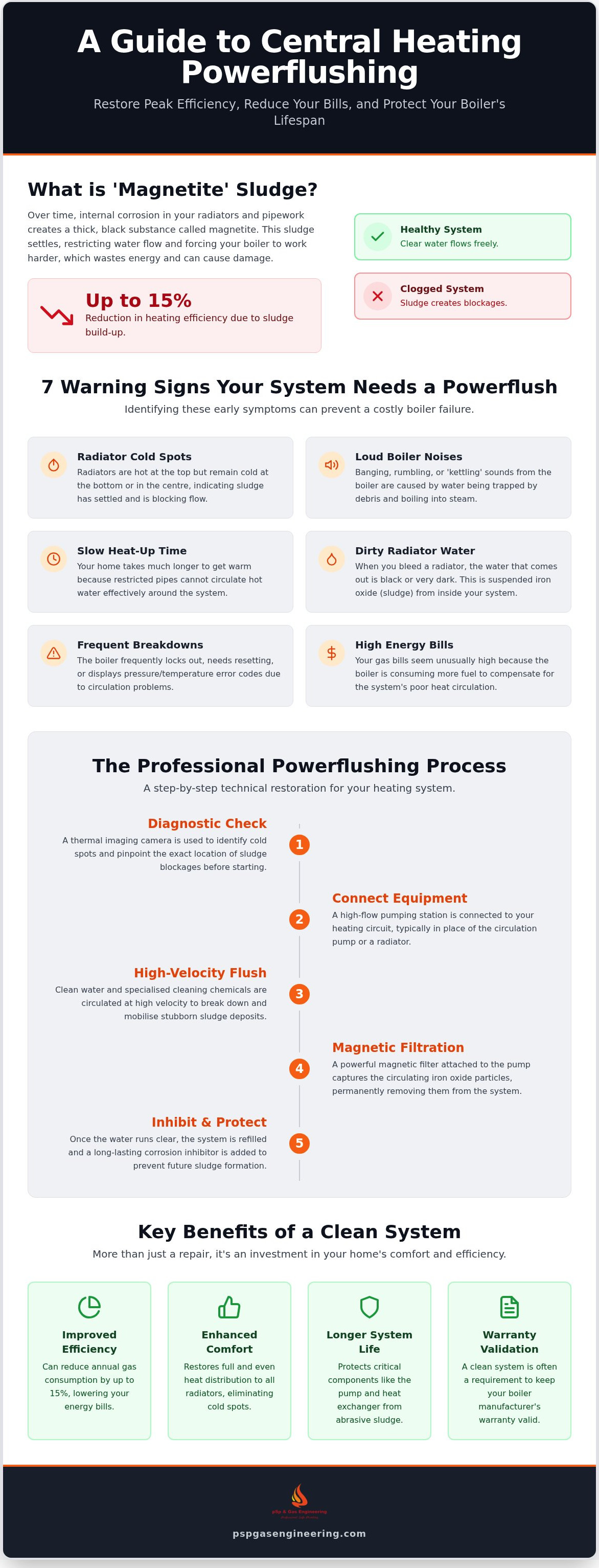
A professional service like Powerflushing isn't merely a standard maintenance task; it's a technical restoration process designed to clear deep-seated debris from your home's pipes. A modern Central heating system relies on the unobstructed flow of water to transfer heat efficiently. Over time, however, internal corrosion creates a thick, black substance known as magnetite. This "sludge" settles in areas of low flow, forcing your boiler to work harder and consuming more gas to achieve the same temperature.
The core of the process involves a specialised pumping station. This equipment operates as an external heart for your heating circuit, bypassing the boiler's own pump to deliver a flow rate that can be reversed or pulsed. This agitation is what separates a professional service from a simple chemical additive. It ensures that even the most stubborn blockages are mobilised and removed, rather than just being thinned out.
Understanding Magnetite and Sludge Formation
Sludge forms through a chemical reaction between the water in your system, the oxygen introduced during top-ups, and the steel components of your radiators. This creates black iron oxide. In areas like Croydon, the situation is often exacerbated by hard water. The high mineral content leads to internal scaling, which acts as a scaffold for magnetite to cling to. As this debris accumulates, it creates "dead zones" where hot water cannot reach. This typically results in radiators that feel cold at the bottom whilst the top remains warm.
When this sludge reaches the boiler's heat exchanger, it can cause "kettling" noises. This is the sound of water trapped behind debris, turning to steam. It's a clear indicator of system distress that requires immediate technical intervention to prevent component failure.
Powerflushing vs. Traditional System Rinsing
Many homeowners confuse a professional flush with a standard gravity rinse. A traditional rinse relies on the system's own pump or basic water pressure, which simply lacks the force to move heavy, settled magnetite. Powerflushing utilises high-velocity water combined with specialised chemicals to break down the bond between the sludge and the pipe walls. This mechanical force dislodges stubborn blockages without risking damage to older pipework because it operates at a controlled, low pressure.
During the process, a magnetic filter is attached to the pumping station. This component is critical. It captures the metallic particles as they are mobilised, preventing them from simply resettling elsewhere in the circuit. By the time the process is complete, the internal environment of your heating system is returned to a chemically stable, clean state. This provides the peace of mind that your boiler is protected by a professional "safe pair of hands."
7 Warning Signs Your London Home Needs a Powerflush
Most homeowners don't realise their heating is failing until the boiler stops entirely. Identifying the early symptoms of magnetite build-up is the best way to avoid a total system collapse. If your system hasn't been serviced recently, these technical red flags suggest that internal corrosion is already impacting your comfort and your wallet.
One of the most obvious indicators is the appearance of the water within your system. When you bleed a radiator to release air, the water should be clear. If it appears cloudy or jet black, you're seeing suspended iron oxide. This debris acts like liquid sandpaper, wearing down the internal seals of your pump and valves. You might also notice that your home takes significantly longer to warm up than it did in previous years. This slow response time is rarely a fault with the thermostat; it's usually a sign that the narrow pipework is restricted by a thick layer of sludge.
Frequent boiler breakdowns or "high pressure" error codes are also common precursors to a total failure. When circulation is restricted, the boiler's internal sensors detect a dangerous rise in temperature or pressure, triggering an emergency shutdown. For a deeper look at these technical indicators, you can consult this guide to powerflushing. If you recognize these patterns in your own property, seeking a professional assessment from PSP & Gas Engineering can prevent a minor inefficiency from becoming a major repair bill.
Diagnosing Radiator Cold Spots
You can perform a simple "hand test" to check the health of your radiators. Whilst the heating is running, carefully feel the surface of each unit. If the top is hot but the bottom or centre remains stone cold, you aren't dealing with trapped air. Because air is lighter than water, it causes cold spots at the top. Cold spots at the bottom indicate that heavy, metallic sludge has settled and solidified. This prevents hot water from circulating through the entire panel, effectively reducing the radiator's size and forcing your boiler to run for twice as long to reach the desired room temperature.
Boiler Noises and Kettling Explained
Noise is often the most alarming symptom of a system in distress. A healthy boiler should operate with a steady, quiet hum. If you hear banging, whistling, or a sound similar to a boiling kettle, the primary heat exchanger is likely restricted by debris. This "kettling" occurs when water becomes trapped behind a layer of sludge and turns to steam. It's a critical warning that your boiler is overheating. If left unaddressed, this local boiling can lead to a cracked heat exchanger, which is one of the most expensive components to replace. Powerflushing is the only reliable way to clear these internal blockages and restore a silent, safe operation.
The Step-by-Step Professional Powerflushing Process
Homeowners often worry that a deep system clean will be messy or disruptive. In reality, a professional Powerflushing service is a highly contained, technical operation. By using a closed-loop pumping station, the engineer ensures that all sludge and debris are captured within the equipment rather than entering your living space. The process is methodical, typically taking a full working day to complete, depending on the number of radiators and the severity of the magnetite build-up.
Diagnostic Testing and Thermal Imaging
Precision begins with a technical assessment. Before any equipment is connected, we use infra-red thermal imaging cameras to "see" inside your radiators. These cameras produce a heat map that identifies exactly where sludge has settled. This establishing of a baseline is essential for two reasons. First, it provides documented proof of the system's current state. Second, it allows the engineer to identify specific "problem" radiators that will require extra attention during the mechanical agitation phase. This diagnostic approach ensures that no part of the circuit is overlooked.
Individual Radiator Agitation and Cleaning
Once the pumping station is integrated into the circuit, the engineer isolates each radiator one by one. This is the secret to a truly thorough clean. By directing the full velocity of the pump through a single unit, the flow rate is high enough to mobilise heavy debris. During this stage, engineers often use a specialised tool to vibrate or tap the radiator surface. This mechanical agitation dislodges stubborn magnetite that has baked onto the internal panels. We monitor the wastewater constantly, continuing the flush until the discharge runs completely clear and free of suspended solids.
System Protection and Post-Flush Care
The final phase focuses on long-term stability. After the debris is removed, the system is treated with a chemical neutraliser to ensure the internal environment is balanced. We then perform pH level tests to verify the water quality. Finally, a high-quality chemical inhibitor is introduced to the circuit. The chemical inhibitor acts as the primary barrier against 2026 corrosion levels by creating a protective film on the internal surfaces of the heating circuit. This proactive step, combined with a final thermal imaging check to confirm even heat distribution, ensures your system operates at peak efficiency for years to come.
Powerflushing Costs and Long-Term Energy Savings
Investing in a technical system cleanse is a strategic decision for your home's long-term finances. According to the Energy Savings Trust, a central heating system burdened with corrosion and sludge can lose up to 15% of its effectiveness. For a household in Croydon, this translates directly into higher gas bills for a home that never feels quite warm enough. Powerflushing restores this lost efficiency by removing the physical barriers to heat transfer, allowing your boiler to reach the desired temperature using significantly less fuel.
Ignoring the build-up of magnetite carries a high "hidden cost." Whilst the initial signs like cold radiators are inconvenient, the long-term impact on internal components is severe. Sludge is a leading cause of premature pump failure and cracked heat exchangers. Replacing these parts, or the entire boiler, is a far greater financial burden than a scheduled maintenance flush. For London landlords, this service is particularly valuable. It ensures tenant comfort, reduces the likelihood of emergency winter call-outs, and helps maintain the records needed for manufacturer warranty compliance.
Calculating Your Return on Investment
The return on investment for a professional flush is realised through both immediate and deferred savings. You'll likely see a reduction in monthly energy expenditure as the system circulates hot water more freely. Beyond the bills, you're extending the operational lifespan of your entire heating circuit. By removing the abrasive particles that wear down seals and valves, you prevent the need for frequent, expensive repairs. Avoiding just one emergency call-out fee during a peak winter month can often justify the effort of a preventative health check.
Preparation and Minimising Household Disruption
A typical Powerflushing operation for a semi-detached house in Croydon usually takes about eight hours. We recommend that homeowners clear a small space around the radiators and the boiler before the engineer arrives. This allows for a smooth, efficient workflow. Our engineers are committed to clean-work practices, using protective floor coverings and ensuring all wastewater is contained within the pumping station. Once the work is complete, your home is left exactly as it was found, only with a significantly more efficient heating system. To secure your system's efficiency and protect your boiler's lifespan, you can book a professional system assessment with our specialist team.
Why Choose PSP & Gas Engineering for Your Croydon Powerflush?
Selecting a technical partner for your home's maintenance requires a balance of local knowledge and certified expertise. At PSP & Gas Engineering, we provide a "safe pair of hands" for complex tasks like Powerflushing. Our team consists entirely of Gas Safe registered engineers who understand the specific challenges posed by the hard water in South London. This local insight allows us to calibrate our cleaning chemicals and mechanical agitation to the exact needs of Croydon properties.
We believe in professional transparency. Every project begins with a clear, fixed-fee quote, ensuring there are no hidden "plumbing surprises" once the work is underway. Our services are also deeply integrated with our boiler installation Croydon offerings. This ensures that every new system we commission starts its life in a pristine, chemically stable environment, maximising its efficiency from day one.
Protecting Your Boiler Warranty
Many homeowners are unaware that Powerflushing is often a mandatory requirement for validating a new boiler warranty. Most major manufacturers specify that the heating circuit must be cleaned according to BS 7593:2019 before a new unit is installed. If a heat exchanger fails due to sludge in an uncleaned system, the manufacturer may refuse to honour the repair costs. We provide the comprehensive documentation required for your gas safe compliance certificate, creating a verifiable paper trail that protects your investment for its full term.
The 'Safe Pair of Hands' Guarantee
Our approach is defined by engineering precision rather than quick fixes. We take pride in our methodical workflow, ensuring that every radiator in your Thornton Heath or Croydon home is individually tested and cleared. This commitment to craftsmanship has built our reputation as a trusted local specialist. Beyond preventative maintenance, we offer 24/7 emergency assistance to support the community whenever heating issues arise. Choosing us means opting for a service that prioritises safety, technical excellence, and the long-term health of your home.
Secure Your Home's Warmth and Efficiency
Maintaining a healthy heating system is a matter of technical precision and preventative care. The accumulation of magnetite sludge is a quiet but destructive force that compromises comfort and increases monthly expenditure. By opting for a professional system cleanse, you ensure that every radiator in your home operates at its full potential whilst protecting the delicate internal components of your boiler.
Powerflushing is the most effective engineering solution to restore a system's efficiency by up to 15%, providing you with the security of a warm home and lower energy bills. Our team of Gas Safe Registered engineers is dedicated to delivering these high standards of maintenance across Croydon and South London. With our expertise in boiler diagnostics and 24/7 emergency support, you can trust that your property is in a safe pair of hands.
Take the proactive step toward a more reliable heating circuit today. Request a free powerflushing quote from our Gas Safe engineers to restore your system's performance and enjoy total peace of mind throughout the colder months.
Frequently Asked Questions
Is powerflushing safe for older central heating systems?
Yes, it is safe when performed by a qualified engineer. Before starting, we carry out a technical assessment to ensure the pipework's integrity. Whilst the process uses high-velocity water, it operates at low pressure to prevent damage. If a system is extremely old and already compromised by deep corrosion, we may recommend alternative cleaning methods to ensure the security of your property's infrastructure.
How often should I have my heating system powerflushed?
Most domestic systems require a professional flush every five to six years. However, this interval depends on the quality of the materials used in your radiators and the local water conditions in Croydon. You should also arrange a flush whenever you invest in a new boiler installation. This ensures that any existing magnetite doesn't immediately contaminate your new unit, protecting your long-term investment and warranty.
Will a powerflush fix a noisy boiler?
A powerflush is often the primary solution for boilers making "kettling" or banging sounds. These noises are typically caused by sludge deposits trapped within the heat exchanger, which cause water to overheat and turn to steam. By removing these internal blockages, we restore a quiet, steady operation. If the noise persists after a clean, it may indicate a mechanical fault that requires further technical diagnostics.
How long does a professional powerflush take to complete?
A thorough Powerflushing service typically takes between six and ten hours to complete. The exact duration depends on the number of radiators in your property and the severity of the sludge build-up. We spend a significant portion of this time focusing on individual radiators to ensure every circuit is clear. For a standard three-bedroom home in Croydon, you should expect our engineers to be on-site for a full working day.
Can I perform a powerflush myself with rented equipment?
Attempting a DIY flush is not recommended due to the technical complexity and the chemicals involved. Professional equipment is far more powerful than retail rental units, and incorrect use can lead to system damage or persistent leaks. Our Gas Safe registered engineers have the training to handle high-velocity pumping stations safely. Entrusting the task to a specialist provides a "safe pair of hands" and ensures the work meets regulatory standards.
What is the difference between a powerflush and a chemical flush?
A chemical flush involves adding cleaning agents to the system and letting the boiler's own pump circulate them for a few days. In contrast, Powerflushing uses an external, high-velocity pump to mechanically dislodge and remove heavy magnetite. Whilst a chemical flush is suitable for minor maintenance on newer systems, it lacks the force required to clear the stubborn, solidified blockages often found in older London properties.
Does powerflushing remove limescale as well as sludge?
Yes, the process is designed to address both magnetite sludge and limescale. We use specialised descaling chemicals that break down the mineral deposits common in Croydon's hard water areas. Removing this scale is essential for restoring the thermal conductivity of your heat exchanger. This comprehensive approach ensures that the internal surfaces of your pipes and radiators are returned to a clean, efficient state, facilitating better heat transfer.
Will powerflushing improve my energy efficiency rating?
It will certainly improve the operational efficiency of your heating system. By removing the insulating layer of sludge, your radiators can emit more heat and your boiler doesn't need to run for as long to reach your thermostat's setting. This reduction in fuel consumption is a key factor in managing home energy costs. A clean system is a fundamental component of a sustainable, high-performing domestic environment.


