
Could a flue look clear at the fireplace while a blockage or structural defect remains hidden further inside? That’s why a chimney flue inspection in London should match the concern, rather than rely on a quick visual check. A sweep removes soot and deposits; a technical inspection assesses the flue’s condition and potential risks. If the issue isn’t visible from accessible areas, a video survey can help investigate further.
It’s understandable to be unsure which service is appropriate, particularly when you’re trying to resolve a concern without overlooking a safety issue. This guide explains what a professional flue inspection can cover, when a camera survey may be useful and what its limitations are. You’ll also learn how to interpret the findings and choose a practical next step. Clear reporting can help distinguish between a blockage risk, visible damage or a condition that may call for further assessment. Flue relining may be considered where the inspection indicates it is appropriate.
Key Takeaways
- A chimney flue inspection London assessment focuses on the flue’s condition and potential faults, whilst sweeping removes deposits.
- A camera survey can help investigate concealed sections for possible obstructions or damage, but visibility depends on access and equipment.
- Compare visual assessment, CCTV, sweeping and integrity testing by the question you need answered and each method’s limitations.
- Before the inspection, describe the concern, identify the appliance and share relevant symptoms, alterations or available flue information.
- Use the report to understand what was observed, what could not be assessed and which next steps may be appropriate.
What Does a Chimney Flue Inspection in London Check?
A flue is the passage that carries combustion products from an appliance to the outside. Its route and construction can vary, particularly in older London buildings that have been altered or divided into flats. A focused inspection assesses accessible parts of the flue for their condition and possible faults, such as an obstruction or deterioration. For a straightforward explanation of the component’s purpose, see What is a Chimney Flue?
A chimney flue inspection London service is not the same as a general appliance safety check. A gas safety inspection assesses gas-related safety, whilst a detailed internal flue survey focuses on the passage itself. Findings relate to the areas assessed; an inspection should not be treated as certification of an entire appliance or property.
How is a flue inspection different from a chimney sweep?
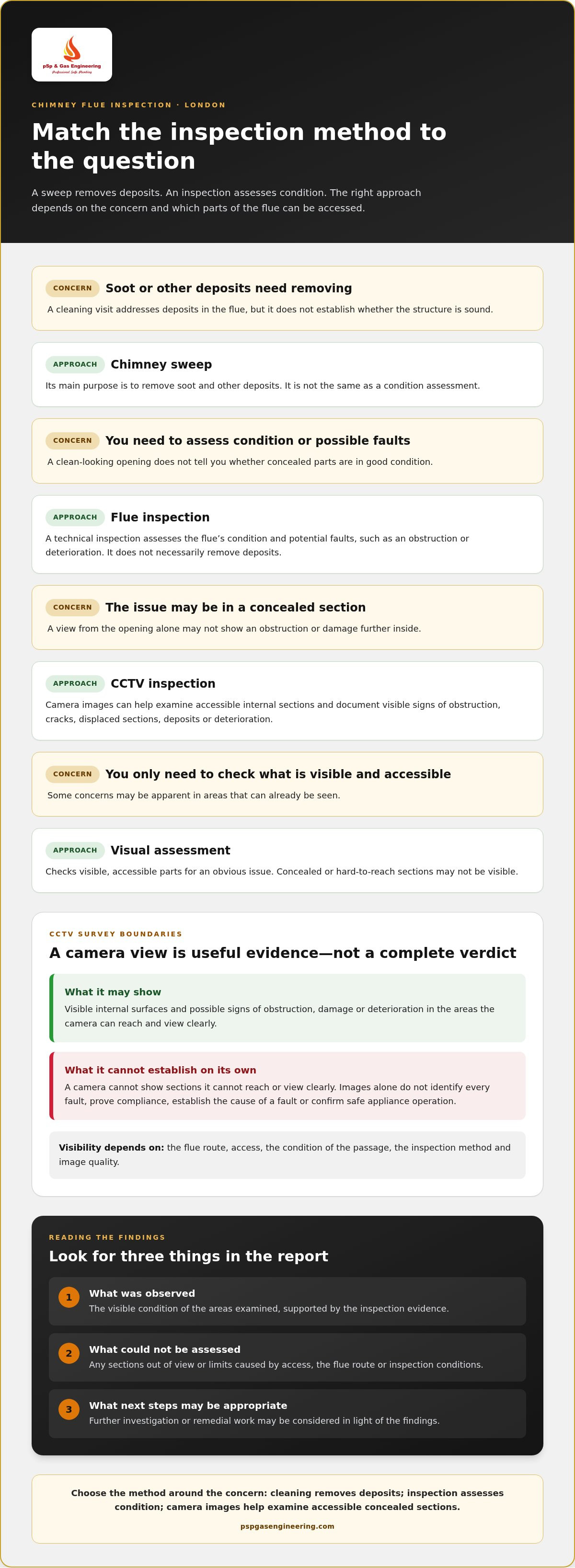
A sweep’s main purpose is to remove soot and other deposits from the flue. An inspection assesses its condition and looks for potential faults. Cleaning may make a flue clearer, but it doesn’t establish whether the structure is sound. Equally, an inspection doesn’t necessarily remove deposits. Depending on the concern, one service may be appropriate, or both may be needed.
Keeping these purposes distinct helps avoid treating a cleaning visit as a full condition assessment, or assuming a survey has cleaned the passage. Neither should be taken as a guarantee about every part of an appliance or building.
When might a London property need a closer flue assessment?
A closer assessment may be useful if an appliance has recurring performance problems, a blockage is suspected or deterioration is visible around an accessible part of the flue. It can also help investigate uncertainty after renovation, a change of appliance or alterations that may have affected a concealed route.
Property layouts matter. A converted house in Croydon or elsewhere in London may contain several appliance and flue arrangements. A shared flue can make it harder to understand where a passage leads and which sections can be accessed. Don’t try to diagnose a fault from symptoms alone. Describe what you’ve noticed so a qualified professional can assess the concern and determine the appropriate inspection scope.
What Can a Chimney Flue Inspection Camera Reveal in London?
A camera survey can provide a view of accessible internal sections of a flue that may be difficult to assess from the opening alone. A CCTV flue inspection uses camera images to examine visible internal surfaces for signs of obstruction, damage or deterioration and to support a professional assessment. The view is not necessarily complete: the flue’s route, access, condition and inspection method all affect what can be seen.
For a chimney flue inspection London residents may arrange after a concern, the value lies in examining visible evidence and relating it to the reported issue. A camera can help show areas that need attention, but it doesn’t establish the cause of a fault or prove that the appliance is operating safely.
What issues may appear in a video inspection?
Depending on access and image quality, a survey may show a visible obstruction, cracks, displaced sections, deposits or signs of deterioration. These are possible observations, not guaranteed findings. The camera images can document what was visible and help an engineer explain the condition of the areas examined.
Images need interpretation. For example, a visible deposit may prompt further assessment, but an image alone may not establish why it formed or whether it explains an appliance symptom. The engineer considers the images alongside the flue layout, appliance information and reason for the inspection. This makes the visual evidence more useful than a diagnosis based on a picture alone.
What can a camera inspection not establish on its own?
A camera cannot show sections it cannot reach or view clearly. Access restrictions, bends, obstructions or the condition of the passage may limit the survey. The report should make clear what was observed and any limitations, so a partial view isn’t mistaken for a complete assessment.
Visual inspection is also distinct from appliance testing and other safety checks. A camera image cannot, by itself, prove compliance, identify every fault or confirm safe operation. The engineer interprets the visible condition in the context of the system and the concern being investigated. The Chimney Safety Institute of America (CSIA) Recommendations offer general homeowner guidance, but they are not a substitute for UK-specific advice.
Clear reporting helps you understand what the video inspection found, what remained out of view and whether further investigation or remedial work may be appropriate. If a concealed flue concern needs a closer look, PSP & Gas Engineering’s video inspections can help investigate visible condition and potential blockage risks.
Chimney Flue Inspection Methods Compared: Which One Fits Your Concern?
Each method answers a different question. For a chimney flue inspection London appointment, the appropriate approach depends on the concern, the appliance and which parts of the system can be accessed. Choose the inspection method based on the question the evidence needs to answer.
| Method | Purpose and question answered | Limits |
|---|---|---|
| Visual assessment | Checks visible, accessible parts. Is there an obvious issue in the areas that can be seen? | Concealed or hard-to-reach sections may not be visible. |
| CCTV inspection | Uses camera images to examine accessible internal sections. Is there visible evidence of an obstruction or damage? | The view depends on access, the flue route and image quality. It doesn’t test appliance operation. |
| Sweeping | Removes deposits. Does the flue need cleaning? | Cleaning does not, by itself, assess the full structural condition. |
| Integrity testing | A specialist test may assess a defined aspect of flue integrity. Does the flue meet the test’s stated criteria? | The method and what it can establish depend on the system and test conditions. It isn’t a substitute for every other assessment. |
CCTV inspection, visual checks and integrity testing
A visual check, camera survey and integrity test aren’t interchangeable. A camera provides visual evidence from the sections it can access; an integrity test addresses a different, defined question using its own procedure. The appropriate scope should reflect the flue and the concern, rather than assume one method suits every property. Where wood-burning systems are relevant, the EPA’s chimney maintenance guidance is supplementary information, not UK-specific advice.
For example, a visible concern may warrant closer visual examination, whilst uncertainty about an internal section may make CCTV useful. A test-specific finding should be interpreted in light of the method used and its limitations.
Does a flue inspection replace a gas safety check or sweep?
No. A flue survey assesses the flue within its inspection scope; a gas safety check assesses gas-related safety, and a sweep removes deposits. One service shouldn’t be assumed to fulfil the purpose of another or automatically satisfy maintenance, insurance or legal requirements. Gas work should be undertaken by a Gas Safe registered engineer.
Landlords seeking compliance context can read this landlord gas safety certificate guide. Keeping the purpose of each visit clear helps match the work to the concern and understand what the findings do, and don’t, establish.
Preparing for a Chimney Flue Inspection in London
A little preparation helps the engineer understand the concern and plan access to the relevant parts of the property. For a chimney flue inspection London appointment, share what you know about the appliance and flue, but don’t try to open or dismantle equipment yourself. The engineer can explain the access and preparation needed for the specific inspection.
- Describe the concern. Note the symptoms or visible changes and when you first noticed them. Mention whether they recur or began after a particular event, such as building work.
- Identify the appliance. Share its type and location, along with any available make, model or flue details. If you’re unsure, say so rather than guessing.
- Arrange access. Consider which rooms, appliance areas or shared spaces may need to be reached, and organise entry before the visit.
What information helps the engineer assess the flue?
Useful details include the appliance type and location, the concern, when it began and whether anything has changed since. Previous inspection or repair information can provide context, as can details of renovations or appliance alterations that may have affected the flue route. Gather documents if they’re readily available; there’s no need to search for information you don’t have. Leave inspection of the appliance and flue to the engineer.
How should access be arranged in London homes and buildings?
Make sure the route to the appliance and relevant rooms is clear, and consider whether the engineer may need access to shared areas in a converted property or block. For rented or managed homes, coordinate entry with the landlord, managing agent or other responsible person. In busy streets, parking arrangements may also affect access, so share any relevant restrictions ahead of the visit.
Access needs can vary with the property layout and inspection method. The engineer will explain what is suitable for the assessment, including which areas need to be accessible. There’s no fixed preparation list for every building, so sharing accurate information is more useful than making assumptions about the flue.
To arrange an inspection and discuss access details, book a chimney flue inspection.
Understanding Inspection Findings and Choosing the Next Step
An inspection is most useful when its findings help you decide what should happen next. A clear account distinguishes what the engineer observed from what may need further investigation, and explains any limits on the areas assessed. For a chimney flue inspection London report, the key is not simply whether an issue was found, but what evidence supports that conclusion and how it relates to your concern.
What should a useful flue inspection report explain?
Look for an explanation of the areas inspected, the condition observed and any access limitations that affected the assessment. If the engineer identifies a possible obstruction or damage, the findings should clarify whether it was directly visible or whether further assessment is needed to establish its cause or extent.
Before agreeing to remedial work, ask for technical terms or recommendations to be explained in plain language. You should be able to understand:
- What was observed and where.
- Which parts of the flue were assessed, and which could not be viewed.
- What the evidence confirms, and what remains a possibility.
- Whether further investigation or remedial work is recommended, and why.
This helps you make a considered decision rather than treating a suspected cause as a confirmed fault. It also gives you a practical basis for discussing the next step with the engineer.
When might flue relining be considered?
Flue relining may be appropriate if inspection findings indicate that the existing flue needs remedial work. It shouldn’t be assumed from a symptom alone or recommended without a clear explanation of how the observed condition supports that option. The assessment should guide the decision; the right response depends on the flue and the findings.
For more detail on this type of remedial work, read the guide to professional flue relining services in London. A focused inspection and clear reporting can help establish whether relining is relevant or whether another follow-up is more suitable.
PSP & Gas Engineering provides residential and commercial flue inspections, including video inspections, with reporting on condition and potential blockage risks. For a clear assessment of your flue, request a flue inspection quote.
Take the Next Step with a Clear Flue Assessment
The right chimney flue inspection London service depends on the concern: a sweep removes deposits, whilst a technical inspection assesses condition and possible faults. A video survey can help examine accessible internal sections, but its findings have limits. Clear reporting should explain what was observed, which areas were assessed and what follow-up may be appropriate.
PSP & Gas Engineering provides residential and commercial flue and video inspections, with reporting on structural condition and potential blockage risks. If findings indicate that remedial work may be needed, flue relining can be considered as a possible next step. Gas work is carried out by Gas Safe registered engineers.
Start with the evidence and a practical plan. Request a flue inspection quote and take a considered step towards understanding your flue’s condition.
Frequently Asked Questions
What does a chimney flue inspection involve?
An engineer assesses accessible parts of the flue using a method suited to the system and the reported concern; this may include a video inspection. For a chimney flue inspection London homeowners should expect the scope and any access limitations to be explained, alongside the findings and suggested follow-up. This assessment differs from sweeping, which removes deposits, and from a gas appliance safety check, which covers gas-related safety within its scope.
Is a CCTV chimney inspection worth it?
A CCTV inspection can be useful when the concern involves concealed or difficult-to-view sections of a flue. It can provide visual evidence of accessible areas, helping an engineer assess their visible condition. However, images don’t automatically establish the cause of a problem or prove that an appliance is safe. Its value depends on the question being investigated, the flue layout and whether suitable access is available.
Can a chimney camera inspection find a blockage?
A camera may show an obstruction or deposits in the sections it can access. What’s visible depends on the flue route, access and inspection conditions, so a clear image of one area doesn’t confirm the condition of every section. The engineer interprets the images alongside information about the appliance and property. Don’t attempt to clear a suspected blockage or dismantle equipment yourself; arrange a qualified assessment.
How is a flue inspection different from a gas safety check?
A flue inspection focuses on the flue’s condition or visible interior, whilst a gas safety check assesses gas appliances and related safety matters within its scope. Neither should be assumed to replace the other. For a rented property, check the requirements that apply to your circumstances. Gas work should be carried out by a Gas Safe registered engineer, including checks involving gas appliances and their flues.
What happens if a chimney flue inspection finds damage?
The engineer should explain what was observed, which areas were accessible and whether further investigation or remedial work is recommended. The appropriate next step depends on the finding and the flue system; it may involve further assessment or a suitable repair. A camera image alone isn’t a complete diagnosis. Before deciding on work, ask for a clear explanation of the evidence and how it supports the recommendation.
How do I arrange a chimney flue inspection in London?
Describe the property, appliance, flue location and reason for the inspection when requesting a quote. Mention access restrictions, symptoms and any previous alterations or work that may help plan the assessment. PSP & Gas Engineering provides flue and video inspections across Greater London, including Croydon. Sharing the information you have helps explain the inspection approach and prepare access to the relevant rooms or shared areas.


