
Local gas work should start with the right qualification, not guesswork. A gas engineer in CR2 must be registered with the Gas Safe Register to carry out gas work in the UK, according to the Health and Safety Executive. Sanderstead and Selsdon are close to Croydon, and this guide explains what to consider when arranging work in these areas.
It’s reasonable to want clear answers about where an engineer works and which jobs they can handle. You’ll learn how coverage around CR2, Sanderstead and Selsdon relates to boiler installations, gas safety inspections and other gas and boiler work, as well as the qualifications to look for. The following sections cover local service, the scope of common jobs, and how registration and appliance-specific competence help you make an informed decision.
Key Takeaways
- Find out how service around South Croydon relates to Sanderstead and Selsdon, and what to consider when arranging a visit.
- Learn why gas work must match an engineer’s Gas Safe registration and the appliance-specific qualifications they hold.
- Understand what can be involved in gas fire work, boiler installation, servicing and repairs.
- See how boiler installations, gas safety inspections, flue relining and video inspections can address different property needs.
Do you install boilers in South Croydon and Sanderstead?
Gas engineers working near CR2, including South Croydon and Sanderstead, can attend residential properties in the area. Sanderstead and Selsdon are around ten to fifteen minutes from the Croydon base, while the nearest CR2 streets are about a mile away. These local distances help explain why residents can arrange gas work without looking beyond their area.
Registration is essential for gas work. According to the Health and Safety Executive, anyone carrying out gas work in the United Kingdom, the Isle of Man and Guernsey must be registered with the Gas Safe Register. A current Gas Safe licence is required to practise, and registration should cover the work involved, such as work on a boiler or gas fire.
Which gas engineers in CR2 are Gas Safe registered? The engineer serving the area states registration number 585424. The Gas Safe Register is the source for checking an engineer’s current registration and the work categories they are qualified to carry out. Registration is specific to the individual, so the engineer doing the job should be registered for that appliance type.
When choosing a Gas Safe engineer, check their identity, current registration and relevant appliance category before work begins. Boiler work, for example, requires suitable boiler competence. Registration alone does not prove competence in every gas specialism. A gas safety inspection can also help identify whether an appliance needs further attention.
If you smell gas in South Croydon, treat it as an urgent safety issue, not a routine boiler appointment. Leave the affected area and contact the gas emergency service for immediate guidance. Do not rely on a booked engineer’s visit as an emergency response.
Gas appliance and gas fire installation
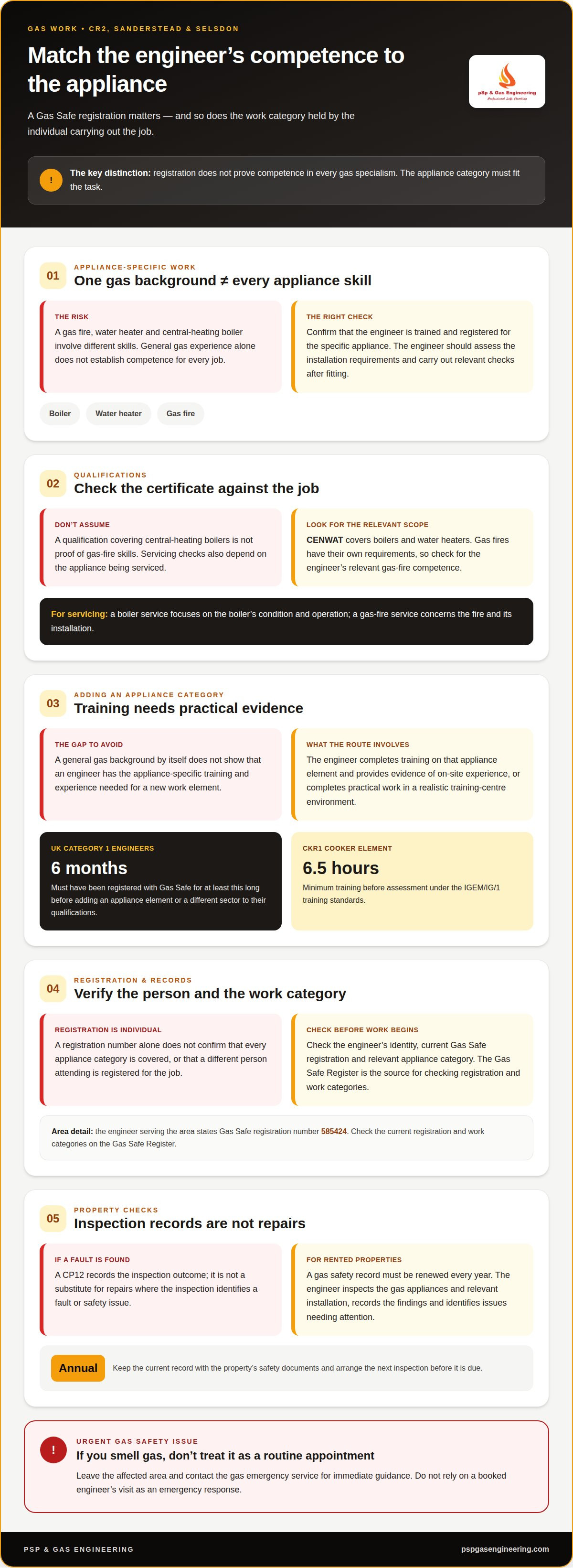
Gas appliances must be installed by an engineer trained to work on that specific appliance. A gas fire, water heater and central heating boiler each involve different skills, so general gas experience alone does not establish competence for every job. Before work begins, the engineer assesses the appliance and installation requirements, then carries out the relevant checks after fitting it.
For boilers and water heaters, CENWAT is a recognised qualification covering those appliance types. Gas fires have their own requirements, so check that the engineer has the relevant competence. A qualification covering central heating boilers, for example, is not proof of gas fire skills.
Servicing follows the same principle: the appliance type determines the work and checks involved. A boiler service focuses on the boiler’s condition and operation, while a gas fire service concerns the fire and its installation. An annual boiler service keeps most manufacturer warranties valid. The engineer can explain the findings and whether further work is needed.
A Category 1 gas engineer adding an appliance qualification must complete training on that appliance element. They must also provide evidence of on-site experience with the appliance or complete practical work in a realistic work environment at a training centre. This makes the qualification relevant to the appliance, rather than simply extending a general gas background.
For an application or qualification route, identify the appliance work you intend to undertake first. An engineer adding gas fire work needs the appropriate appliance training and practical evidence; CENWAT relates to boilers and water heaters. If your project involves replacing a boiler, review the boiler installation service to understand the work available for that part of the job.
Applicants must have experience servicing boilers and gas appliances. In the UK, Category 1 gas engineers must have been registered with Gas Safe for at least six months before adding an appliance element or a different sector to their qualifications. Under the IGEM/IG/1 training standards, a UK gas engineer adding the CKR1 cooker appliance element must complete a minimum of 6.5 hours of training before assessment.
Gas engineering qualification and certifications
A gas engineer’s qualification should match the appliance and work involved. Recognised routes into gas service work include a Level 3 Diploma in Gas Utilisation Installation and Maintenance and the Gas Engineering Operative Level 3 Advanced Apprenticeship. The Accredited Certification Scheme (ACS) is another route for people with relevant skills from plumbing, heating or ventilation to demonstrate competence.
For landlords, a gas safety record for a rented property in CR2 must be renewed every year. The record is commonly known as a CP12, and the engineer records the findings of the inspection. The gas engineer role in CR2 includes annual landlord checks. Keep the current record with the property’s safety documents and arrange the next inspection before it is due.
Commercial catering appliances require a different scope of competence from domestic boilers and gas fires. A domestic qualification or landlord CP12 should not be treated as evidence that an engineer is qualified for commercial catering equipment. The relevant appliance and work category matter, so commercial premises need an engineer whose training covers that equipment.
Reviews of gas engineers in CR2 can help you understand customers’ experiences, but they don’t establish technical qualifications. Look for specific comments about the work completed, communication and documentation, then consider those alongside the engineer’s relevant Gas Safe registration and appliance categories.
For a landlord’s gas safety inspection, the process is straightforward: the engineer inspects the gas appliances and relevant installation, records the outcome, and identifies any safety issues requiring attention. A CP12 is the resulting record for the rented property, not a substitute for repairs where an inspection finds a fault. Keeping each year’s record makes it easier to track the property’s inspection history.
When reviewing qualifications, match the named certificate to the planned task. For example, a Level 3 gas engineering qualification supports a recognised training route, while appliance-specific competence remains important for the work being undertaken. This distinction helps landlords and property managers assess gas safety documentation with greater clarity.
Boiler installation, servicing and repairs
A boiler installation starts with assessing the property’s heating and hot-water requirements. The engineer considers the existing system, available space and how occupants use hot water. For example, a household that regularly uses two showers at once may find a combi boiler struggles to supply both simultaneously. This demand can inform the discussion about suitable boiler arrangements before installation begins.
During installation, the engineer fits the selected boiler and connects it to the property’s heating and hot-water system. They then check that the appliance operates correctly and explain its controls and operation. A clear handover helps occupants use the new boiler and understand which records to keep.
Annual servicing gives an engineer the opportunity to inspect the boiler, assess its operation and record the service. An annual boiler service keeps most manufacturer warranties valid. In CR2, the service record is emailed on the same day as the service, providing a clear document for the homeowner’s records. If a service identifies a fault, the engineer can explain the findings and appropriate next steps.
For a repair, the engineer first diagnoses the problem, then explains the work needed. A boiler repair call-out includes diagnosis and any minor fix completed within the first hour. More involved faults may require further work, depending on the cause and parts needed. This distinction helps homeowners understand what the initial visit covers before deciding about additional repairs.
Whether you need a new system or help with an existing boiler, choose work that matches the appliance and the issue. A gas engineer in CR2 can assess the heating system and explain the relevant installation or repair steps. For a replacement system, explore boiler installation services as a practical next step.
PSP & Gas Engineering
PSP & Gas Engineering can help homeowners in CR2 plan gas and boiler work around their property’s needs. Its Gas Safe registered engineers carry out boiler installations and gas safety inspections, with flue relining and video inspections also available for relevant property and flue concerns.
Turn to the team when you need a new boiler, a gas safety inspection or a closer assessment of a flue. The right work depends on the appliance and the issue identified, so details about your property and the job help establish the next step. For example, a flue concern may call for an inspection before deciding whether relining is needed.
To discuss gas or boiler work for your property, contact PSP & Gas Engineering.
Plan your next gas or boiler project
Before arranging work, decide what outcome your property needs: a new heating system, a documented gas safety inspection or investigation of a flue concern. A clear description of the appliance and the issue helps shape a useful conversation with a gas engineer in CR2. For a fault or safety concern, explain what you have noticed rather than assuming it requires replacement.
PSP & Gas Engineering provides Boiler Installations, Gas Safety Inspections and Flue Relining. These services address different needs, from planning a boiler replacement to recording an inspection or resolving a flue issue. Share your property type and the work you have in mind to establish the appropriate next step.
For guidance on a gas or boiler project, contact PSP & Gas Engineering. A clear starting point can make it easier to move forward with confidence.
Frequently Asked Questions
Do you charge extra to come to Sanderstead or Selsdon?
Sanderstead and Selsdon are close to Croydon, but the price depends on the work and property. The cost is provided after a quote request, taking account of the job required and relevant site details. Include your postcode and describe the appliance or issue when requesting a quote, so the proposed work and visit can be considered together.
Need Help with a Heating Emergency?
For an urgent heating fault, contact PSP & Gas Engineering and explain what has happened, such as a boiler stopping or a loss of hot water. Include any warning messages shown on the appliance. If you smell gas, treat it as a gas emergency, not a routine heating repair, and contact the appropriate gas emergency service.
Which CR2 areas do you cover?
Service is focused strictly on the CR2 postcode district and surrounding local neighbourhoods. Sanderstead and Selsdon are among the specific local areas residents frequently ask about. When describing your address, include the full postcode and whether the property is a house or flat. This gives useful location context for discussing the gas or boiler work required from your local gas engineer CR2.
Reviews of gas engineers in CR2
Reviews can indicate customers’ experiences with the work, communication and documentation. They do not establish technical qualifications, so check the engineer’s current Gas Safe registration and relevant appliance categories.
Gas safety certificate costs for landlords in CR2
Landlords must renew the gas safety record every year.
Gas engineer call-out fees in CR2
It includes diagnosis and any minor fix completed within the first hour.


