
A safe school heating system is about more than classroom warmth. For school heating system maintenance in Croydon, relevant rules include the School Premises (England) Regulations 2012, which require hot water at the point of use not to pose a scalding risk. The Health and Safety at Work Act 1974 and the Workplace (Health, Safety & Welfare) Regulations 1992 are also relevant to school HVAC, according to the UK legislation register.
For education providers, school heating system maintenance in Croydon helps keep heating and hot-water systems safe and dependable. This guide explains the regulations that apply in England and the practical checks that support safe operation.
You’ll learn how hot-water temperature controls relate to scalding and Legionella risks, what planned maintenance can cover, and when boiler, gas safety and plumbing services may help schools, colleges and universities in Croydon.
Key Takeaways
- Understand which UK rules shape school HVAC safety, including duties around hot water and workplace conditions.
- Learn why hot-water temperature management matters for controlling Legionella risk and reducing scalding hazards.
- See how planned checks, commissioning and handover can help keep heating systems ready for school use.
- Recognise warning signs that may point to a heating fault, and when specialist boiler or gas safety services can help.
Boiler and hot-water services for schools, colleges and universities
Croydon schools can support efficient heating by maintaining boilers, reviewing controls and matching operation to building use. These steps can reveal avoidable energy use while keeping hot-water management within safe limits.
Boiler and plant-room servicing
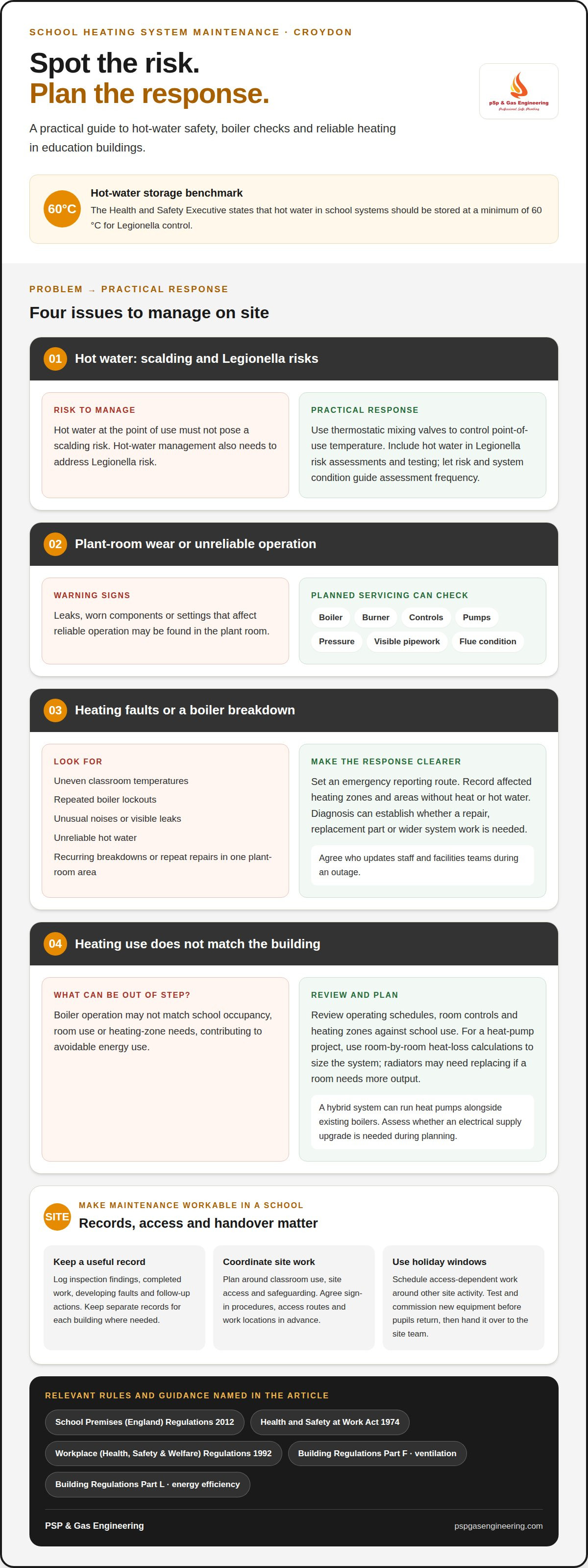
Planned servicing examines the boiler, burner, controls, pumps, pressure, visible pipework and flue condition. In the plant room, engineers can identify leaks, worn components or settings affecting reliable operation. The Health and Safety Executive states that hot water in school systems should be stored at a minimum of 60 °C for Legionella control. Servicing should consider both system performance and safe hot-water management.
Heating repairs and emergency cover
When a boiler fails, diagnosis helps establish whether a repair, replacement part or wider system work is needed. Schools and colleges can set an emergency reporting route, identify affected heating zones and record areas without heat or hot water. Clear records help engineers focus repairs and explain operational limits. Site procedures should also identify who communicates updates to staff and facilities teams during an outage.
Signs of heating system failure
Uneven classroom temperatures, repeated boiler lockouts, unusual noises, visible leaks and unreliable hot water can signal a developing fault. Recurring breakdowns or repeated repairs in the same plant-room area may indicate a wider issue. An engineer can assess equipment condition, component wear and system performance before advising whether repair or replacement suits the school’s needs.
Heating efficiency improvements
Review operating schedules, room controls and heating zones to match boiler use to school occupancy. If considering a heat-pump installation, room-by-room heat-loss calculations help size the system; radiators may need replacing where a room requires more output. A hybrid system can run heat pumps alongside existing boilers. Heat-pump projects may also require an electrical supply upgrade, so assess the infrastructure during planning.
HVAC services for Croydon education providers
Heating, ventilation and hot-water planning helps education providers manage the demands of occupied buildings. In Croydon, facilities teams can organise inspections around classroom use, site access and safeguarding procedures.
Annual servicing and inspections
A planned maintenance schedule records inspection findings, completed work and developing faults. It can cover heating plant, controls, ventilation equipment and hot-water systems, with the scope tailored to each building. Keep dates, engineer findings and follow-up actions together in site maintenance records. This helps facilities staff spot recurring issues and plan work before they disrupt teaching spaces.
For gas appliances, a gas safety inspection can address safety checks relevant to the school’s equipment. Coordinate site access with the facilities lead and record any actions arising from the inspection. Separate records for each Croydon school building can help teams track which equipment has been assessed and what follow-up remains.
School holiday servicing
School holidays can be a practical window for work requiring access to classrooms, plant rooms or heating controls. Facilities teams can agree entry arrangements, identify restricted areas and schedule tasks around cleaning or building work. A written programme helps staff understand which spaces may be unavailable and how planned work fits with other site activity.
Test and commission new heating equipment before pupils return, then hand it over to the site team. This gives facilities staff time to understand the operating information and controls before the building is occupied. Record any handover actions alongside the equipment details.
Education buildings across Croydon vary in layout, occupancy and heating infrastructure. A maintenance plan should reflect each site’s equipment and use, rather than applying the same checklist to every school. A college with several buildings, for example, may need separate records for each plant room and classroom block.
Safeguarding arrangements also shape how work is organised at an education site. Agree sign-in procedures, access routes and work locations in advance. Clear coordination helps protect pupils and staff while allowing commercial heating inspections to proceed with less disruption to lessons.
Heating system health and safety
School HVAC safety involves more than maintaining classroom warmth. In Croydon, facilities teams need to consider boiler operation, hot-water controls, ventilation and how engineers work around pupils and staff.
The UK Health & Safety at Work Act 1974 is listed as relevant to school HVAC by the UK legislation register. The Workplace (Health, Safety & Welfare) Regulations 1992 are also listed by the UK legislation register as relevant to ventilation requirements. Together, these references make safe building conditions an important part of heating and ventilation planning.
Hot-water management needs attention too. Thermostatic mixing valves help control water temperature at the point of use, reducing scalding risk while allowing hot water to be stored and distributed for system control. Include the hot-water system in Legionella risk assessments and testing, with assessment frequency guided by risk and system condition.
Ventilation checks should establish whether each occupied space receives suitable airflow. A blocked intake, poorly operating fan or obstructed vent can affect indoor conditions even when the boiler works correctly. Building Regulations Part F concerns ventilation, while Part L concerns energy efficiency; both are relevant to school HVAC planning.
Air conditioning is not a general substitute for ventilation. It provides cooling, whereas ventilation introduces and removes air. Schools without air conditioning can still plan comfortable learning spaces by reviewing ventilation performance and heating controls. Proposed upgrades should account for how heating, cooling and ventilation interact throughout the building.
A practical safety review can follow a clear sequence: inspect plant and visible equipment, assess hot-water controls, review ventilation in occupied areas, then record faults and corrective actions. Gas appliances also need appropriate attention from competent engineers. A Gas Safety Inspection can form part of this process, helping education providers address gas-appliance safety alongside wider HVAC checks.
What are the signs a school heating system needs repair or replacement?
Uneven classroom temperatures can signal that heat isn’t reaching every area as intended. A warm corridor beside a cold teaching room, for example, may point to a control, circulation or radiator issue. Record the affected spaces and when the difference occurs. This helps an engineer distinguish a local fault from a wider system problem.
Repeated boiler lockouts, unusual operating noises, visible leaks or unreliable hot water also warrant attention. Note whether the fault returns after a reset, affects one heating zone or interrupts the whole building. Keep records of repairs and recurring faults. A pattern of repeat call-outs can help show whether individual components are failing or the equipment needs a broader condition assessment.
- Room-by-room performance: record persistent cold spots and rooms that overheat.
- Boiler behaviour: note recurring shutdowns, irregular operation and changes in noise.
- Visible condition: report leaks, corrosion or damage around accessible pipework and radiators.
- Hot-water reliability: log interruptions or inconsistent supply at points of use.
Repair may be suitable when an engineer identifies a specific, replaceable fault and the wider system remains serviceable. Consider replacement when faults keep returning, essential components are deteriorating or the system struggles to meet the building’s heating needs. Assess plant condition, repair history, controls and heat delivery across occupied spaces, rather than relying on one symptom alone.
Arrange a professional assessment when repeated failures affect classrooms or the boiler shows visible damage. If a suspected gas-appliance issue arises, stop treating it as routine performance trouble and arrange a gas safety inspection. Clear records of symptoms and previous repairs help the engineer investigate efficiently and advise on suitable next steps.
PSP & Gas Engineering
PSP & Gas Engineering helps education providers address gas and boiler concerns identified during school heating reviews. Services include boiler installations, gas safety inspections, flue relining and video inspections. These are relevant when a school is considering a boiler replacement, needs a gas appliance inspected or requires a closer assessment of a flue.
All work is carried out by Gas Safe registered engineers, supporting compliance with UK gas safety standards. The right service depends on the issue: a suspected appliance safety concern calls for an inspection, while replacement planning may involve a boiler installation. This offers a practical next step when maintenance findings point to specialist gas or boiler work.
For help with a school boiler or gas safety concern, contact PSP & Gas Engineering.
Make your next maintenance decision with confidence
Use your heating review to set clear priorities for the site team. Record which issues affect safety, reliable operation or learning spaces, then assign responsibility for the next action. This approach to school heating system maintenance in Croydon gives facilities teams a practical starting point, especially when several buildings or departments need coordination.
A concise maintenance record supports future planning. Note the equipment, reported symptoms and completed work so recurring concerns are easier to identify. Share relevant details with the engineer before work begins, including access arrangements and affected areas. This keeps school heating system maintenance in Croydon focused on the site’s needs.
Where your review identifies boiler or gas-system work, PSP & Gas Engineering can discuss the appropriate next step. Contact PSP & Gas Engineering today to talk through your school’s requirements and plan a clear way forward.
Frequently Asked Questions
What should schools do if hot water supply is interrupted?
Report the interruption to the site facilities lead and identify which buildings, outlets or activities are affected. Note whether cold water remains available, whether there are visible leaks and whether the boiler or controls show a fault. Keep affected outlets out of use until the cause has been assessed. This record helps the engineer distinguish a local plumbing problem from a wider plant failure.
What routine maintenance should a school heating system receive?
Plan maintenance for the boiler, heating controls, pumps, radiators, accessible pipework and hot-water equipment. Record inspection findings, completed work and outstanding defects against the relevant building or plant room. Include ventilation equipment where it forms part of the site’s HVAC system. Tracking recurring faults and room-level complaints helps facilities teams prioritise follow-up and plan maintenance around the school calendar.
How often should school boilers and heating systems be serviced in the UK?
Set servicing intervals according to equipment requirements and the school’s documented maintenance programme. One assumed interval may not suit every system because equipment type, usage and operating conditions differ. Keep a schedule for each boiler and associated controls, then record the date, findings and follow-up work after each visit. This gives facilities teams a clear history for planning inspections and addressing repeated faults.
What UK regulations and safety checks apply to school heating systems?
Relevant considerations include the School Premises (England) Regulations 2012, Building Regulations Part F for ventilation and Part L for energy efficiency. The UK Health & Safety at Work Act 1974 and Workplace (Health, Safety & Welfare) Regulations 1992 are also listed as relevant by the UK legislation register. Schools should also consider COSHH when managing chemicals used for HVAC cleaning or water treatment.
Which heating maintenance contractors serve schools in Croydon?
For gas and boiler-related work in Croydon, education providers can contact PSP & Gas Engineering to arrange an appointment. Relevant services include boiler installations and gas safety inspections, as well as flue relining and video inspections for flue-related concerns. These services address specific gas engineering needs identified during a school’s wider maintenance planning, rather than replacing the site’s full HVAC management programme.
How can schools in Croydon arrange emergency heating repairs?
For emergency assistance with a boiler or gas-related issue, schools can contact PSP & Gas Engineering on 07411 667458. Work is by appointment, so provide the site location, affected area and the fault symptoms when arranging attendance. If the issue involves a gas appliance, describe any warning signs clearly so the team understands the nature of the concern before the appointment.


