

Did you know that an oversized boiler could be adding hundreds of pounds to your annual energy bills without making your home a single degree warmer? It's a common trap for homeowners who believe that 'bigger is better' when it comes to heating. You've likely encountered conflicting advice from generic online calculators, leaving you worried about cold showers or skyrocketing gas bills. Finding a reliable boiler sizing guide London homeowners can use is the first step toward avoiding these costly mistakes, especially when dealing with the unique architectural demands of the capital.
This article is designed to give you total confidence in your decision. By mastering the technical requirements of kW ratings, you'll ensure your home stays perfectly warm whilst keeping your energy bills to an absolute minimum. We'll examine the specific factors that dictate boiler capacity, from radiator counts to insulation levels, providing you with a clear path toward lower maintenance costs and a more efficient home.
Key Takeaways
- Understand the difference between central heating and domestic hot water kW ratings to ensure your new boiler handles both demands effortlessly.
- Learn how London’s unique property types, such as Victorian terraces with high ceilings, influence the specific capacity required for efficient heating.
- Use this boiler sizing guide London homeowners can trust to avoid the pitfalls of 'short-cycling', which can inflate running costs and reduce boiler lifespan.
- Recognise the importance of accounting for London’s hard water when selecting a boiler to protect the heat exchanger from premature wear.
- Gain the confidence to move beyond basic online calculators by understanding the technical measurements a Gas Safe engineer uses to specify your system.
Understanding Boiler Sizing: Why Kilowatt (kW) Output Matters for London Homes
In the plumbing and heating industry, a boiler's "size" doesn't refer to its physical footprint but to its power output, measured in kilowatts (kW). One kilowatt represents 1,000 watts of heat energy. When consulting a boiler sizing guide London residents often find that modern units are significantly smaller in dimension than their predecessors, yet they offer vastly superior power capacities. The fundamental objective of any specification is to match this output to the specific heat loss of your property, ensuring the system can maintain comfort even during the coldest winter nights.
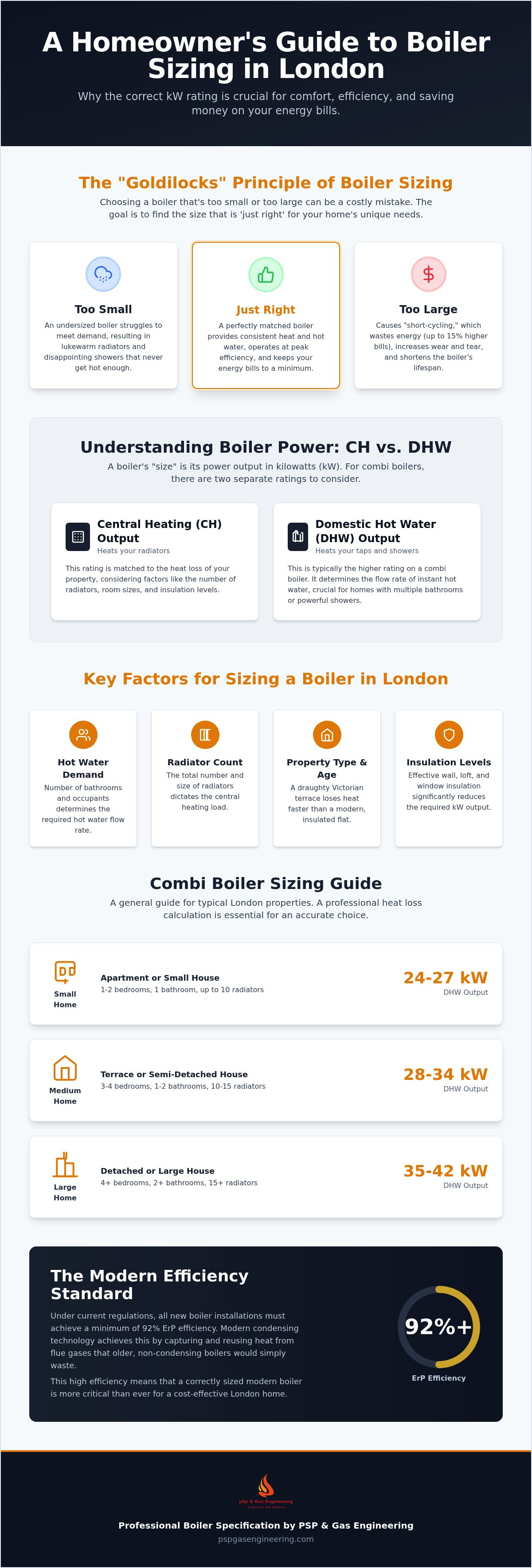
It's vital to distinguish between central heating (CH) output and domestic hot water (DHW) output. For combination boilers, the DHW rating is usually higher to provide the instantaneous heat required for a high-pressure shower. Conversely, the CH output is tailored to the number of radiators and the volume of water within the system. Precision here is key; a system that's perfectly balanced provides a "safe pair of hands" for your home's long-term energy security.
The "Goldilocks" Principle of Boiler Sizing
An undersized boiler is a frequent source of frustration, leading to lukewarm radiators and showers that never quite reach a comfortable temperature. However, many homeowners mistakenly believe that installing an oversized boiler provides a safety margin. In reality, an overpowered unit leads to "short-cycling." This occurs when the boiler generates heat faster than the radiators can dissipate it, causing the system to rapidly switch on and off. This cycle places unnecessary mechanical strain on the gas valve and fan, potentially increasing annual gas consumption by up to 15% and shortening the boiler’s overall operational lifespan.
Input vs. Output: Navigating Technical Specifications
Understanding the relationship between gas input and heat output is essential for evaluating efficiency. The input rating describes how much gas the unit consumes, whilst the output reflects the actual heat delivered to your home. Understanding Boiler Sizing requires a grasp of modern condensing technology, which captures latent heat from flue gases that would otherwise be wasted. Under 2026 efficiency standards, all new installations must achieve at least 92% ErP efficiency. This high level of performance means that modern sizing calculations differ significantly from those used for older, non-condensing models, making professional assessment more critical than ever for maintaining a cost-effective London home.
Calculating the Correct Capacity for Your New Combi Boiler Installation
Identifying the correct kilowatt (kW) rating involves a systematic assessment of your household's peak requirements. Unlike older systems that often relied on over-specification and guesswork, this boiler sizing guide London approach ensures every watt of energy is utilised effectively. We follow a logical four-step process to determine the ideal capacity for your specific living conditions.
Your first priority is domestic hot water demand. A single professional living in a studio flat has vastly different needs compared to a family of five in a multi-storey house. If your home features high-pressure rain showers or multiple bathrooms where simultaneous use is common, the boiler must be capable of maintaining a consistent flow rate across all outlets. Next, we evaluate the heating load by counting radiators and calculating their BTU (British Thermal Units) requirements. Each room has a unique heat loss profile based on its volume, window surface area, and the number of external walls. Finally, property age plays a decisive role. A draughty Victorian terrace in Croydon requires a more robust output than a modern, highly insulated apartment in Canary Wharf to achieve the same internal temperature. For a precise assessment tailored to your home’s unique layout, you can request a professional boiler installation quote from our Gas Safe registered team.
Sizing for Hot Water: The Combi Boiler Priority
In a combination system, the boiler heats water directly from the mains on demand. A 24kW model is typically the baseline for a one-bedroom flat with a single bathroom. However, for larger London homes, we often recommend 30kW or 35kW units. These higher ratings aren't necessarily for the radiators; they're primarily to ensure a higher flow rate, measured in litres per minute. This prevents a sudden drop in temperature when someone opens a kitchen tap whilst you're in the shower.
System and Regular Boilers: Sizing for the Cylinder
If your property utilises a separate hot water cylinder, the sizing logic shifts. Here, the boiler’s primary job is to reheat the water stored in the tank rather than providing it instantaneously. Because the tank acts as a buffer, the boiler doesn't require the massive instantaneous power of a combi. A heat-only boiler might only need a 15kW to 18kW rating to efficiently manage a three-bedroom house, provided the cylinder is correctly specified for the family's daily hot water consumption.
London Property Factors: How House Type and Insulation Influence Boiler Size
Generic heating advice often fails to account for the unique architectural landscape of the capital. A boiler sizing guide London homeowners can rely on must address the reality of our housing stock, which ranges from drafty Victorian terraces to modern high-rise apartments. The "Victorian Factor" is perhaps the most significant variable. Many properties in areas like Croydon or Dulwich feature solid brick walls without cavity insulation, coupled with high ceilings that increase the total volume of air requiring heat. These factors mean that a three-bedroom period home often requires a higher kW output than a modern house of the same floor area.
Environmental conditions also play a critical role in system longevity and performance. London and the surrounding boroughs are notorious for hard water. Over time, limescale accumulates within the heat exchanger, which can restrict flow and reduce thermal efficiency. Whilst we always recommend high-quality scale reducers, we also consider how this mineral build-up might impact the boiler's ability to meet your home's demands five or ten years down the line. Similarly, the transition from original sash windows to modern double glazing significantly alters a property's heat loss profile, potentially allowing for a more compact, lower-output boiler that costs less to run.
Heat Loss Calculations for Period Architecture
In period homes, we calculate volume rather than just floor area. High ceilings create a large reservoir of air that must be heated before you feel the benefit at floor level. London terraces also present a specific challenge; they often lose more heat through the roof and the front and back elevations than modern semi-detached properties. If you've recently added a large glass extension or a conservatory, the heat loss through these glazed surfaces is substantially higher than through a solid wall. We adjust our sizing specifications to ensure the boiler can overcome these thermal "leaks" without overworking the internal components.
Space and Flue Constraints in South London Homes
Physical space often dictates the final boiler choice as much as power requirements do. In many South London properties, boilers are located in tight kitchen cupboards or utility rooms where every centimetre matters. High-power boilers sometimes require larger casings or specific clearances for safe operation. Additionally, the flue path is a major consideration. We frequently perform video inspections in older Croydon chimneys to determine if they can be relined for a modern condensing flue. The ability to safely discharge waste gases often limits which high-capacity models can be installed in a particular location, making professional site assessment indispensable.
The Risks of Incorrect Sizing: Efficiency, Lifespan, and Comfort
Selecting the wrong capacity for your heating system isn't merely a technical oversight; it's a decision that carries long-term financial and operational burdens. This boiler sizing guide London homeowners are following demonstrates that precision is the only way to safeguard your investment. When a boiler's output doesn't align with the property’s actual heat loss, the system enters a state of perpetual inefficiency that compromises both your comfort and your bank balance.
The most common issue with oversized units is "short-cycling." Because the boiler is too powerful for the radiators, it heats the water to the target temperature almost instantly and then shuts down. This rapid on-off behaviour prevents the boiler from ever reaching its peak operating temperature. Industry data suggests that short-cycling can increase your annual gas bill by up to 15% because the unit consumes a surge of gas every time it restarts. Beyond the fuel cost, this cycle places immense mechanical strain on the fan and the gas valve. These components are designed for steady operation, not the constant ignition sequences required by an overpowered system.
Conversely, an underpowered boiler presents its own set of challenges. It will run constantly, yet your home may still suffer from persistent "cold spots" in rooms furthest from the heat source. Most importantly, a boiler that's too small for the system often fails to reach "condensing mode." This is the highly efficient state where the boiler recovers heat from its own exhaust gases. If the return water temperature remains too high because the boiler is struggling to meet demand, you lose the primary benefit of modern heating technology.
Financial Impact: Purchase Price vs. Running Costs
Homeowners often face a dilemma: is it worth paying an extra £200 for a higher kW model just to be safe? In many cases, that additional upfront cost is a poor investment if the higher capacity isn't required. An accurately sized boiler pays for itself through reduced repair bills and a longer overall lifespan. When a system is specified correctly, your Gas Safe annual service becomes a routine check rather than a diagnostic session for worn-out components. To ensure your system is specified for maximum longevity, you can book a professional boiler installation assessment with our expert team.
The Environmental Cost of Inefficiency
Precise boiler specification is a vital component of reducing your home's carbon footprint. Whilst modern modulating pumps can help the system adjust its power slightly, they cannot compensate for a fundamentally mismatched boiler. True efficiency relies on the unit operating within its intended range. Ensuring Gas Safe compliance during the installation process guarantees that combustion is handled safely and efficiently, minimising wasted energy and protecting the local London environment.
Professional Boiler Specification: Moving Beyond Basic Online Calculators
Whilst automated tools offer a quick estimate, they lack the nuance required for a precise installation. Many manufacturers promote "60-second" matching tools that often lead to oversizing because they default to a higher capacity to avoid the risk of under-performance. This boiler sizing guide London homeowners are consulting emphasises that a professional specification is an engineering task, not an algorithm. A physical inspection is the only way to identify underlying infrastructure issues that a digital calculator simply cannot see.
A qualified engineer performs onsite measurements that no software can replicate. We measure dynamic flow rates and static water pressures to ensure the incoming mains supply can actually support the boiler's potential output. For instance, installing a high-capacity 35kW combi boiler is counterproductive if your lead or copper mains pipe only delivers 10 litres per minute. We also identify system bottlenecks, such as restrictive 15mm gas pipework that may need upgrading to 22mm to safely supply a more powerful unit. This methodical approach ensures your new system operates within its design parameters from day one.
Future-proofing is another critical element of professional specification. If you are planning a loft conversion or a rear extension in the next few years, we can specify a boiler with the modulation range to handle your current needs whilst possessing the reserve capacity for your future home improvements. This foresight prevents the need for a costly second replacement when your property’s heat loss profile changes.
What to Expect from a PSP & Gas Engineering Site Survey
Our site surveys are comprehensive and designed to provide total peace of mind. We take the time to measure every radiator and calculate the specific heat loss for each room, accounting for the unique quirks of Croydon and London property styles. We also conduct a thorough assessment of your current flue terminal and gas pipework integrity. Using our local experience, we provide a reassuring recommendation that balances your immediate comfort with long-term mechanical reliability.
Booking Your New Combi Boiler Installation
Securing an accurately sized system starts with a professional evaluation. We provide a clear, detailed overview of the required capacity for your London property, ensuring you aren't paying for power you don't need or suffering with a system that can't cope. Using Gas Safe registered professionals for the final fit is a legal and safety requirement that guarantees the installation meets all current UK building regulations. To take the first step toward a more efficient home, you can Contact PSP & Gas Engineering for an expert boiler survey and receive a professional, no-obligation quote.
Secure Your Home’s Heating Future
Selecting the correct boiler capacity is a fundamental step in ensuring your London property remains efficient and comfortable for years to come. By moving beyond generic calculations and accounting for specific factors like ceiling heights and water pressure, you protect your heating system from the premature wear caused by short-cycling. It's clear that this boiler sizing guide London serves as a roadmap to precision; it's the most effective way to manage long-term running costs whilst maintaining a warm, welcoming home.
Our team of Gas Safe Registered Engineers is here to provide the technical authority you need for a successful installation. As specialists in London flue inspections and complex system design, we offer the meticulous attention to detail that period properties require. We also provide 24/7 emergency support to ensure you always have a "safe pair of hands" to rely on. Request a Free Boiler Installation Quote in London today to start your journey toward a perfectly balanced heating system. With the right expert guidance, you can enjoy total peace of mind and a home that's heated with absolute precision.
Frequently Asked Questions
What size boiler do I need for a 3-bedroom house in London?
A three-bedroom house in the capital typically requires a combination boiler with an output between 28kW and 34kW. This specific range ensures sufficient power for the central heating system whilst providing a comfortable flow rate for multiple hot water outlets. If your property features high ceilings or original sash windows common in London, we often recommend the higher end of this scale to compensate for the increased heat loss.
Is a 24kW boiler powerful enough for a family home?
A 24kW boiler is usually better suited for smaller apartments or houses with a single bathroom. For a busy family home where multiple taps or showers might run simultaneously, this capacity often struggles to maintain consistent water pressure and temperature. Most family-sized properties in London benefit from a 30kW unit or higher to ensure domestic hot water demand is met without compromise during peak morning hours.
Can a boiler be too big for a house?
Yes, an oversized boiler can lead to a phenomenon known as short-cycling. When the unit's output far exceeds the property's actual heat loss, it reaches the target temperature too quickly and shuts down repeatedly. This constant ignition cycle places unnecessary mechanical strain on internal components and can increase your annual gas consumption by up to 15% compared to a correctly specified and balanced model.
Does a higher kW boiler use more gas?
A higher kW rating doesn't automatically mean higher gas bills for heating, as the boiler only uses the power required to reach the set temperature. However, it will consume more gas momentarily to provide a higher flow of instantaneous hot water. Following a boiler sizing guide London homeowners can trust ensures your unit is specified for maximum efficiency, matching consumption directly to your home's thermal requirements.
What is the best boiler size for a flat with one bathroom?
For a typical London flat with one bathroom and up to ten radiators, a 24kW combi boiler is the standard baseline. This capacity provides a reliable balance between physical dimensions and performance. If you have a particularly powerful thermostatic shower, you might consider a 27kW model to ensure the flow rate remains consistent even during the colder winter months when the incoming mains water temperature drops significantly.
How do I know if my current boiler is the wrong size?
Signs of an incorrectly sized boiler include radiators that take an unusually long time to get hot or water that never reaches a stable temperature. Conversely, if your boiler frequently fires up and shuts down every few minutes, it's likely oversized for your system. A professional assessment using a boiler sizing guide London can confirm if your current unit is mismatched to your property's specific heating and hot water demands.
Will a new combi boiler installation require larger gas pipes?
Upgrading to a more powerful modern combi boiler often necessitates increasing the gas pipe diameter to 22mm. Older systems frequently utilised 15mm copper piping, which may not deliver the volume of gas required for a high-output 30kW or 35kW unit to operate safely and efficiently. Our Gas Safe registered engineers always assess your existing pipework integrity and gas pressure as part of a comprehensive site survey.
How much does a boiler installation in Croydon typically cost?
Boiler installation costs in Croydon and across London typically carry a premium of 20% to 30% compared to the national average due to higher operational and labour costs. Whilst specific prices depend on the complexity of the flue and pipework, upgrading to a modern A-rated unit can save a detached house up to £550 per year on energy bills. We always provide detailed, no-obligation quotes to ensure full transparency.


