
Low water pressure in a Croydon home may be caused by a partly closed valve or a blocked outlet, rather than a problem with the street supply. To fix low water pressure in a Croydon house, first check whether the problem affects one tap or every outlet, then inspect accessible valves and look for signs of a leak. Water pressure below 2.7 bars is likely too low for a home.
A weak shower or slow-filling tap can disrupt everyday routines, and it’s not always clear whether the cause is inside the property or on the water network. A quick check of the cold kitchen tap can help: SES Water advises that filling a 1-litre jug in under 7 seconds is likely to indicate normal flow.
This guide explains how to check your stopcock and isolation valves, spot common causes such as limescale or leaks, and understand when a pressure reducing valve may be involved. You’ll also learn how to distinguish a possible supply issue from an internal plumbing problem and decide what to do next.
Key Takeaways
- Compare several taps to see whether low flow is limited to one outlet or affects the whole home.
- Check accessible stopcocks and isolation valves gently; a valve that is not fully open can restrict flow.
- Consider whether a pressure reducing valve may be affecting the supply, especially if pressure problems began after plumbing work.
- Look for clues such as limescale, leaks or a wider supply issue to narrow down the likely cause.
Why do I have low water pressure in house?
Work through these checks to find out whether low pressure affects the neighbourhood supply or just your property. This distinction helps you choose the right next step.
-
Ask neighbours about supply problems
Ask nearby neighbours whether their taps have also lost pressure. Compare homes on your street, rather than elsewhere in Croydon, as properties can have different supply arrangements. If several neighbours report the same problem, a shared supply issue is more likely. If their pressure is normal, note which taps are affected in your home before checking your plumbing.
-
Test mains pressure and flow rate
Run the cold kitchen tap and use a one-litre jug to check its flow. SES Water advises that filling the jug in under 7 seconds is likely to indicate normal flow. A home reading below 2.7 bars is likely too low. Compare the kitchen tap with other outlets, and record whether the pressure changes during the day. This helps describe the issue clearly when reporting it.
-
Distinguish supply issues from property faults
Check whether pressure is low throughout the home or only at particular taps. If the cold kitchen tap works but other outlets do not, the fault is more likely inside the property. A partly closed stopcock can restrict flow, so check whether it is fully open. Responsibility for water supply issues may depend on whether the problem is in the street mains or the pipework serving the property. The Water Industry Act 1991 is cited in connection with Thames Water's minimum pressure obligation, according to legislation.gov.uk.
-
Contact the water supplier for an investigation
Contact Thames Water when neighbours share the problem or your checks suggest a mains supply issue. Thames Water must maintain at least 1 bar at the property boundary. Give the supplier your address, when the pressure changed, which taps are affected, and neighbours’ observations. If the issue appears confined to your home, contact a plumber or landlord instead. This helps separate a network fault from an internal plumbing problem.
Checking stopcocks and isolation valves
Start with the affected outlets, then check accessible valves. This can help show whether the restriction is local or affects the home’s pipework.
- Compare the flow at several taps, including the kitchen tap and bathroom basin. If only one outlet runs slowly, check its nearby isolation valve, which may be restricting flow to that fitting. If you’re working out how to fix low water pressure in a house in Croydon, note whether taps throughout the home are affected. Record which outlets behave differently so you can describe the pattern clearly.
- Find the inside stop valve, often beneath the kitchen sink. Check its handle position and gently turn it anti-clockwise to make sure it is fully open. Don’t force a stiff valve, as this could damage the fitting or pipework. Then run a tap and see whether the flow improves. Checking the stop valve takes little time.
- Inspect accessible isolation valves near appliances and individual taps. When open, their small handles or slots should align with the pipe; a crosswise position can indicate that a valve is closed. Check one valve at a time, then run the related tap to see whether the flow changes. If a valve is stuck, damaged or difficult to identify, leave it alone to avoid risking a leak.
- Find out whether neighbours are affected, then check Thames Water’s local service updates for planned work or reported network issues. A neighbourhood problem points towards the shared supply, whilst normal pressure nearby makes an internal restriction more likely. These checks help narrow down how to fix low water pressure in a Croydon home. If the stop tap and isolation valves appear open but flow remains poor, arrange suitable plumbing services to inspect the property’s pipework.
What is a Pressure Reducing Valve and do I need one?
A pressure reducing valve (PRV) controls high incoming mains pressure before it reaches household fittings. It is not a booster, so it won’t fix low pressure caused by a closed stopcock or restricted pipework.
- Check for a PRV near the internal stop valve, water meter or point where the supply enters. The valve reduces incoming pressure to protect taps, appliances and pipework. London mains pressure can reach 4-8 bar, whilst a PRV may reduce it to 2-3 bar. Household water pressure should be kept at a suitable level for the fittings.
- Check accessible internal and external stop valves before suspecting the PRV. The internal stop valve is often beneath the kitchen sink; gently turn it anti-clockwise to open it fully. An external stop valve may be in a boundary box. Check whether it appears closed, but don’t force a stiff or damaged valve. A partly closed valve can restrict flow throughout the home.
- After checking the valves, compare the flow at several outlets. If only one tap is affected, its isolation valve or limescale around the fitting may be responsible. If pressure is low across the property, a faulty PRV is one possible cause. A stuck or incorrectly adjusted valve can restrict flow even when the stopcocks are open.
- Arrange a plumbing inspection if the stop valves are open but low pressure continues. A plumber can investigate the PRV and measure pressure on either side to determine whether it is restricting supply. Don’t adjust the PRV yourself, as changing its setting can affect household fittings. The right remedy depends on whether the fault is in the valve, incoming supply or internal pipework.
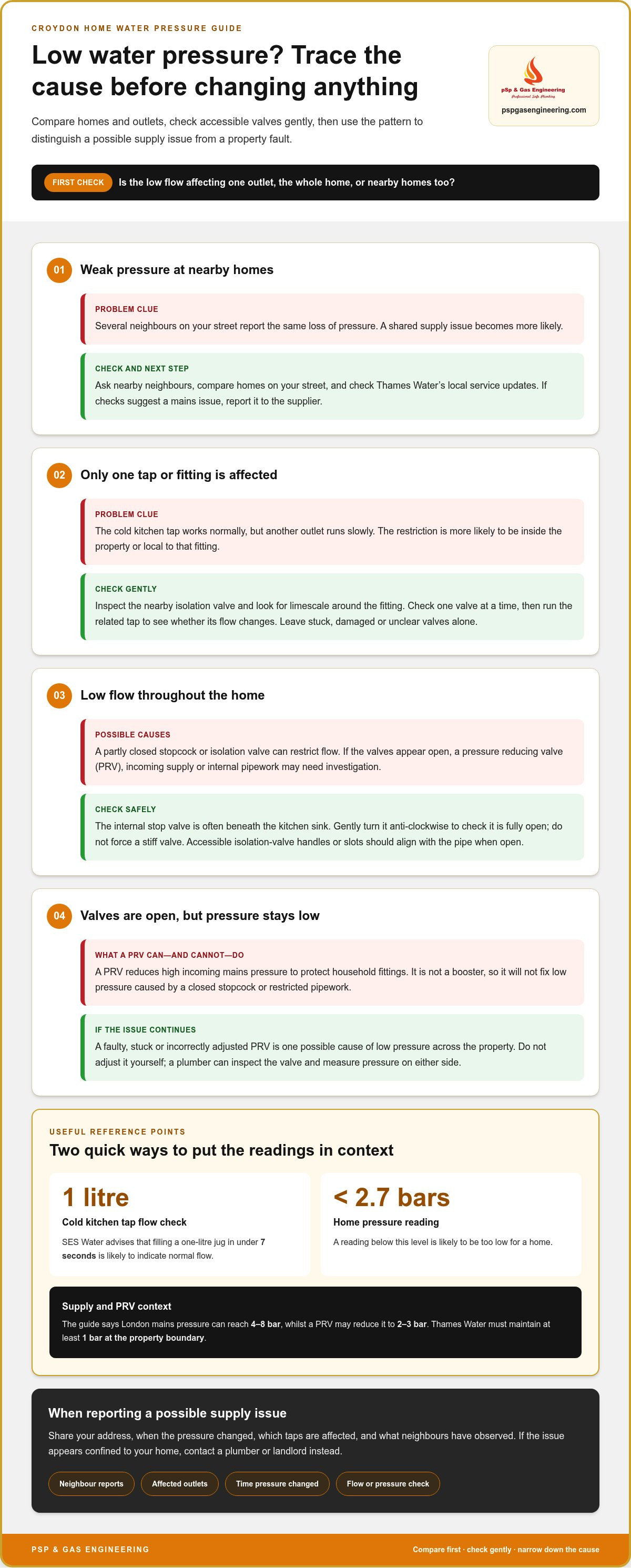
Common causes of low household water pressure
- Compare flow at different taps and note whether the change happened suddenly. If several Croydon neighbours also have weak flow, high demand or a network fault may be affecting the mains supply. SES Water identifies high network demand, a burst pipe and a home’s location as possible causes. If neighbours have normal flow, focus your checks on the property’s plumbing and supply pipe.
- Inspect visible pipework for signs of a leak, such as damp patches or unexplained water use. Fluctuating pressure can indicate a leak, although other causes are possible. A burst or leaking pipe can reduce flow before water becomes visible indoors. If you suspect a leak, avoid running several appliances at once and arrange an inspection rather than opening walls or floors yourself.
- Check whether limescale or a blocked fitting is limiting flow at one outlet. Croydon’s hard water can contribute to limescale build-up in taps, showerheads and pipework. If only the kitchen tap or shower is affected, clean its removable aerator or showerhead and compare the flow afterwards. A restriction affecting several outlets needs investigation beyond one fitting.
- Consider the pipe material, layout and height of any storage tank. Older London properties built before approximately 1970 may have original lead supply pipes. A narrow or restricted pipe bore can limit water flow, while gravity-fed systems produce about 0.1 bar per metre between the tank’s water surface and outlet. A loft tank 2-3 metres above a bathroom provides only 0.2-0.3 bar. In cold weather, frost around a pipe can signal freezing. For persistent low pressure, arrange an inspection of your home’s plumbing to help identify the cause.
PSP & Gas Engineering: Boiler Installations
PSP & Gas Engineering can help investigate plumbing faults within your home. Its plumbing services are relevant for restricted pipework, persistent low flow or a suspected internal leak. If the pressure problem affects hot water from your boiler, a plumbing assessment can help distinguish a boiler-related issue from a wider household supply fault.
For boiler-related concerns, PSP & Gas Engineering also provides Boiler Installations and Gas Safety Inspections. These services address boiler installation and gas safety needs, not neighbourhood mains problems. If your checks point to an issue with the street supply, contact Thames Water. For a persistent fault inside your property, contact PSP & Gas Engineering to discuss the plumbing problem.
Contact PSP & Gas Engineering to discuss your home’s plumbing issue.
Take the next step towards reliable water flow
If you’re looking to fix low water pressure in your Croydon home, use your observations to guide the next step. Note which outlets are affected, when the problem occurs and whether flow changes after checking accessible valves. This gives a plumbing professional a clearer starting point and helps distinguish a local restriction from an issue that needs further investigation.
For a fault in your home’s plumbing, contact PSP & Gas Engineering to discuss the issue. The company also provides Boiler Installations, Gas Safety Inspections and Flue Relining for those separate needs. If the evidence points to a neighbourhood supply problem, Thames Water is the appropriate contact for the mains network.
Contact PSP & Gas Engineering to discuss your plumbing concerns and consider a practical next step. With a clear account of what you’ve observed, you can move forward with greater confidence.
Frequently Asked Questions
Need a plumber?
Contact a plumber if poor flow remains limited to your home after you’ve checked accessible valves and cleaned a blocked outlet. For example, weak flow at several taps may point to an internal leak, restricted pipework or a faulty valve that needs investigation. A plumber can assess the household plumbing and identify the fault. If several nearby homes are affected, report the supply problem to the water company.
Who fixes water problems in Croydon?
Thames Water handles water mains in the street up to the property boundary; the homeowner is responsible for the supply pipe inside the boundary. For an internal plumbing fault, PSP & Gas Engineering provides plumbing services in Croydon. Its engineers are Gas Safe Registered and Level 2 and Level 3 qualified in gas engineering. Contact the relevant party according to where the problem appears to lie.
How to check whether low water pressure affects one tap or the whole house?
Run cold water briefly at several outlets, such as the kitchen sink, bathroom basin and bath tap, and compare the flow. Note which taps run slowly and whether hot and cold supplies behave differently. If only one outlet is affected, inspect its aerator or showerhead for a blockage. A pattern across several rooms suggests a wider household issue.
What are the common causes of low water pressure in a house?
Common causes include a partly closed stopcock, a blocked tap aerator, limescale, a leak, restricted pipework or a mains supply problem. A faulty pressure reducing valve can also restrict flow. Consider when the change began: a sudden drop may follow work on the supply or a leak, while a gradual decline may point to a developing blockage. The outlets affected can help narrow down the cause.
How to safely check and clean tap aerators, showerheads and filters?
Turn off the tap before removing a detachable aerator, and place a cloth over the sink waste to catch small parts. Rinse the filter under water and gently remove visible debris with a soft brush. For a limescale-blocked showerhead, soak it in white vinegar for 30 minutes, then rinse thoroughly. Avoid force on fittings that resist removal, as this can damage seals or connections.
How to check for leaks or a faulty pressure-reducing valve at home?
Look for damp patches, dripping joints and unexplained changes on your water meter. To check for possible water use, take a meter reading, avoid using water for at least an hour, then compare the readings. A PRV fault is harder to diagnose visually: note whether low flow affects several outlets and whether the valve or nearby joints show signs of leakage. Have a plumber inspect the valve rather than adjusting it yourself.


